
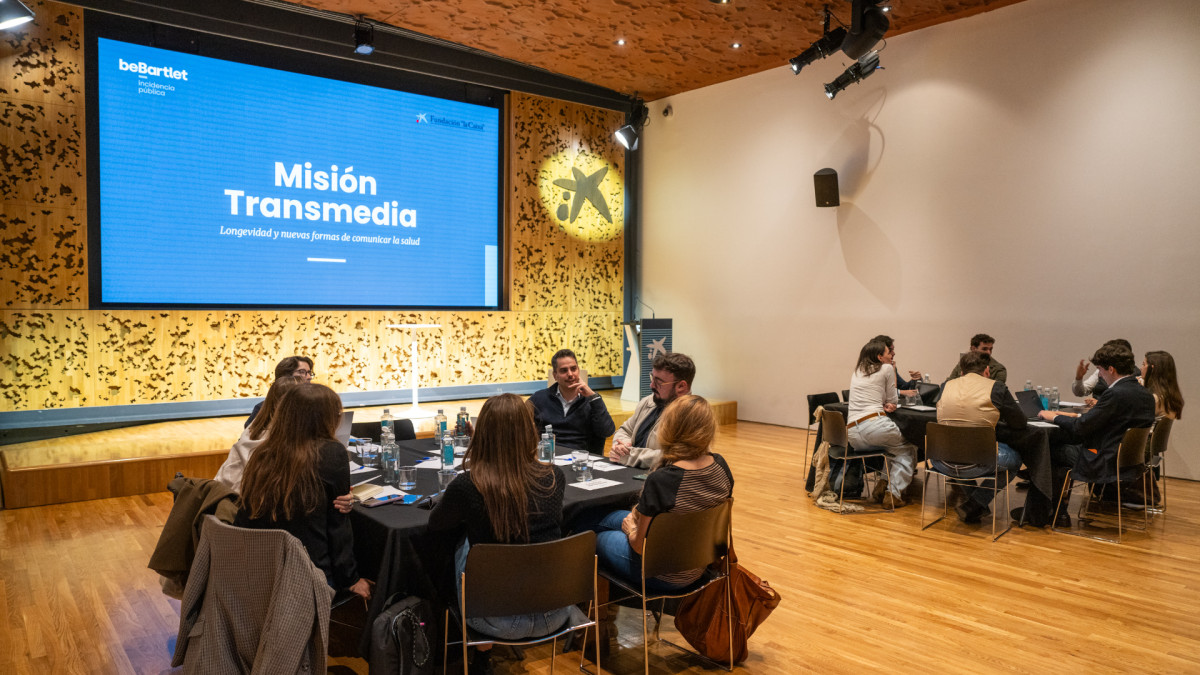
The misinformation does not affect all generations in the same way nor does it circulate through the same spaces, so in a society that is growing older, understanding how older people inform themselves is essential to addressing, for example, the challenge of communicating public health policies. Generating rigorous knowledge constitutes only the starting point, because its effectiveness depends on the channel through which it circulates and on the transmitter’s ability to make it understandable and to generate trust, especially when it competes with a WhatsApp chain sent by a family member or with a recommendation that comes from a close circle.
On this tension between access to information, trust, and vulnerability, the latest session of Transmedia Mission with the support of the “la Caixa” Foundation was built, which addressed misinformation and information overload among older people, the persistence of ageism in communication, and ways to bring new narratives closer to this audience, in a day led by journalists and presenters from different media outlets, challenged by the need to reach increasingly diverse audiences.
That approach requires revisiting some common ground, because older people do not constitute a homogeneous block and their exposure to misinformation cannot be explained exclusively by a lack of competencies. They coexist those who maintain established information habits with those who have progressively incorporated digital tools and with people who have never developed a daily relationship with the media. The result is a cohort shaped by educational and cultural differences, as well as by very diverse life experiences, which is hardly reducible to a single category: “the elderly”.
Óscar Justo, coordinator of beBartlet, presents the Transmedia Mission session, which has for three years been a reference space in the dialogue around the media.
The misinformation does not always enter through social networks
One of the clearest conclusions of the session was that a significant portion of the misinformation that reaches the senior audience arrives via WhatsApp and other everyday spaces of trust, from family conversations to neighborhood surroundings or what someone comments in a bar, while large open social networks occupy a less central role than often assumed.
“To understand how misinformation circulates among older people, it is necessary to look beyond digital platforms and pay attention to the trusted environments in which information is shared”
This difference is especially relevant because it forces a revision of traditional communication strategies. Publishing fact-checked information on an institutional page or debunking content on a social network can have a limited effect when the inaccurate information circulates within private conversations where credibility often depends on the personal relationship between the sender and the receiver.
The challenge is to make reliable information travel through those same channels and adapt to the codes that determine what content gets shared. Against simple, easily forwarded deceptive messages, scientific evidence needs formats capable of fitting into that conversation through a clear language and audiovisual resources that help organize information without diluting its complexity.
The issue gains particular importance in areas such as public health policies, where statements about nutrition, medicines or lifestyle can bear a scientific veneer even when they lack sufficient evidence. In these cases, the credibility of the sender becomes part of the message itself, so scientific societies, healthcare professionals, or the figure of the expert patients can play a particularly valuable role when they are able to translate knowledge from a position recognizable and close to the recipient.
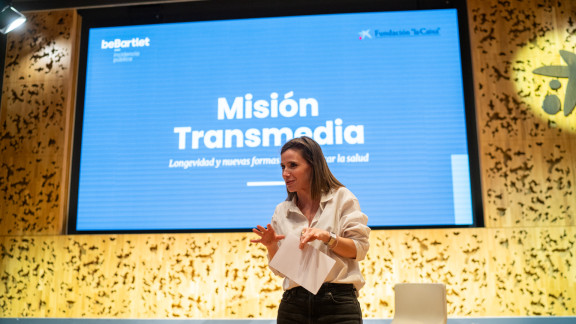
Victoria Arnau, presenter of Antena 3 Noticias and co-presenter of Espejo Público.
Literacy without paternalism
> The adaptation of formats solves part of the problem, while another aspect concerns the capacity of citizens to distinguish a reliable source from one that is not and to understand the mechanisms by which information circulates in the digital environment. Media literacy thus emerged as one of the central consensus points of the conversation. Learning to identify who is behind information and verifying its provenance are skills that acquire increasing relevance as the information ecosystem becomes more complex and it becomes harder to recognize at a glance which contents are backed and which imitate the codes of a legitimate source.
In this area, the example of entities with territorial reach such as the Fundación “la Caixa” was offered, which can play a relevant role through workshops and programs aimed at the senior population, conceived as practical training that allows them to navigate the information environment with greater confidence. The logic would be similar to basic education for interpreting messages that reach a screen before accepting them as true or sharing them with others. Combating misinformation among adults requires strengthening their decision-making capacity, since a protective policy that substitutes their judgment with others risks entrenching an ageist view and turning digital vulnerability into a justification for restricting their autonomy.
Combatir la desinformación también implica proporcionar herramientas para interpretar los mensajes y reconocer fuentes fiables, pero sin convertir la protección frente a la información engañosa en una forma de tutela”
Similarly, when a person shares inaccurate information, a response based on ridicule or reproach can be counterproductive. Part of the vulnerability to misinformation is explained by a digital divide that not everyone has had the opportunity to overcome and by a loss of trust in institutions and media that intensified during the pandemic. Any strategy aiming to recover that trust will thus have to rely on pedagogy and on guidance that respects the interlocutor.
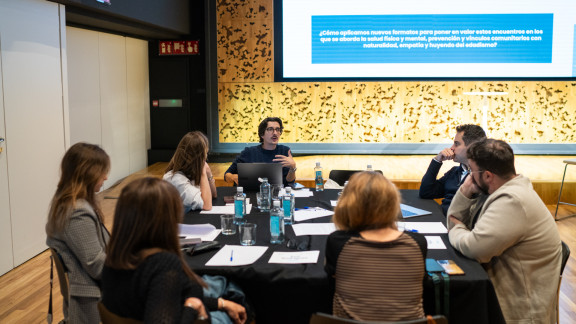
The dialogue with various experts in specialized sectors deepened the understanding of the origins and consequences of misinformation on networks.
How we talk to older people and how we talk about them
It is difficult to build effective communication aimed at older people when the sector itself continues to present them as a uniform category defined primarily by their limitations. Between 65 and 100 years old there are several generations coexisting, with very different professional trajectories and different ways of relating to technology, which forces us to question a segmentation based almost exclusively on age.
Interests, the level of autonomy, and consumption habits may be more useful for understanding an audience than the birth date, especially when the aim is to design content that responds to their real needs and not to a preconceived image of what aging means.
Ageism also appears inside the media themselves. The conversation highlighted a paradox that is hard to ignore: there is a call for communications that better represent an aging society while many newsrooms reduce the presence of senior professionals and concentrate much of their editorial effort on attracting younger audiences.
“Ageism not only shapes the messages directed at older people, but also the way the media portrays them and the space they are given within the public conversation”
This dynamic implies losing experience and professional memory, as well as limiting the ability of editorial teams to understand a substantial portion of the population. Normalizing aging on screen or calling on older experts when they are the ones who know a subject best should be part of a more faithful representation of society, without their presence needing to be justified as an exception or as a specific policy of generational diversity.
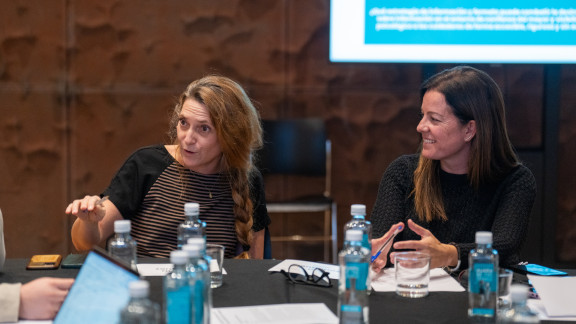
One of the session’s conclusions highlighted the need to create common spaces across generations.
Reclaiming shared spaces
Communication with older people cannot be solved solely from a screen. Radio, television, and local media continue to function as recognizable spaces for a large portion of this audience, just as community centers, neighborhoods, and family relationships remain hard to replace.
In-person interaction therefore emerged as another relevant piece of the debate, especially when the need was raised to create environments where older people can compare information and maintain community ties that also function as spaces of trust.
In that same logic, intergenerational formats gain importance. For too long, the relationship between generations has been framed as a process in which young people teach technology and older people receive help, when experience allows for much more balanced exchanges, where knowledge circulates in both directions.
“Beyond digital channels, communication also needs to reclaim meeting spaces and intergenerational relationships as paths to share knowledge and build trust”
Issues such as loneliness or mental health affect different generations in distinct ways and therefore offer common spaces for conversation. Creating formats where young people and older people participate as valid interlocutors can help reduce stereotypes and recover a sense of community that has weakened as social spaces have fragmented.
A battle for trust
All these challenges return to a fundamental question: how to rebuild trust in information in an environment that does not always favor the circulation of rigorous content.
The problem goes beyond the senior audience and relates to the operating model of the digital ecosystem itself, whose business model often rewards content capable of generating more attention and polarization.
To communicate public health policies more effectively to a population that is aging requires understanding how information circulates in their everyday environments and assuming that any effective strategy must be built on respect for their autonomy. That means adapting formats to their real consumption habits and strengthening their ability to interpret what they receive, while the media themselves rethink how they represent aging and relate to it.
“Communicating public health policies more effectively to a population that is aging requires understanding how information circulates in their everyday environments”
Combating misinformation among older people demands something more difficult than merely debunking false content after it has circulated. It requires rebuilding a relationship of trust with information and with the individuals who transmit it, without starting from a paternalistic view or turning age into a synonym for vulnerability. The answer lies in strengthening citizens’ critical capacity and in recognizing older people as fully valid interlocutors within the public conversation. In a society that is aging, the quality of information will also depend on our ability to include them in it without tutelage.
In collaboration with the Fundación “la Caixa”
