
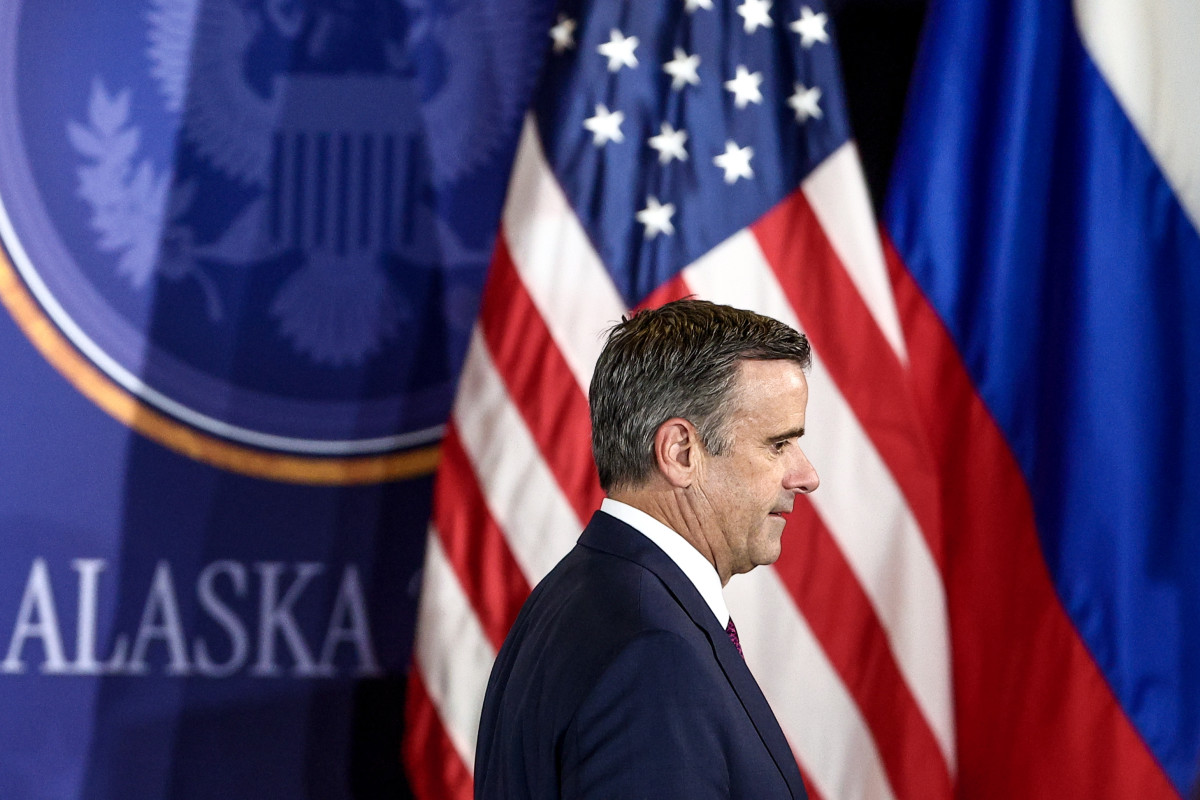
The unannounced visit of CIA director John Ratcliffe to Moscow on August 25 drew press attention. It did not unfold around the threat that, apparently, led him there. According to later U.S. reporting, Ratcliffe used the trip, among other aims, to warn Moscow not to undertake any military action that could affect NATO territory. The visit matters not because it revealed a new risk, but because a scenario that had been looming for months in signals from Russian elites, propaganda, and political decisions has now entered the public diplomatic agenda.
Only a year ago, most Western public assessments considered a direct Russian military escalation against Europe a medium-term risk. NATO Secretary General Mark Rutte spoke of a three-to-seven-year horizon in which Russia might be able to strike Alliance territory if NATO did not reinforce its defenses. By spring 2026, that horizon had begun to shorten. The risk moved from being measured in years to months, not because Russia had grown stronger, but because the country’s internal political logic had become more dangerous.
“The risk moved from being measured in years to months, not because Russia had grown stronger, but because the country’s internal political logic had become more dangerous”
The EK StratCom Center, a Madrid-based think tank specializing in Russia, began documenting this shift at least as early as April. A report published on April 25 concluded that the Russian security bloc was not merely intensifying its rhetoric against NATO but openly pushing for a widening of the war beyond Ukraine, combining claims of an imminent European aggression with concrete provocations in the Baltic region. On May 7, another report documented the next phase: Kremlin propaganda was preparing the Russian public for a possible escalation beyond Ukraine and already attributing responsibility to the West in advance.
At the same time, an internal struggle within the elites began to surface, described by EK Stratcom as the “strategic pause party” and the “permanent war party”. The former included sectors of the economic and civil elite and figures such as Sergei Chemezov and Oleg Deripaska. Their argument was not liberal or humanitarian, but pragmatic: a ceasefire or strategic pause could preserve economic and administrative stability and give the regime room to maneuver. The opposing camp, rooted in the political-security apparatus, increasingly conceived war as a principal organizing principle of the state.
By late summer, the balance seemed to tilt against those advocating a pause. The Kremlin had tested narratives that allowed a ceasefire to be framed as a victory. Yet later developments pointed in another direction: preparations for a possible mobilization, greater securitization of the state, harsher anti-Western rhetoric, and the systematic normalization of a prolonged confrontation.
This changes the central question. It is no longer simply a question of how the Kremlin intends to end the war: can Putin’s regime afford to end it?
Can Putin afford to end the war?
Russia is not on the brink of an economic collapse, but its problem is different. The war economy that has helped sustain employment, military production, and the incomes of certain households is beginning to become a trap. The Central Bank cut its 2026 growth forecast to a range of 0% to 1%, while keeping the policy rate at 14%. Ukrainian strikes against refineries and other critical infrastructure have also made the costs of the war more immediate inside Russia, contributing to fuel shortages and price pressures.
“The war economy that has helped sustain employment, military production, and the incomes of certain households is turning into a trap”
Securing soldiers for the war is also becoming costlier. Contracted troops require increasing regional payments, while the state expands the legal, digital, and administrative infrastructure that could support a new mobilization. EK Stratcom’s August assessment detected a drop in contracted-recruit inflows, rising recruitment costs, and a rapid acceleration of legal preparations for a possible mobilization after the elections, potentially covert, though noting that no definitive decision had been made.
At the same time, public opinion is moving in the opposite direction. In February, a record 67% of Russians polled by the independent Levada Center said the country should move toward peace negotiations; only 24% supported continuing military operations. By July, about two-thirds still favored negotiating.
For the Kremlin, that is precisely the problem. Peace would lay bare all the problems that the war allows one to explain through the existence of an external enemy: stagnation, a drop in living standards, budgetary constraints, casualties, repression, and the absence of a credible future. As long as the war goes on, the regime retains a universal explanation for almost everything that goes wrong and maintains an exceptionally wide political space for repression, censorship, and other instruments of authoritarian control.
“As long as the war continues, the regime has a universal explanation for almost everything that goes wrong”
The Kremlin, therefore, no longer primarily needs to win the war. It increasingly needs the war not to end. Ukraine, meanwhile, loses effectiveness as a trigger for a new rally-around-the-flag effect, even among some supporters of the war. Russians show little willingness to fight themselves, while polls continue to reflect a sustained preference for negotiations.
To push a new cycle of political mobilization—and coercion that would compel Russians to accept the continuation of an aggressive policy—would require a threat of greater scale. It would no longer suffice to say that “the military operation continues.” The message would have to be different: “Russia no longer fights Ukraine; NATO has entered the war against Russia.” After a real Russian military escalation in Europe, mobilization could be framed as national defense regardless of who started the new conflict; repression as a fight against enemy collaborators; and economic difficulties as the price of national survival.
The risk of a limited escalation
That is where the Kremlin’s internal logic directly connects to the risk of a military escalation in Europe. Putin does not need to believe that Russia can defeat NATO; he needs only to believe that NATO will hesitate to respond decisively.
“Putin does not need to believe that Russia can defeat NATO; he only needs to believe that NATO will hesitate to respond decisively.”
The most dangerous scenario, therefore, is not a Russian offensive toward Warsaw or Berlin, where Moscow would risk a powerful military response. It is a limited escalation that the Kremlin believes it can keep below the threshold that would trigger a full Alliance response. The aim would be to test the collective defense, to heighten fear and divisions within Europe, and to recapture in Russia the siege mentality. The Kremlin has increasingly boxed itself into a position where perpetual war begins to serve Putin’s regime’s survival.
The question Moscow would press European governments to answer is simple: Are they truly prepared to enter a major war with a nuclear power over a limited Russian military action that affects, for instance, a Baltic state?
The information arena is already being prepared for that question. In July, EK Stratcom documented a coordinated escalation of rhetoric among Kremlin officials, security apparatus members, propagandists, and war-supporting channels that presented a conflict with Europe as increasingly inevitable. In August, networks linked to the Kremlin involved in manipulation and foreign information interference (FIMI) were constructing in Germany, Poland, and the Baltic states a model of preventive justification: Ukraine was portrayed as the origin of the threat, European defense preparations as moves toward aggression, and a future Russian action as an unavoidable response.
“Even before any possible incident occurs, audiences are being told why Russia should not be held responsible for what happens next”
In other words, before any possible incident occurs, audiences are being told why Russia should not be held responsible for what happens next. Russia’s hybrid war against Europe is already underway through sabotage, cyber operations, FIMI, political interference, and coercive pressure. European authorities have linked Russia to drone incursions, sabotage, cyberattacks, and other hostile activities across the continent. The question is not so much whether the Kremlin would have to start a completely new conflict with NATO as when Moscow will decide to turn a limited part of the confrontation into open war.
One year ago, this risk was discussed mainly in terms of years. Since spring, the relevant horizon has been measured more and more in months.
The visit of the CIA director to Moscow showed that the iceberg, visible at least since April in signals from Russian elites, propaganda, and the regime’s internal dynamics, has already surfaced on the diplomacy and security agenda.
The most dangerous mistake today is continuing to look at 2029 or 2030 while the threat is already at Europe’s doorstep. Europe cannot keep planning its defense preparation around some indefinite future moment. The choice is to prepare now or risk discovering later that the moment to act has already passed.
