
One of the topics that most divides public opinion in Spain is the amnesty for those indicted in the Catalan independence process. Neither the CIS nor the CEO have addressed this issue directly in their barometers, despite its high relevance. The 40dB barometer from December 2023 included questions about four connotations attributed to this measure of grace: two negative —injustice and privilege— and two positive —coexistence and integration—. The results leaned toward the negative connotations, though significant differences were observed according to political ideology and territory.
With the Constitutional Court (TC) endorsement of the amnesty law, the issue —always latent— has resurfaced strongly, without any public or private barometer having reflected it so far. However, on X (formerly Twitter) a heated debate has emerged about this new step toward the consolidation of the amnesty. Although a poll is not comparable to an analysis of tweets, the opacity surrounding public opinion on this matter allows such a study to shed some light on the volume of mobilization. Also on the arguments for and against, the degree of aggressiveness in the discourse, the figures praised or vilified, and even the stance adopted by the media in this debate.
Volume and structure of the reaction on X
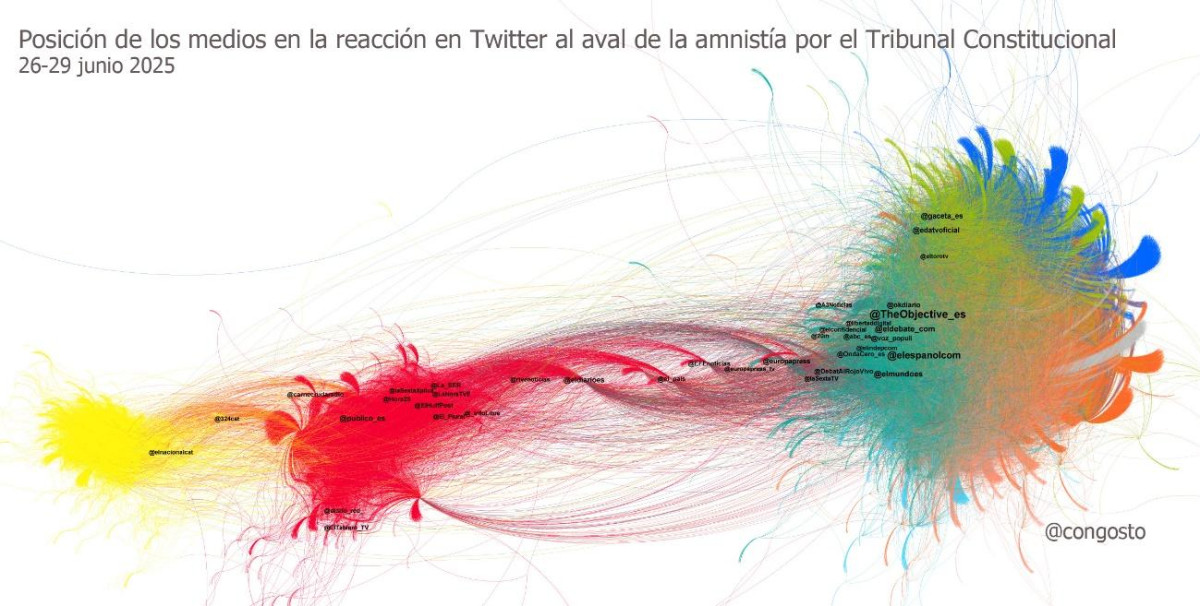
To understand how the debate was organized, a graph was created in which each of the 48,089 participating profiles appears as a dot, and the nearly 160,000 retweets function as lines connecting them. The algorithm used, called ForceAtlas2, groups profiles that share more content among themselves, bringing them closer together, while distancing those with less in common in their interactions.
The structure of the debate reflects a division into three blocks: conservative (71.95%), progressive (20.42%), and pro-independence (7.63%). The reaction has been similar to that recorded on October 28, 2023, when Sánchez defended the amnesty for “the interest of Spain and in defense of coexistence among Spaniards,” as well as on the day of his presentation in the Congress of Deputies, on November 13 of the same year. It should be noted that, on this occasion, the blocks appear more separated, which signals greater polarization of positions. To a large extent, the media act as a bridge between the conservative block and the progressive one, and the latter with the independentist.
Arguments of the debate
By having classified each profile according to its ideological group, it is possible to analyze separately the content of their messages for each bloc. To do so, the help of artificial intelligence —in this case, NotebookLM— was used, which allows extracting patterns, detecting discourses, and identifying actors.
Conservative bloc: very negative arguments
The most repeated argument is that the Amnesty Law is unconstitutional and illegal. The Constitutional Court is accused of “twisting” the Constitution and of grounding its decision on the idea that “what the Constitution does not expressly prohibit is legal.” It is also interpreted the amnesty as a corrupt political transaction, whose objective would be to allow Pedro Sánchez to obtain the seven votes needed from Junts to form a government.
The TC’s endorsement is presented in this camp as a “
Progressive bloc: positive assessment and critique of the opposition
In the progressive bloc the fact that the TC declared the amnesty as “fully constitutional”, dismissing the appeals and the thesis that the Charter expressly prohibits it, is welcomed. It is argued that the measure is a “magnificent news for Spain,” as it has helped bring peace, normality, and convivencia to Catalonia, reducing both independence sentiment and political tension.
Criticism of the opposition for “politicizing justice” and it is alleged that right-wing sectors delegitimate institutions —such as the Constitutional Court itself— when the resolutions do not favor them, going so far as to try to “hack” the rule of law. In addition, it is highlighted that the amnesty has benefited police and other citizens involved in the events of the procés, not only independence leaders.
Independentist bloc: necessary but not sufficient
From the independentist bloc, the TC’s declaration that the amnesty is “fully constitutional” is celebrated, which is interpreted as a success or achievement for the movement. Some see it, however, as “yet another piece of evidence of Spanish repression.” It is considered that the amnesty is a step to “defeat repression,” “reverse much of the repression,” and “end all repression of the Catalan national minority.” Nevertheless, it is consistently stressed that the amnesty does not resolve the underlying political conflict, which remains self-determination and independence. Many tweets point out that the main beneficiaries have been the police —the “piolins”— who intervened in the 1-O, and it is criticized that the measure serves to “whitewash the Spanish regime” at democratic and international levels.
“The amnesty is seen by certain parts of the independentist group as a surrender or defeat, but it condemns all those judges of the TS who refuse to apply the law”
Regarding negative assessments, the strongest argument is that the amnesty does not represent the true objective of independence, which is independence itself. It is labeled as a “surrender” or even a “defeat” that demonstrates the failure of the procèss to achieve that end. Some describe it as a “smokescreen” to “cover the cap under the wing, regain lost privileges and pledge new vassalages,” or as a “pact with the devil.” It is also strongly denounced that the judges of the Supreme Court refuse to apply the law, something considered a “democratic fraud,” “prevarication,” or a “rebellion by judges of rotten state structures.” It is also noted that the law was drafted by some of its own beneficiaries —such as Jordi Turull (“I participated in the drafting of the law”)— and that it mainly benefits political leaders, not all those who were punished.
Aggressiveness of the discourse in the three blocks
In the conservative bloc, the level of aggressiveness detected is high. The language used tends to be demeaning, insulting, and filled with exclamations, with expressions such as “prostitucional,” “fucking trash,” “sinvergüenzas,” “pile of filth,” “sheep, brainless and intellectually indigent,” “traitors,” “an aberration,” “dictatorship,” “Puta basura!” or “What is this called? DICTATORSHIP. And we will swallow it.”
In the progressive bloc there is also a high degree of aggressiveness toward critics of the amnesty, especially toward opposition members —notably from the Partido Popular—. Descriptors include “ultras,” “fascist horde,” “monkeys,” “idiots,” “subnormals,” “fucking moron,” “scum” or “HDLGP.” Vulgar expressions are frequent, such as “fucking shit of scum,” “fucking nerve,” “fucking moment,” “fucking joke,” “shit,” “to hell,” “go away,” and “up yours.” Journalists and public figures who speak out against the amnesty are also disparaged with terms like “lackey,” “mercenary,” “rent-a-parrots,” or phrases like “lacks own judgement… another old grump.”
In the independentist bloc, the level of aggressiveness is also high. Direct, scornful language, and in many cases insulting, is used, aimed especially at Spanish political figures considered hypocritical or contrary to the movement’s interests. Terms such as “franquistes,” “terrorista assassí” (referring to Felipe González), “botiflers” (traitors), “escòria” (scum), “subnormals,” “farsant” (fraud), “desgraciat” (wretch), “poca pena” (no pity), “mediocre” or “caragirat” (turncoat) are used. The term “piolins” is frequently employed to refer contemptuously to the national police. Among the strongest expressions are outbursts such as “puta MERDA” (fucking shit), “que els bombin a tots!” (let them all be bombed), “que se la fotin pel cul” (screw it up their arses), “Mori Espanya” (Death Spain), “PutaEspanya” (fucking Spain) and phrases like “Quin gran negoci: Espanya pega, Espanya perdona…” (What a great deal: Spain hits, Spain forgives…).
Valuation of the protagonists
In this debate the protagonists were Pedro Sánchez (Prime Minister), Conde-Pumpido (president of the Constitutional Court) and Felipe González (former Prime Minister and critic of the amnesty).
Pedro Sánchez: traitor, hero or opportunist?
Perceptions of Pedro Sánchez vary greatly depending on ideological alignment.
In the conservative bloc, opinion is markedly negative: he is labeled “liar,” “shameless,” “hypocrite,” “traitor,” “corrupt,” “dictator,” and “felon.” The main focus of criticism is his shift in stance regarding the amnesty, interpreted as an act of “political corruption” motivated by personal or partisan interests.
In contrast, the progressives express a positive view. They praise that he propelled a “magnificent news” by returning the Catalan conflict to the political arena and fostering “pacification” and “normalization.” His pivot on the amnesty is read as a pragmatic adaptation to circumstances or even as a “virtue.”
From the independentist bloc, Sánchez is seen as an opportunist leader who endorsed the amnesty out of the need for parliamentary support—to “keep himself in Moncloa”—rather than out of ideological conviction. While he is credited with enabling the measure’s approval, he is also described as someone “obedient” to the interests of the independentist movement.
Conde-Pumpido: key figure and focus of political interpretation
The figure of Conde-Pumpido, president of the TC, has generated intense and divided opinions depending on political orientation.
From the conservative bloc, the evaluation is extremely negative. He is regarded as the main architect of the amnesty’s validation and described as a “puppet” or “lackey” of Pedro Sánchez.
Among the progressives, his role receives a positive appraisal. He is credited with leading the constitutional backing of the amnesty, and his actions reinforce the narrative that the law is fully compatible with the Constitution.
For the independentist bloc, his role is seen as instrumental in the approval of the amnesty. Nevertheless, some messages question his independence, suggesting that “shows the hidden political card” in the ruling. He is accused of being part of the “Spanish Constitutional Court,” perceived as an institution with political action in service of the State.
Felipe González: most attacked figure by progressives and independents
Felipe González has been the politician pointed at most harshly, by both the progressive and the independentist blocs. He has repeatedly been called “Felipe GALzález” or “Mr. CAL VIVA,” and has been addressed with terms such as “fascist,” “disgusting Nazi, thief, exploiter, traitor to the people and creator of a criminal terrorist gang.” He has also been described as “shameless,” “right-wing charlatan,” “utterly boring” and “the shame of socialism.” Among the stronger expressions are “vomiting bile” and “hatred toward Catalonia,” while some label him a “convinced Francoist” and link him to his past with the GALs, referring to him as a “terrorist killer.”
“Felipe González is highlighted for his hypocrisy in opposing amnesty while benefiting from the 1977 one, but the conservative bloc sees him as a coherent figure.”
The criticisms also target his “hypocrisy,” opposing the current amnesty while having benefited from the 1977 one and pardoning others during his tenure. In contrast, from the conservative bloc he is perceived as a coherent and principled figure, whose opposition to the amnesty reinforces his image of “democratic dignity,” especially in light of the stance taken by Pedro Sánchez.
The media’s position
This kind of debate feeds on the generation and circulation of news that is disseminated and commented on by different ideological groups. Liquidation of a media’s position is defined by the ideological orientation of the profiles that react to its contents. For instance, if a media outlet is referenced by two distinct blocs, its placement will depend on how intensely each bloc interacts with it, functioning as a force mechanism. Conversely, if a media outlet only receives mentions within a single ideological group, its position will be confined to that bloc.
Media in the independentist group
In the independentist bloc, outlets such as 324.cat and elnacional.cat appear, acting as a bridge between the independentist and progressive groups, facilitating the circulation of content shared by both sectors.
Media in the progressive group
In the progressive group —situated between the independentist and conservative blocks— the position of the media is determined by the intensity of their interactions with other blocks. The left-leaning outlets, such as Carne Cruda Radio, Público, Diario Red and Tablero TV, approach the independentist bloc. In the center of the group are the more insular ones, that is, those that receive mentions mainly within their own bloc, such as Hora 25, La Sexta Xplica, El HuffPost, the SER, La Hora TVE, El Plural and InfoLibre. Meanwhile, outlets located further to the right — rtve Noticias, elDiario.es, El País, EFE Noticias and LaSextaTV — are also referenced by profiles from the conservative bloc, acting as connecting points between the two groups.
“Public media outlets are closer to the progressive group: this could be due to bias or to the editorial approach taken in the context”
It should be noted that these public‑owned outlets tend to be positioned within the progressive bloc, according to the interaction pattern recorded. This position could be interpreted as a sign of ideological bias. However, it could also be due to the type of coverage or editorial approach used in the context of the amnesty debate.
Media in the conservative bloc
Within the conservative bloc two groups of media are distinguished according to their level of connection and ideological profile. On one side, moderate conservatives —located closer to the progressive group— include Al Rojo Vivo, 20 Minutos, A3 Noticias, El Confidencial, Onda Cero, ABC, El independiente, Libertad Digital, VozPópuli, El Mundo, El Español, The Objective, El Debate and OKDiario. These media outlets maintain a certain level of interaction with other blocs, which facilitates cross-discourse.
On the other hand, radical conservatives —with little or no connection to the other groups— cluster around toroTV, edaTVOficial and La Gaceta. These media circulate within more isolated circles.
The outlets that generated the greatest impact in terms of diffusion and mentions were The Objective, El Español and El Mundo.
Evolution of the media position
The media’s position has undergone light changes since the Amnesty Law was presented in Congress. The most significant development has been the shift of El País and La SER toward more progressive positions, reinforcing their bond with that ideological bloc. In parallel, there is a movement of eldiario.es toward areas closer to the conservative bloc, though without leaving the progressive group. These changes reflect nuances in editorial orientation and public perception according to the reactions and references recorded on social networks.
Conclusions
Since the Amnesty Law was brought to the table, a social fracture has been created that has not closed over time; rather, it has widened. Reactions on X have shown a high degree of polarization, especially at key moments such as October 2023, when Pedro Sánchez defended the measure in the PSOE’s Federal Congress with the argument that “one must turn necessity into virtue,” or in November of the same year, when the PSOE alone registered the law in the Congress of Deputies.
After some time has passed since the TC’s endorsement of the Amnesty Law, the level of polarization has notably increased. The discourse on X shows an almost unbearable degree of aggressiveness across the three ideological blocks —independentist, progressive, and conservative— reflecting the difficult path toward mutual understanding and coexistence.
