
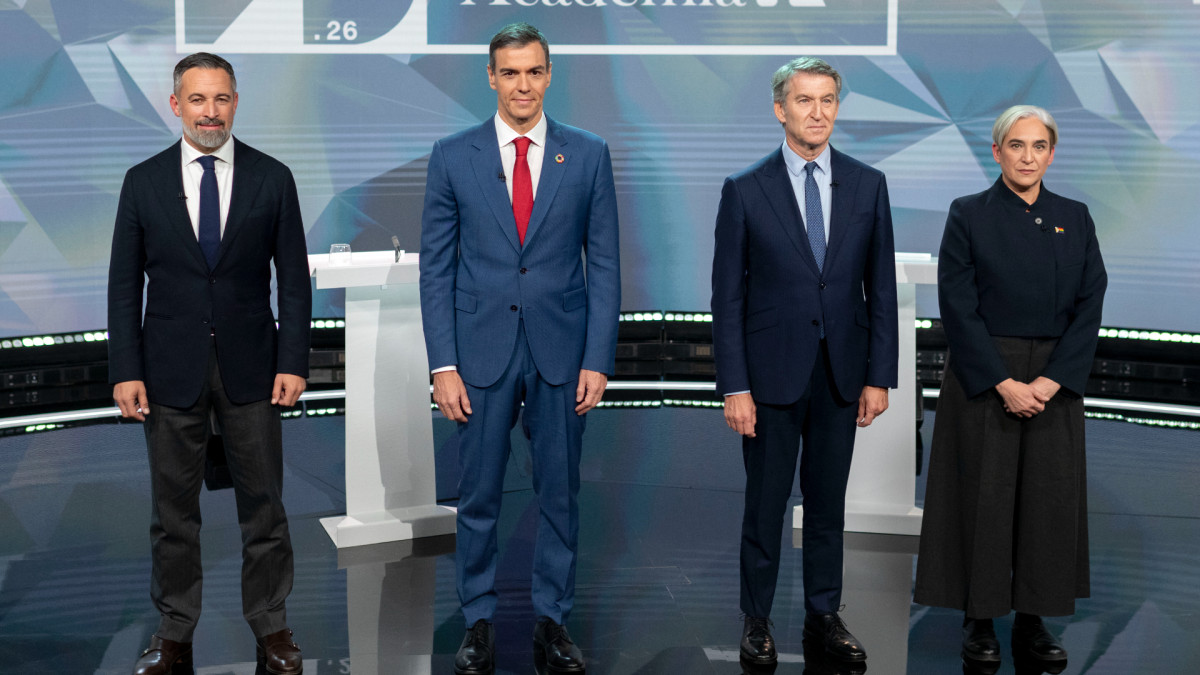
We vote for what we want and, increasingly, we vote against what we fear. The voter who chooses based on proposals tends to arrive determined in the final week, while the one who chooses out of fear or due to an anti-vote, that is, to prevent someone else from governing, can wait until the eve, which makes the last debate a showcase of adversaries. In the debate of Thursday the 26th, three days before the elections, Pedro Sánchez, Alberto Núñez Feijóo, Santiago Abascal and Ada Colau traversed the same blocks and rarely tackled the same issue.
The most probable scenario is that the left comes out strengthened from the debate and that this owes less to its achievements than to the campaign’s tougher Abascal, whose intervention could give a demobilized voter a reason to reconsider their abstention. In 2023, with the campaign already closed, 10.1% of voters decided, 3.3% on the day of reflection and 6.8% on the same day. That minority, about 2.65 million voters if that decision pattern repeats and turnout hovers around 73%, is the one that could still be up for grabs.
Each candidate tried to steer the debate into the terrain where the voter grants them an advantage, which John Petrocik described in 1996 as the ownership of the issues. Hence, even subjected to the same thematic blocks, the four candidates ended up outlining four Spains with their own axes.
The Social-Democratic Spain: Preserving Rights
Sánchez opened with a forward stance against retreat and sustained it until the final minute, returning the discussion to the classic axis of the era of the two-party system, the public sector versus the private. He did so at the cost of an oncology treatment that almost no one could pay out of pocket and with Amnesty International’s report identifying at least 57 rollbacks in human rights in the programs of the PP and Vox, which allowed him to tie Feijóo to Abascal through a source outside the campaign. The same report warns of omissions in the proposals of PSOE, the Frente Amplio and Podemos.
“The most probable scenario is that the left comes out strengthened from the debate and that it owes less to its successes than to the tougher Abascal of the campaign.”
His most recognizable asset, foreign policy, appeared little and almost always as a domestic warning. There is an explanation: in the November barometer, foreign policy accounted for 1.1% of mentions as a national problem, although 65.8% said they were very or somewhat worried about the war in the Middle East when asked directly. The voter worries about the world if asked, but does not bring it into the conversation when thinking about what is going wrong in Spain.
On housing he argued that competition is regional, a legal nuance whose electoral effectiveness is debatable. In the CIS October barometer, 40.7% placed the greatest competences in the autonomous communities and 48.1% replied that the State should have more, so the voter can accept the distribution of competences and keep passing the buck to La Moncloa.
The Conservative Spain: Governance and Ownership
Feijóo moved within a Christian Democratic frame on social issues and liberal on the economy, the frame of a country that barely makes ends meet and has a house to protect. He came across as more convincing when he spoke for himself than when he stuck to the argument, especially when he grounded it in the example of the small business. Squatting allowed him to recover the axis of property rights, even though the May CIS recorded this issue with barely 0.5% mentions as a national problem.
“Feijóo moved within a Christian-Democratic frame socially and liberal economically, of a country that barely makes ends meet and has a house to protect.”
He devoted more time to corruption than the data would suggest. In the November barometer, it was cited by 7.6% of respondents, and by voting recall it was 12% of those who remember voting for PP in 2023 versus 4.7% of those who recall voting for PSOE, which suggests that the argument has more traction among his own voters than among socialists. Regeneration, which would have turned the reproach into a proposal, did not appear.
The night also left him with a cut he did not need when he replied to Colau that “good governance is to stand at the forefront of a national emergency and not run away from Paiporta and you, quiet.” Sánchez reproached him at the event and Colau reminded him later, so that the one who at the outset had joined in condemning the gender-based violence that Vox avoided ended giving away that phrase to his two left-wing rivals.
In the migration block his interlocutor was no longer Sánchez. He said that “Ceuta is not for sale, Ceuta is defended” and repeated that it will be his first dossier in the Council of Ministers, a promise he had already made in the city in October and in the face-to-face on the 19th. The insistence has an arithmetic explanation. Ceuta elects a single deputy, and in 2023 the PP won it with 12,918 votes compared to 11,332 for PSOE and 7,752 for Vox, according to official results, so that with less than 1,600 ballots’ difference, a Vox recovery at the PP’s expense could jeopardize the latter’s seat.
The Activist Spain: Housing and the Halt to the Far Right
Colau had at hand the country’s most cited problem. The November CIS places housing at 59.5% of mentions, far ahead of economic problems (24.7%), the quality of employment (23.9%), and immigration (23.1%). Her role was that of the insistence, the one who asks more from the Government and reminds the PP of its votes, with the Argentine recession as a warning to associate Abascal with Milei and with the minimum wage as the best moment. The government had approved nine days earlier an increase of 5.3%, up to 1,286 euros, and Feijóo had responded then that he is not satisfied with the minimum wage and that what he wants is for the average wage to rise, a position that on the set was hard for him to defend. She ended the night in the anti-vote camp, appealing to avoid a government with the extreme right.
“Colau had the role of the demanding, the one who asks more from the Government and reminds the PP of its votes, with the Argentine recession as a warning to associate Abascal.”
Colau stated that only 0.1% of foreigners committed any crime last year. The INE’s convicted statistics show for 2025 15.3 convicts per thousand foreign adults and 6.1 per thousand Spaniards, that is, around 1.5% and 0.6%. 70.2% of those convicted had Spanish nationality, but neither that distribution nor the conviction rates allow determining what percentage of each population committed a crime during that year, so these figures are not enough to contrast Colau’s claim.
The Anti-Immigration Spain: Abascal and the Fourth Wall
Abascal kept a debate of his own in which only he and the camera were present. He broke the fourth wall in every turn to address the viewer, with few exchanges with the other three, and closed by urging votes “so that Spain regains its future.” His axis places fourth among the country’s problems, more than 36 points behind housing, and yet he applied it to all blocks, including housing, which he explained through immigration.
What brought him to the set was the international frame of the radical right, purchased with hardly any adaptation. The remigration, which he proposed as a solution, is a term popularized by the Austrian identity movement of Martin Sellner and today promoted by the FPÖ, Reconquête and Vox itself; the defense of the combustion car recalls Donald Trump’s discourse. It gives the sense that the Spain he addressed responds to an argument crafted outside Spain.
When he stepped off that track, Abascal looked uneasy and ended up adopting, in the economic blocks, the PP’s framework on institutional erosion, when usually it is the PP that must adopt Vox’s frame. He even announced the AI legislature without accompanying it with a single measure.
“It gives the impression that the Spain Abascal was addressing responds to an argument crafted outside Spain.”
It was in the interaction with his opponents where he found himself cornered, first on housing, when he was associated with the vulture funds, and later in the area where he is most comfortable, immigration. He called Ceuta “the crystal ball” of what will happen in Spain, the city that functions in his discourse as a self-fulfilling prophecy, and he claimed that “Sánchez is the Moroccan candidate in this Sunday’s elections.” The president replied that the only one who had done military service and sworn allegiance to the flag was him, a reply that avoids discussing the accusation and returns the credential to the one who racked up three extensions. Abascal replied that he had done “more military service” than his opponent.
Feijóo and he spoke about Ceuta for an entire block and neither addressed the people living there, who heard their city described as invaded while Morocco was used as a resource for emotional voting, whose cost is paid in the coexistence at the border. Abascal can thus retain the hard vote, though he risks the soft vote as soon as the conversation moves away from the fence.
The Anti-Vote: What Remains to Be Decided
Outside those four Spains that had a voice on the set remains the anti-vote bloc: those who still have not found a sufficient reason to go to the ballot box. The pool of mobilizable electors is larger than the 10.1% suggests, because in 2023 52.9% of those who abstained admitted having considered voting at some point during the campaign, and 27.8% of those who did vote admitted having considered not voting.
“Abascal can thus keep the hard vote, though he risks the soft vote as the conversation moves away from the fence.”
The closing of Sánchez and a line from Feijóo suggest that the candidates themselves read the last week this way. The president spoke to the viewer in his final minute, telling them that “you will have much more power than Abascal and Feijóo together,” and Feijóo left a line that names the opponent’s frame in attempting to deactivate it: “Sánchez asks for your vote with fear, I ask for your vote with memory.” Fear and memory are two ways of asking for a vote against someone.
The most serious objection is that fear mobilizes in both directions. The tougher Abascal also activates his own supporters, and the rejection of Vox could end up as a useful vote for Feijóo among moderates, although the “silent” cut introduces an element of uncertainty in the two days remaining. For someone torn between the sofa and the ballot box, the question may be less about which of the four Spains they would like to inhabit and more about which one they fear finding on Monday.
In this cognitive war, it remains to be seen whether the social media cuts of Abascal’s sharpest moments will turn the fear of rights rollback proclaimed by the progressive bloc into a sufficient motive to wake up that Spain that wants to vote and to begin voting, which today yawns.
