
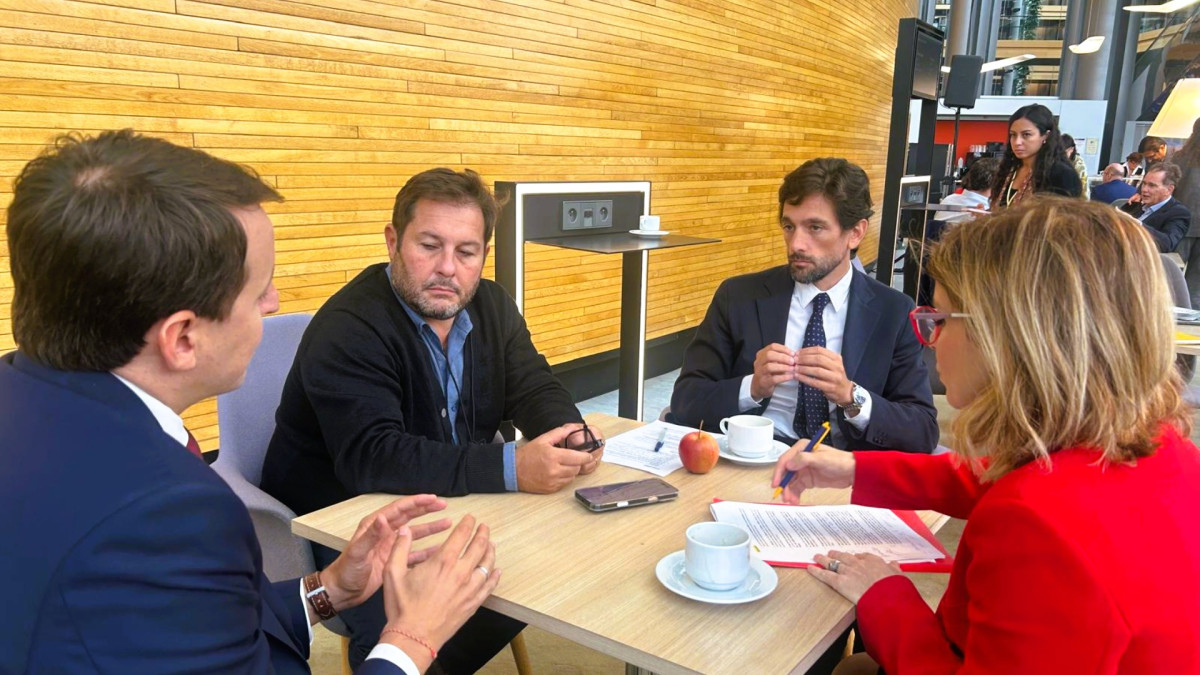
Coinciding with the debate on the State of the European Union (SOTEU) in Strasbourg, three of the MEPs who collaborate with Agenda Pública UE have been able to speak with our editor and director, Marc López Plana. The aim of the meeting was to provide an almost real-time analysis of the speech just delivered by the President of the European Commission, Ursula von der Leyen.
The result was exactly that: they could compare on the spot the first read that the MEPs had of the topics addressed by Von der Leyen. In a relaxed and informal setting, but where each participant wanted to clearly mark their positions, Hana Jalloul, Javi López and Adrián Vázquez analyzed the most current issues such as the geopolitical situation, immigration, the rule of law or the trade relationship with the United States, among others.
Thanks to the three for accepting the proposal for this conversation of the section Agenda Pública UE, with which they collaborate. I would like them to give a preliminary assessment of Von der Leyen’s speech in these moments so critical for the European Union.
Javi López (J. L.): The speech by Von der Leyen sends the central message that Europe must be independent. It rightly places two major areas of work—security and competitiveness—as the pillars for a more autonomous Europe in a world that is increasingly turbulent.
She devoted a substantial portion of her speech to Ukraine and Gaza, and rightly so. She takes steps forward in terms of EU pressure on the Netanyahu government—for the first time—with sanctions on some of his ministers and partial suspension of the trade association agreement—and she defends a broad consensus in the European Union in support of Ukraine.
The speech, at a moment when the pro-European majority is weakened, is a bet to rebuild it. It lays a foundation for that pro-European majority of those who voted for the Von der Leyen Commission—conservatives, socialists, liberals, greens. With her speech, with her messages on housing, green commitment and competitiveness, she achieves what she aims for.
Adrián Vázquez (A. V.): The line from the SOTEU that I hold onto is: “Europe must fight for its freedom and for its place in the world.” For its freedom, of course, given what happened with those Russian drones entering Poland last night, for example. Additionally, she announced some sensible defensive measures.
And then, for its place in the world. It is aimed at maintaining our competitiveness, because without that competitiveness, without that industrial and economic muscle, we will be an actor of little consequence. There are people who sometimes do not understand this, but either we maintain that economy, that industrial muscle that is in decline and relaunch it, or we will not be able to, for instance, to influence third countries that are not doing things well. The message runs along these two lines.
She has been bold, especially in foreign policy. domestically, however, I think she needs to be more aware of the new majorities. She has to be more aware of the major challenges we face as a Union internally and not only externally.
And she must be more ambitious in terms of competitiveness. At the same time, she must be careful not to hurt sectors as crucial to us as the primary sector, or it is likely that this European Commission will fare somewhat poorly in the coming months.
Hana, you are an expert on the Middle East; are you satisfied with what Von der Leyen said about the partial freezing of trade agreements with Israel?
Hana Jalloul (H. J.): We’re quite satisfied. Although it comes late, as Iratxe García rightly said during her intervention as the social democratic spokesperson. At least this comes, and we value it.
It’s true that she mentioned there isn’t enough consensus yet, but that also helps against the violent settlers, against extremism and against members of Netanyahu’s government. It’s a positive and important advance. It has taken us a long time to get here. I want to remind you that our Government already said: many of the measures we were proposing. Can more be done? Yes, but we are happy. It’s true that, for example, she did not mention the term genocide.
I liked her speech, also when she spoke about Ukrainian children. I think that is where we must be. It is exactly what is going to be done, especially so that every Ukrainian child has the right to return without fissures.
On the other hand, she tried to move away a bit from that image of weakness she had with Trump at the time and wants to show that she is a woman with a strong, forceful, and above all unifying message toward the parliamentary groups. In this I agree with Adrián, because I think she has tried to unite the parliamentary groups more. Although there are other majorities clashing with the shouts of the rude far-right.
In other topics I consider important, she defended Mercosur, which you know is crucial for Spain. She also spoke about housing, European independence or promoting the construction of cars on European soil, a key issue for our autonomy. She sought to reinforce Europe’s values and the strength it has in housing, in industry, etc.
Even though she arrived late to many things and there are thousands of deaths —because every day there are a hundred or two hundred children dead— finally measures are being adopted that should have been adopted a long time ago.
Full Speech by Ursula von der Leyen in Strasbourg
Javi, the leader of the European People’s Party, Manfred Weber, cited Pedro Sánchez. What do you think about that?
J. L.: Pedro Sánchez is the leader of the most important government on the left in Europe and, strategically, for the European People’s Party (EPP) it is the target to beat. In fact, he is part of the political debate.
At the same time, to build a majority that makes governance in Europe possible today, it is only possible with the European socialists. A temporary majority for a parliamentary vote without the socialists is possible. But, without us, it would not be a functional majority of government in Europe. Acknowledging the important role of the EPP, which has fourteen commissioners in the College of Commissioners and also has a majority in the European Council, the party must especially take responsibility for that governance.
Attacking the most relevant government of a political family that is necessary for Europe’s political stability, I don’t know if that is the most useful. But, well, it is part of the political debate.
Adrián, you are an expert on rule of law issues. The topic of linking funds to compliance with rule-of-law standards has been discussed. Can you delve into this? Which countries do you think could be affected?
A. V.: We already have the conditionality mechanism that must be implemented. And one of the things we must improve in the Union is to leverage the annual rule-of-law report, which is increasingly comprehensive and has a greater impact.
We have seen it, for example, with the chapter on Spain. This year’s report is especially critical of the government of Pedro Sánchez. But it is also true that we lack the implementation. We lack the ability to force those improvements that the rule-of-law report demands or also to the Venice Commission, even if it is a different institution from the EU.
“The problem we face with violations of the rule of law is that the trend is worsening. The report notes that each year it gets more widespread and more Member States violate it, some even in a serious way”
In that sense, Von der Leyen has indeed announced two or three things, such as that European democracy study, also against disinformation and the European Centre for Democratic Resilience, to have a media-follow-up program, ensuring that misinformation stops once and for all. But it is not enough. The problem we face with violations of the rule of law is that the trend is worsening. The report, since its inception six years ago, says that every year it gets worse and more Member States are violating it, some of them seriously.
We already have broad jurisprudence from the European Court of Justice on violations of the rule of law. Therefore, we could use the mechanism and cut funds in exchange for changing certain laws that contravene the treaties. The problem is that so far this has only been done with parties of one political color—Orban and, previously, PiS (Law and Justice) in Poland.
Right now there has been a mission, for example, in Slovakia, where a left-wing party leads an authoritarian government too. A party that used to be in the Socialist Group and is now expelled.
In Spain there are also clear violations indicating that, sooner or later, actions must be taken. I hope our Government has listened to this and will apply the measures it has announced, which will cost them because they are working in the opposite direction. But as I said, eventually all these issues end up in the courts. In relation to Spain, we have many of these cases currently open in the ECJ and, when there is jurisprudence, we will see what is done.
I find it noteworthy that Von der Leyen has put on the table the idea of overcoming unanimity in decision-making on foreign policy.
H. J.: We have been talking for a long time about changing majorities for some votes in the Council because nothing gets done. What this does is weaken the EU’s role. When they see we lecture on human rights and democracy, but we are not able to influence these issues—for example, stopping the killing of children—we have a serious problem. That is why, in part, what Von der Leyen has emphasized is true.
It is true that we, for example, who saw the EU moving so slowly, have wanted to move forward with the measures presented by President Sánchez two days ago. And this is crucial. She emphasized it with the settlers and the sanctions against Netanyahu’s extreme-right ministers, although, by the way, many are already sanctioned by the International Criminal Court (ICC). It is something she did not mention today, but it also belongs to the rule of law and the international system, as well as to international humanitarian law.
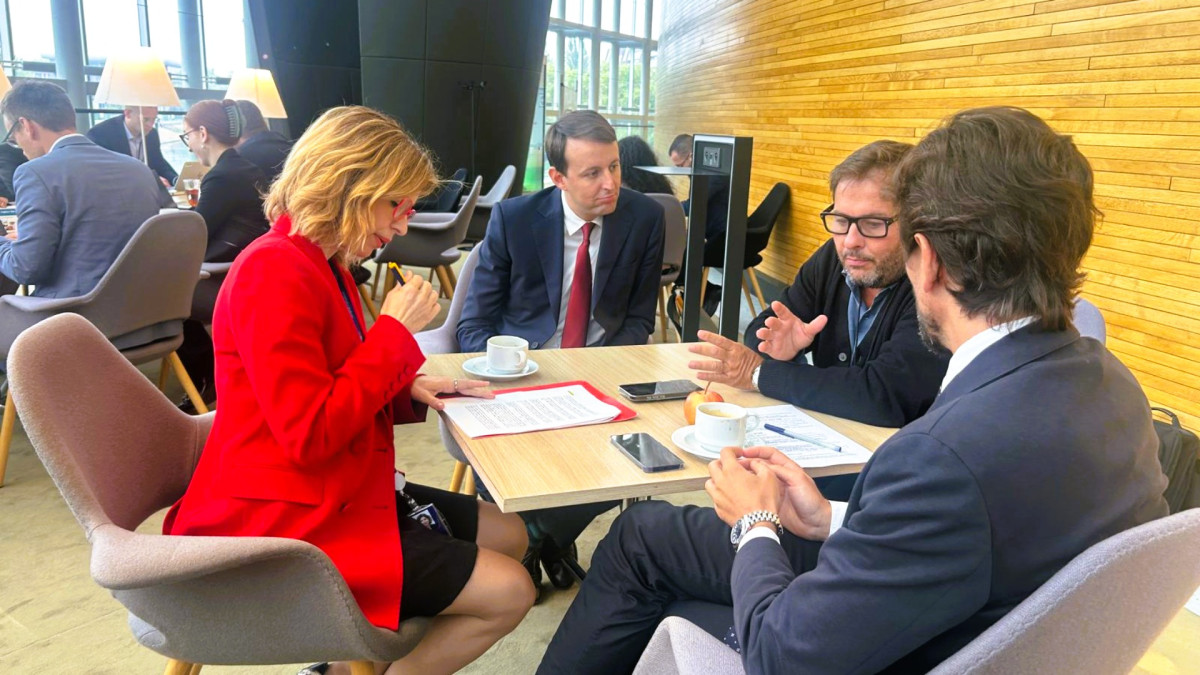
The three MEPs talk with Marc López Plana at the European Parliament. Photo: Courtesy image.
¿Cómo valora, Javi, la relación entre Parlamento y Comisión? Estos días, en esta visita que hemos hecho varios periodistas españoles con la Delegación de la Comisión en España, hemos escuchado que existe sorpresa en el Parlamento a raíz del papel de la Comisión en el marco financiero plurianual.
J. L.: For now, Parliament is highly critical of the European Commission’s proposal on the multiannual financial framework, the macro EU budget that will shape almost a decade [seven years] of European spending.
The plan unveiled last July by the European Commission includes three aspects that generate substantial concern in Parliament. First, the deep cuts in cohesion policy and in the Common Agricultural Policy (CAP). Second, centralization through national allocations—per country—of the funds distributed in each Member State. And third, the conditionality, which is something new in cohesion policy and in the CAP.
“My conviction remains that there is only one functional majority possible, albeit weaker and more fragile”
On these three points there are enormous criticisms from the European Parliament, from all groups, I would say. We will see a very tough two-year negotiation. The truth is that, during this period, we have not yet managed to stabilize the governance and the relationship between the European Commission and Parliament; majorities are more fragile—that is a reality—just as balances are weaker. Although my conviction remains that there is only one functional majority, albeit weaker and more fragile. It is also, probably, a result of the enormous challenges we face and the politically difficult decisions that must be addressed. The speech today aims, among other things, to grease the relationship between the Commission and the Parliament.
Adrián, to what extent does seeing that in a country like Spain—also in others—there is a strong tension between the two major parties, PP and PSOE, contradict the European level where it is always stressed that this broad majority between the two major parties must keep functioning for Europe to go forward.
A. V.: Well, every Parliament has its own characteristics. What is true is that if you look at European election results since 2009, both the Socialist family and the People’s Party family maintained the Parliament’s majority until 2019. In 2019 they did not have a majority for the first time and then the liberals and greens entered. The same happened in 2024. In other words, going from two dominant families to needing more groups makes governance far more difficult and, as Javi said, keeping a functional government becomes harder.
There is a very clear trend, since 2009, of growing support for parties that are less favorable to the European Union, both on the right and on the left. Perhaps part of the problem is that we do not speak with enough clarity, and I am the first to admit this. We must be much clearer with society and try to give answers.
And secondly, there are parties that do not understand majorities and alternatives; it is not a question of citizens being bad or being the devil. The issue is that they are truly affected by certain things we do from here and, in the end, they decide to bet on parties that seek to destroy.
But, how should we treat these parties from the central group?
A. V.: Personally, I have a stance. If we take, for example, the Spanish parties, I would never ally with Bildu because it is a party that does not condemn terrorism or killings. It is the only party with which I would say: “I would never do anything.” But I am a democrat and I understand that, beyond those who do not condemn assassinations, I must negotiate with what the citizens choose.
The cordons sanitaires seem undemocratic to me because what you have to do is accept what the citizens say, try to improve and bring out the best of the majorities you have. If I would always like to have a centrist majority? Of course. If I am going to go around insulting citizens who choose other parties that are more extreme? No.
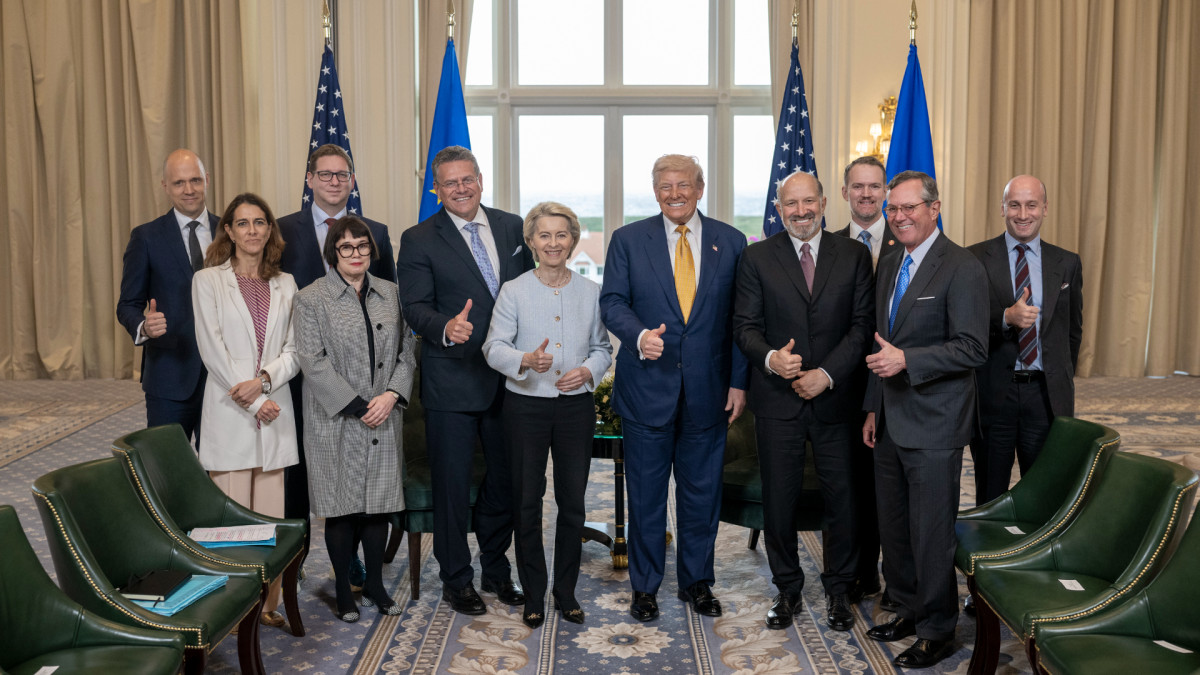
One of the controversial images of the tariff negotiations between the US and the European Union Photo: Daniel Torok / White House
Hana, we arrive at this debate after photos that have sparked anger among public opinion and European media. I am referring to the images of Von der Leyen signing an agreement with Donald Trump, at Trump’s property. And also the photos of several European presidents and prime ministers in the Oval Office, seemingly showing either a form of deference or accompanying Zelenskiy, depending on the view. The snapshots have provoked some indignation; what does Von der Leyen’s speech solve today?
H. J.: That photo was not good and, from the European Parliament, it has not been well received. It has caused a certain unease, because we always speak of our independence and our ability to make our own strategic decisions in many areas. Draghi said the other day: we are at the back of the line.
In my view, we show a lot of weakness in many matters. We have shown it with Gaza and we see it now. We have demonstrated it by accepting a 15% tariff. No action against the United States. And they force you to invest in defense. Von der Leyen defended that agreement.
Just as I think Mercosur is very good, I believe more explanations are needed on this issue. This afternoon there is a debate in the Chamber on the matter; let’s see what arguments are put forward. Last week there was a bit of discussion in the INTA Committee (International Trade), but nothing was clarified.
“Kaja Kallas spoke yesterday and gave a deplorable intervention, I must say. […] Kallas promised an agreement with the Israelis to allow humanitarian aid in, but no pact has been sought”
Also Kaja Kallas spoke yesterday and gave a deplorable intervention, I must say. I was clear: it was shameful. “I ask many things regarding Israel, but they are not done,” she said. Incidentally, we have discussed it; tomorrow here a resolution will be voted, the first in consensus with the People’s Party, so I hope an agreement can be reached. It would be the first after two years. Kallas promised an agreement with the Israelis to allow humanitarian aid, but no pact has been sought on this, and the same thing happens in trade matters. We hope to see this afternoon what is clarified in Parliament.
Regarding the Oval Office, the image is complicated, but I consider that European leaders must be there, as he is the President of the United States. It is somewhat Trump’s policy toward the rest of the world, of imposition.
Yesterday [Tuesday] it was leaked that he spoke with his allies about bombing Qatar. But we all know that it had been agreed that Qatar would be the mediator between Hamas and Israel. His allies and Hamas have been negotiating there…
When negotiating with someone like Trump, we must look out for European interests, because we have accepted too many things we should not have accepted. Today, with this clear message, Von der Leyen has tried to move away a little from that photo and the criticisms she has faced from all groups in this Chamber.
It is important to emphasize the phrase that Javi said: “A functional majority possible.” I’ll stay with this line from today’s talk, because we have built this Europe with conservatives and liberals from the start.
This is where we should be. When forces like Vox swallow you up—as polls show—, the leading opposition party in Spain disappears, as is happening. I do not think it is wise for the People’s Party to be so close to this scenario when we could perhaps be closer to each other. Here—in the European Parliament—where historically it has been the case.
Of course, we cannot tolerate or accept positions like those we are seeing in Murcia, where Vox has imposed that Arabic classes are no longer taught, which means discarding a part of our culture. And the same happens with other issues, such as the far-right’s refusal to support the climate pact.
I think today it has been made clear when the representatives of the far-right were told: “Not there.” It has been an attempt to recover that historic majority in the Chamber, which is where we must move toward together.
A. V.: I’m going to make a comment about the photo. I’m not going to Murcia, because we are in Europe.
H. J.: You already mentioned Bildu. Did Borja Sémper say he would pact with Bildu?
A. V.: I am not Sémper. About the photo, I meant that obviously the people sitting there are not fools; they understand what the interests are. They have a calculation about the electoral timelines in the United States. There are sixteen months left until midterm elections, and in many constituencies, the Republicans are losing ground.
I think they are making that calculation with a kind of technical denial in which they still have to land the details of the agreement. For me, they are playing with that, honestly. Because it is not the same to have Trump with a majority in the House and Senate as with a partial majority. That’s the direction they are taking. We here also play, even if we do not do it on X [Twitter].
What do you think of Von der Leyen’s statements on immigration?
A. V.: I’ve been defending this for ten years. The question would be to those who did not defend this three years ago. I am delighted with what she has said.
J. L.: She gave a very tough speech on immigration, very much in line with the current times and the current balance of power in Europe. Very focused on border control.
Obviously, Europe has to be able to manage its borders, but migration is not only a question of managing those borders. There is also international law involved, humanitarian law, your responsibility in terms of how you manage integration, etc. So I would say that we are all in favor of orderly border management, but I think it is an incomplete discourse, very much of the moment.
There are many fears around migration or anxieties that are instrumentalized, in my view, by the far-right in Europe. The fears of citizens and their worries and their vote, whatever it may be, are always legitimate. Now, there are ideas that are not. We must be able to distinguish citizens from the political options that try to instrumentalize their fears. Europe’s history makes it clear that there are ideas that are toxic to our democratic coexistence. Toxic and that cannot be treated like the rest. That has been Europe’s political tradition and political culture for the last decades, always.
In that democratic consensus, Christian democracy and the center-right have always stood, considering that the ideas of the far right—not its voters—are a threat, a threat to Europe’s democratic convivencia. Citizens should never be attacked, but we should fight against ideas that you believe could threaten your lifestyle.
The truth is that Europe has a fertility problem, Adrián, a very important one. How will we solve this if not through immigration?
A. V.: It is a problem for our welfare state, for the maintenance of the species, indeed. But there are two ways to address it. The first is, of course, to implement policies to boost birth rates: financial aid, tax benefits for large families, greater reconciliation policies… I think we need to go in that direction. On that note, I’ll mention the case of Hungary and Poland, which are not examples to imitate in many respects. Both countries, especially Hungary, have successfully incentivized many policies to increase birth rates.
H. J.: Borders, as I have always said, are not for people, because the oldest thing in the world is to migrate. It does not matter the sea, it does not matter the mountains. We are growing economically very strongly because more than 800,000 migrants contributed to the stability of the labor market. These are figures, these are data, not ideological questions. We aligned reforms of the immigration regulations with migrants’ skills and work sectors. There were economic sectors that needed it, the employers themselves asked for it.
Thanks to that, when the percentage of the population of working age falls, the migrant population will be contributing, paying pensions and taxes. We believe in inclusive policies that are necessary.
Very well. Thank you all very much for making time in a day as tight as this.
