

Overpopulation panic is sooooo 20th Century! Welcome to the era of depopulation dread.
Around sixty years ago, observers were said to be amid a sweeping, world-altering surge in population. In the present, a different worry has taken hold for some economists—that the current century may actually see a sharp decline in humanity’s numbers on a global scale.
In 1968, the Stanford biologist Paul Ehrlich published The Population Bomb, at a moment when the planet’s population stood a little above 3.5 billion and the worldwide total fertility rate hovered just under five children per woman. From this vantage point, he argued that the struggle to feed everyone had already ended. He forecast that the 1970s would bring famines of immense scale, predicting that hundreds of millions would starve despite any emergency efforts mounted now. His prescribed remedy was population control, to be imposed by force if voluntary measures proved insufficient. In his view, birth rates had to be brought into line with death rates, or humankind would drive itself into extinction.
Although hunger has claimed millions of lives—largely in the context of civil conflicts—Ehrlich’s dramatic forecasts of global famine caused by “overpopulation” did not come to pass. Today, the world’s population sits just short of 8.3 billion.
Now the dominant concern is not excess births, but an eventual population implosion, a worry sharpened by a new study from two economists, Jesús Fernández-Villaverde of the University of Pennsylvania and Patrick Norrick of Northwestern University. They contend that humanity’s total fertility rate may already have slipped beneath the level needed to replace the population, with no obvious rebound in sight. (The traditional replacement rate is defined as 2.1 children per woman over a lifetime.)
What is striking—and puzzling—to the researchers is that some of the most rapid fertility declines appear in lower- and middle-income nations and among those with lower educational attainment.

This observation runs counter to the traditional demographic pattern in which fertility tends to fall as incomes rise. If this downward trend continues and intensifies, the world’s population could begin shrinking later in the century—perhaps quite rapidly—an outcome the authors christen Terra Incognita.
The researchers emphasize that achieving very low fertility does not require extraordinary levels of childlessness or minuscule family sizes. They illustrate by imagining a group of 100 women in which 15 are childless by choice or medical reasons, 10 have one child, 60 have two, 10 have three, and 5 have four, yielding 180 births and a completed fertility rate of 1.8—below the replacement level. Now suppose a modest shift where 26 women are childless, 23 bear one child, 46 have two, and 5 have three. The completed fertility falls to 1.3, the conventional threshold for ultra-low fertility, even though three quarters of the women did not alter their behavior. “Any explanation [for the decline in fertility rates] need only account for the quarter who switch, not the 75 percent who do not,” the researchers write. “A woman at two may easily switch to one, or from one to zero, in response to relatively small changes in relative prices or opportunity costs.”
So what is driving the decline in birth rates? The researchers review widely cited factors—rising housing costs, more education for women, shifts in preferences and social norms, the time demands of skill-intensive economies, and the impact of smartphones on face-to-face interactions—and argue that while each plays a marginal role, none alone explains the global prevalence of the trend across such a diverse set of nations.
They speculate that modernity itself may be the principal driver behind the falling fertility. “We inhabit a society organized around large institutions and formal credentials, which makes a third child costly and childlessness relatively inexpensive, and that has created a mismatch between women’s outward status and men’s inward roles,” they contend. In this framework, children no longer contribute to household income, kin networks have frayed, and the cost of educating an extra child is high.
“As modernity spreads everywhere, even to nations with relatively low per-capita income, fertility falls everywhere.”
Fernández-Villaverde and Norrick also highlight an intriguing relationship between skewed gender norms and fertility rates. As women’s opportunities outside the home expand, men’s expectations about household duties and child care can stay entrenched. Societies with highly uneven gender norms enter with very high total fertility, but decline quickly once educated women with outside incomes resist. This gender mismatch in rapidly modernizing societies may help explain, in part, the strikingly low fertility levels seen in many East Asian countries.
The pair acknowledges they cannot identify any self-regulating feedback mechanism that would push fertility back up to replacement. They also note that pro-natalist government measures—subsidies, generous parental leave, free child care—produce only modest increases in fertility.
Continued ultra-low fertility at around one child per woman would cause a pronounced, exponential drop in population. Following current trends, China’s population, for instance, could decline by roughly half by the year 2100.
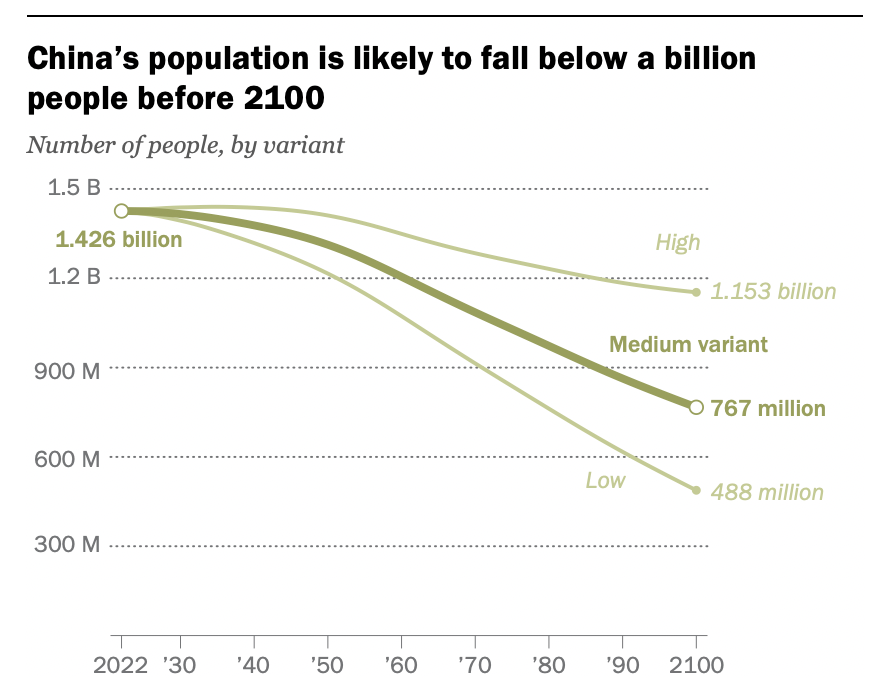
For illustrative purposes, imagine what the 2100 population would look like if, around 2040, global fertility dropped and stayed at the East Asian rate of one child per woman, given current mortality trends:
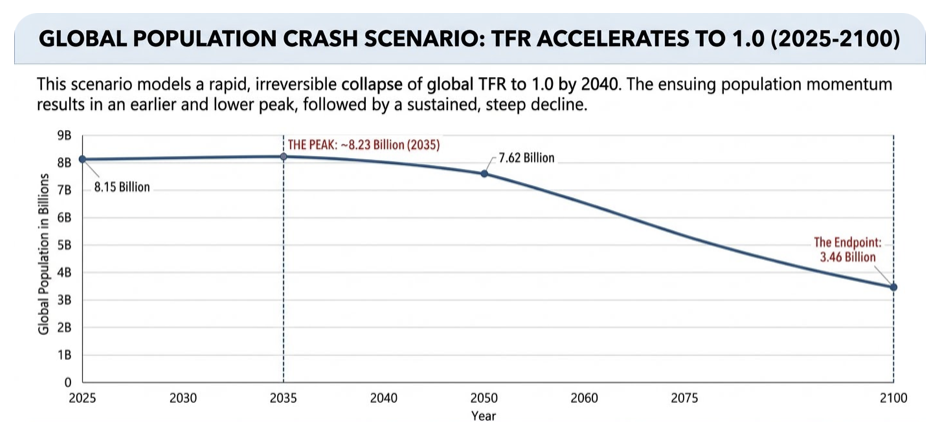
In short, more people would be dying than being born over the century, so population by the end of the century would likely return to the level Ehrlich warned about.
Should we fear a smaller world? Fernández-Villaverde and Norrick believe so. They contrast the recent economic and demographic trajectories of the United States and Japan to illustrate their point. As Japan’s working-age population diminished, its annual GDP growth hovered near 0.8 percent; by contrast, a rising working-age cohort helped the United States sustain roughly 2.6 percent growth on average.
The authors warn that a shrinking population tends to slow economic expansion as the creation of new ideas lags (fewer researchers), entrepreneurial vigor wanes (stagnant incumbents), and older workers resist new technologies. At the same time, supporting aging and ailing citizens imposes hefty fiscal obligations on younger workers.
Yet there may be a countervailing trend. They note that one of the oldest patterns in demography recently paused its downward slide in the United States: fertility rose among households in the top quintile of income, roughly at a threshold around $175,000, and the fertility of highly educated American women also climbed. The likely explanation is that such households can afford outsourcing childcare and other domestic labor. The authors conclude that “children are becoming a luxury good.”
I once pointed to a similar tendency roughly thirty years earlier in a 1997 piece titled Kids as Status Symbols:
So, you own a beach-house compound on Nantucket, a 63-foot Hinckley sailboat, a corporate jet, a nanny, and a gardener; and your stay-at-home spouse with an advanced degree leads the local United Way campaign. What other asset could enhance your high social and economic standing? Perhaps you should have more children?
If the United States were to grow its GDP at about 2.5 percent annually into 2100, the economy would exceed $200 trillion, and divided among 350 million Americans that would amount to roughly $600,000 of GDP per person. With that level of income, most people could afford to employ a whole cadre of robots to handle tasks and care for any number of children.
Finally, recall Ehrlich’s insistence: “The birth rate must be brought into balance with the death rate or humankind will breed itself into oblivion.” If Fernández-Villaverde and Norrick’s observations hold up, Ehrlich might have been correct after all, but for a different reason: the world could vanish from lack of new births rather than from an excess of them.
