
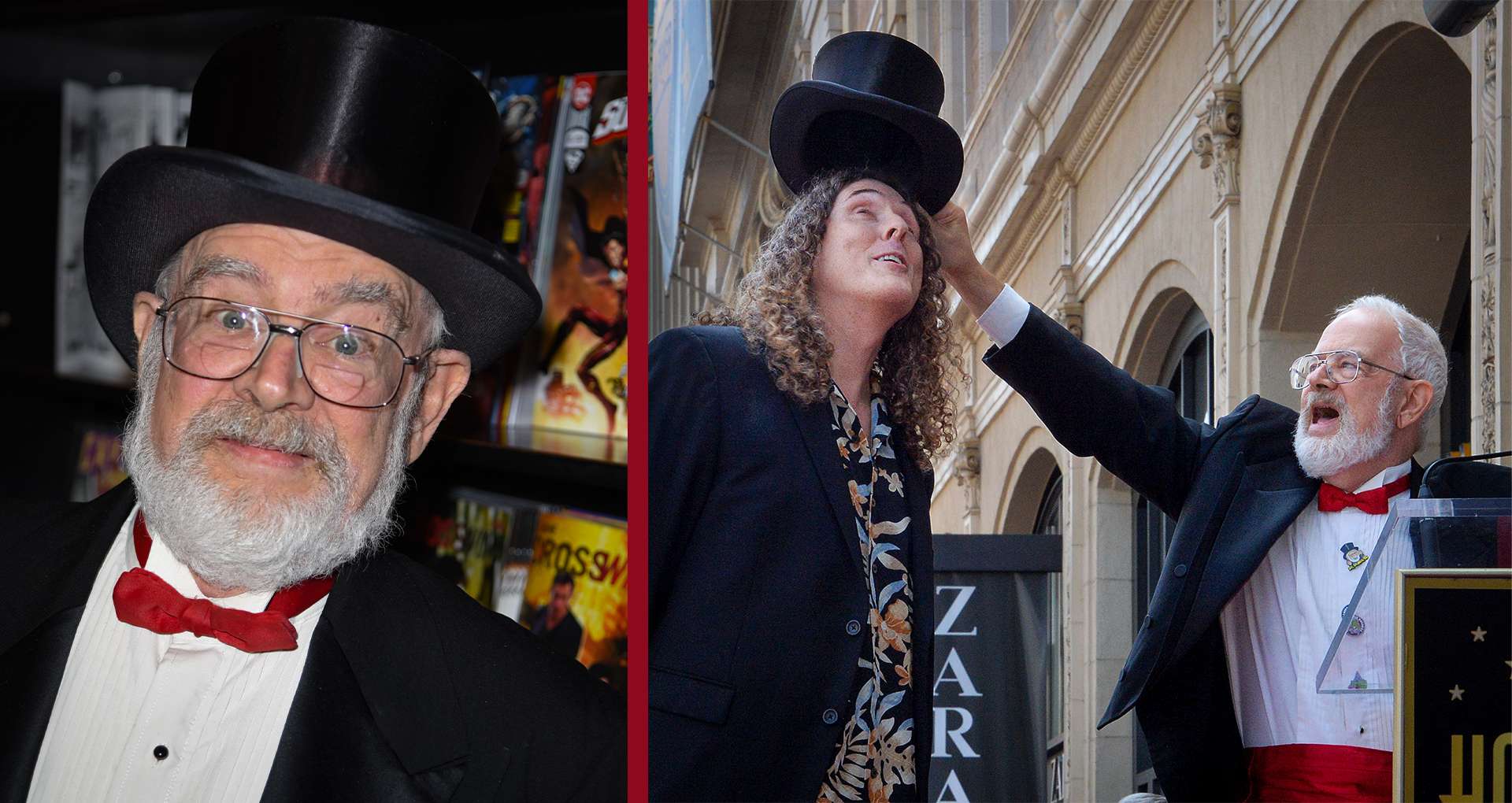
After more than five decades on the air, Dr. Demento has stepped away from broadcasting.
Barret Hansen, better known to listeners as Dr. Demento, recently wrapped up his weekly program after a 55-year run of spinning quirky, goofy, or simply odd songs on radio and online. He wasn’t some fringe character; he helped shape American comedy and stood as one of the era’s most influential champions of cultural liberty.
That claim might feel a stretch to those who grew up in a culture shaped by post-SNL and post-Seinfeld sensibilities. Yet in the early 1970s, that horizon was still distant. Television still faced rigid censorial review before airing, and the same code governed a lot of what mainstream radio could broadcast. Hansen’s program pushed against those boundaries.
Listeners never quite knew what he would play next. One moment could present a sweet vintage novelty like the Playmates’ “Beep Beep,” a ditty about a little Nash Rambler that somehow proved more powerful than the Cadillac it chased. The next could bring a risqué tune about sex, such as Ruth Wallis’ “Davy’s Dinghy” (not about a boat) or the Lemon Sisters’ suggestive “In My Country” (“The swamp is thick, but don’t be afraid/Come guide your canoe right through my marsh…willows”). There was humor about drugs, from the comparatively tame “Friendly Neighborhood Narco Agent” to a mid-’90s spoof of “The Devil Went Down to Georgia” titled “The Devil Went Down to Jamaica” (“Johnny, roll a ball of hash, and make sure it’s the bomb/’Cause the devil’s got the kind of stuff they smoked in Vietnam”). “Cows With Guns,” mocking bovine revolt led by Cow Tse-tung, stood alongside timeless comic tunes from Spike Jones and Tom Lehrer.
And sometimes the show tilted into pure oddness. The two biggest sensations—Barnes & Barnes’ “Fish Heads” and Ogden Edsl’s “Dead Puppies”—illustrate the program’s offbeat spirit. “Fish Heads” jokes that fish heads are never spotted sipping cappuccino in Italian eateries with Oriental ladies; “Dead Puppies” laments, “Dead puppies aren’t much fun/They don’t come when you call/They don’t chase squirrels at all.” Other selections treated darker humor, from a school shooting (Julie Brown’s “The Homecoming Queen’s Got a Gun”) to a pedophile (Ogden Edsl’s “Kinko the Clown”). The show also welcomed Tom “T-Bone” Stankus’ existential blues, Frank Zappa’s mischievous “Don’t Eat the Yellow Snow,” and a track whose verses mostly string together a parade of Los Angeles street names, Felix Figueroa’s “Pico and Sepulveda.”
Occasionally the soundscape was punctuated by cowbells and other effects. Hansen enjoyed sharing the stage with witty friends bearing alliterative handles, such as Captain Chaos and Laughing Linda. Each broadcast concluded with the “Funny Five”—the week’s top requested songs—an ending that placed listeners at the heart of the experience: you could help shape the dementia.
How Barret Hansen Became Dr. Demento
Hansen grew up in Minneapolis as a bit of a loner who collected records, spun them at his high school dances, and later pursued formal music study, earning a Bachelor of Arts from Reed College and a Master of Arts from UCLA. After finishing school, he wrote liner notes for record labels, amassed his own vast collection, and spun tracks at KPPC, a free‑form FM station.
That’s where he became Dr. Demento. A turning point came when he played Nervous Norvus’ 1956 novelty hit “Transfusion,” a song about a reckless driver repeatedly crashing his car—only to be revived by blood transfusions. A colleague at the station quipped that he must be demented to spin that record, and the persona stuck.
The Dr. Demento Show began in 1971 as a rock program sprinkled with novelty tunes, but Hansen quickly realized that the vast majority of audience requests leaned toward the humorous. By the end of 1971 he had moved to KMET, presenting a four‑hour showcase of what he called “loony laughing records,” which became the top Sunday‑night program in the Los Angeles market. He entered national syndication in early 1974 with a taped two‑hour edition; it rapidly gained traction. He drew national attention, including a feature in Newsweek, and even appeared on network television. Some songs he played—“Junk Food Junkie” and “Shaving Cream”—found their way onto the Top 40 charts. “I was very happy when something I helped start eventually reached the charts,” he recalled.
A brief interruption occurred in 1977–1978 when his syndicator went bankrupt, but Hansen continued broadcasting, yielding the third‑longest tenure in American radio history for a single‑hosted musical show. Listeners began sending him their own creations, elevating Hansen to a role akin to a talent scout for musical comedy—much like Johnny Carson or Lorne Michaels could boost new performers, Dr. Demento could launch careers.
He wasn’t tied to any single type of humor or a single musical category. If someone mailed him a decent record or tape, he would play it. Let the audience decide was his guiding principle.
Dr. Demento and Weird Al Yankovic
In that spirit, he helped nurture performers such as Brad Stanfield, Damaskas (a UCLA student known as Sulu), and most famously, Alfred Yankovic, who handed Hansen his first tape back in 1973.
“Weird Al” Yankovic would go on to become the most successful musical comedian in American history, collecting five Grammys and an Emmy, with singles charting for more than three decades. Hansen’s program gave Yankovic his first platform and introduced him to legendary humorists like Stan Freberg, Jones, Lehrer, and Allan Sherman. It was Hansen’s show that inspired Yankovic to pursue musical comedy as a career. There simply would be no Weird Al without Dr. Demento.
When asked about their dynamic, Hansen notes that he never managed Yankovic—though in many respects he served as something closer to a paternal influence. “I saw myself as a bit of a father figure to Yankovic,” he says, aided by the roughly 20‑year age gap. The breakout lyric for “Another One Rides the Bus,” a parody of Queen’s “Another One Bites the Dust,” was penned during a weekend in a cabin with Hansen and friends. Hansen also helped Yankovic secure his first post‑collegiate job, and the pair once toured together when the Demento name was the bigger draw.
Yankovic has never resented or rejected this influence, and the two remain close. Hansen maintains ties with other protégés as well, such as Sulu and Mike “Musical Mike” Kiefer. His loyal following spans from alternative rock artists like Courtney Love and Dave Grohl to Fox News personalities such as Greg Gutfeld and Kennedy. A 1990s chat group about the show evolved into the Demented Music Database, and the bustling Dr. Demento Facebook group now hosts more than 146,000 members. A YouTube search for one of the novelty songs Hansen once featured almost always leads to a comment thread recalling how they first heard it from the good old Dr. Demento. Such devotion is unusual for a DJ long after his peak popularity.
But Hansen wasn’t merely a jockey spinning records. Tuning in to Dr. Demento felt like entering a private club that prized intellect, nonconformity, and humor. A friend of mine recalls discovering the show in 1974 as a lifeline—a realization that there were other people like him. Even former President Richard Nixon once described listening to a train whistle as a boy and imagining the distant places he longed to visit. Each Sunday, Hansen’s “train ride” carried listeners into a quirky, demented land and then brought them back home safely.
The Libertarianism of Dr. Demento
Hansen amassed more than 200,000 records, one of the world’s largest private collections, and he was always glad to share his passions with his audience. In doing so, he educated a generation—perhaps, to some, a cautionary tale about corruption through exposure. What exactly did he teach?
He never promoted a formal political platform. He tended to avoid overt political humor and even told Steve Martin in a 1977 interview that political jokes didn’t particularly appeal to him. In one of his late episodes, he lamented the rancor that increasingly poisoned politics, noting that anger had dulled the humor in many political songs and that he chose to play fewer of them as a result.
Nor did he seek to reshape the craft of comedy. Plenty of other entertainers were chasing that trend in the 1970s, and his show featured many of them—Mel Brooks, National Lampoon, Monty Python, Steve Martin. Yet he always resisted the idea that he belonged to the same crowd. He simply regarded his mission as presenting material on the radio that listeners would not hear anywhere else.
But that did not mean he stood apart from the broader spirit of the era. Hansen championed tolerance and freedom, and he infused that perspective into his program. Anyone could be showcased, regardless of race, gender, or age, and nothing could be mocked if the treatment remained humane.
“There were moments when it crossed my mind that I acted as a gatekeeper, that opening a door could allow others to walk through,” he says. “I don’t like barriers.” The show proved his point. Veteran performers like Rusty Warren and Benny Bell, whose risqué records rarely aired on commercial radio, suddenly found themselves in the spotlight. Lehrer praised the Doc for helping to keep his work alive by reissuing his morally sharp satires from earlier decades, and the scene even welcomed Harry “The Hipster” Gibson and his 1943 anti‑Ovaltine track “Who Put the Benzedrine in Mrs. Murphy’s Ovaltine?” When Hansen interviewed Gibson in 1976, the singer recalled that the record had been banned for years for being “subversive”—until someone named Demento started playing it. Gibson’s reaction was telling: “You probably didn’t know it had been labeled subversive.” Hansen’s quiet reply: “Well…” And he knew very well why he played it.
In the early 1990s, Hansen highlighted songs that poked fun at political correctness and argued that colleges surrendering to PC tendencies were undermining their mission to teach people how to think for themselves. He believed that barriers were harmful no matter which side of the spectrum they arose from, a stance that helps explain why he joined the Libertarian Party in the 1980s and spoke at this magazine’s 20th‑anniversary gathering. His show carried a gentle, libertarian ethos: enjoy yourself, be authentic, and don’t worry. For nearly four decades, it conveyed a message of easygoing tolerance that reached households across the country for two hours every Sunday night.
What Is Dr. Demento Doing Now?
As radio faded in the face of vaudeville’s decline and television supplanted radio drama, the internet has begun to diminish vintage, music‑driven radio stations. Those that endure often rely on prearranged formats that dampen the spontaneity and originality that the best disc jockeys once offered. The ready availability of tracks on YouTube and Spotify also means unconventional comedy acts no longer require airtime to find an audience.
Yet Hansen remains a presence, even if he no longer hosts a weekly show. He keeps assembling collections of humorous music and recently released his own single, Get Demented. He also popped up on the CBS comedy Georgie and Mandy’s First Marriage, a show set in the 1990s when Demento’s program enjoyed national syndication; Hansen has had two cameos in the latest season, assessing and then performing a fictional song sent to him by one of the characters.
People continue to produce material in the spirit of what he loved to broadcast. Comedy musicians (the Funny Music Project, the Wolves of Glendale, Kira Coviello) tour, post new songs on their websites, or craft videos for social media. Coviello’s stage act, Honest2Betsy and her Bawdy Broads, blends singing, dancing, ventriloquism, and a segment in which she proclaims herself the world’s only topless accordionist.
Call it silly, strange, or funny if you like. Yet there’s one word that truly captures the phenomenon: demented.
