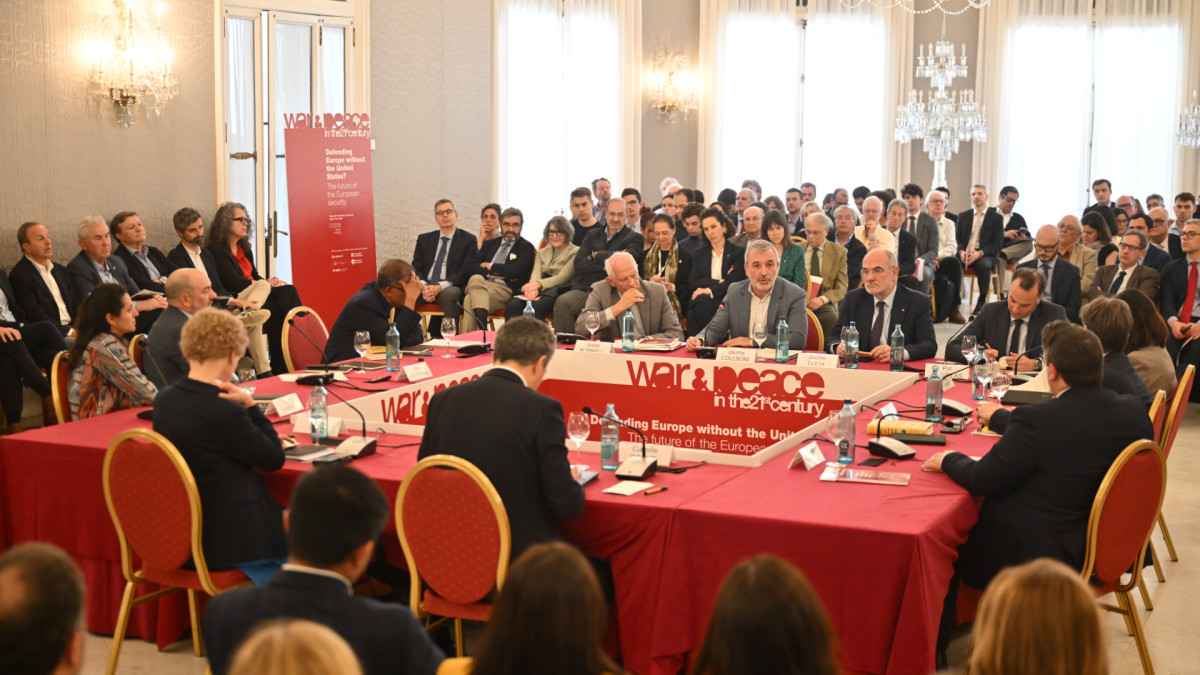
The Pedralbes Palace Conference Hall does not usually serve as the stage for declarations of war, but what happened this April 18, 2026 at CIDOB’s War and Peace conference was the closest thing to a live autopsy of the post-Atlantic order. Under the title —no longer provocative, but sadly pragmatic— of Can Europe defend itself without the United States?, the continent’s geopolitical elite has gathered to acknowledge what barely three years ago would have been considered a heresy in Brussels or Madrid: the “American umbrella” has closed and Europe is soaked.
I’ve covered other conferences where the coffee was stronger than the resolutions. But what we heard from Josep Borrell and from the experts who participated is not another crisis diagnosis. It is the confirmation of a systemic clash. Europe is no longer in a waiting room; it is in the operating room.
The Death of “Strategic Innocence”
In the past, the European project managed to settle into a very comfortable peace under the premise that social expenditure was for Europeans and security spending for the Americans. That social contract has shattered. Trump has transformed the U.S. from protector ally to “ideological predator”.
“Trump has transformed the U.S. from protector ally to «ideological predator»”
The Greenland incident —repeatedly mentioned in the panels as a national trauma for the EU— and the outright disdain for International Law in the recent war against Iran have left European capitals in an impossible sandwich. On one side, a Russia that no longer seeks only territory in Ukraine, but the fracture of European solidarity; on the other, a Washington that uses security as currency to dismantle EU digital regulation or to push through onerous trade deals. The experts’ conclusion is brutal: the U.S. is no longer the guarantor, it is the source of uncertainty.
The Capacity Labyrinth: Money or Will?
The technical debate led by Camille Grand, secretary-general of the defense industry association, and Daniel Fiott, senior researcher at the Real Instituto Elcano, pointed to the core issue. The problem for Europe is not a lack of money. In fact, military spending has surged since 2024. The problem is the Balkanization of spending.
Europe is immersed in a national arms race, not a community one. The example of FCAS (the future fighter jet) explains it well: while France and Germany quarrel over intellectual property, Russia continues learning on the Ukrainian battlefield. The industry’s analysis is clear: we have the technology (we cover 98% of the tactical needs), but we lack the “enablers” that the U.S. used to provide: intelligence satellites, strategic airlift capacity and long-range ballistic-missile defense.
“If tomorrow American forces withdraw from bases on European soil, the EU would be left blind and deaf within hours”
If tomorrow the American forces withdraw from bases on European soil, the EU would be left blind and deaf within hours. We do not have a unified command-and-control system. We have twenty-seven armies with different manuals that barely speak to one another without a NATO translator.
The Nuclear Factor: the Versailles Umbrella
Perhaps the most disruptive element of this analysis is the nuclear turn. The French proposal of an “Advanced Deterrence” has ceased to be a Gaullist grandeur fantasy and has become a survival necessity.
“That Berlin has agreed to join this nuclear-direction group is probably the most important tectonic shift in German foreign policy since 1945”
France has opened its nuclear doctrine to partners such as Germany, Poland, the Nordic countries and Spain; for now, it prefers to stay out. It is not the creation of a European bomb managed by the Commission, but a coordination of exercises and deployments that seeks to send a message to Moscow: even if Washington does not respond, we have our own decision centers. The fact that Berlin has agreed to enter this group of nuclear direction is probably the most important tectonic shift in German foreign policy since 1945.
The Internal Rift of the Trojan Horse in Budapest
One cannot discuss defense without discussing unity, and here the analysis grows somber. The presence of Viktor Orbán—and his systematic leaks of information to Moscow—was the elephant in the room throughout the day. It remains to be seen what will happen now with the new Hungarian prime minister. Also, pay attention to the results of Bulgaria’s elections.
“The veto system has become a tool of blackmail that prevents Europe from reacting at the speed of Russian drones”
Can there be a common defense if one member of the table is actively working for the adversary? The short answer is no. The EU faces the unanimity dilemma. As Steven Everts noted, “we need unanimity to end unanimity.” The veto system has become a tool of blackmail that prevents Europe from reacting at the speed of the Russian drones. The “coffee geopolitics” (sending Orbán out of the room to vote) is not a sustainable strategy for a military power.
The Global South and the Loss of Moral Supremacy
Professor Amitav Acharya offered a necessary dose of reality: while Europe is preoccupied with its own concerns, the rest of the world watches with suspicion. The double standard between the response to the invasion of Ukraine and the silence or complicity in the war against Iran has alienated the Global South.
For countries like India, Brazil or South Africa, Europe has lost its status as a “normative power”. If the EU wants to defend itself, it needs not only Patriot missiles in Ukraine (of which, by the way, 90% are still American); it needs legitimacy. The 2026 EU-India agreement is a step in the right direction, but it is a marriage of convenience, not love. Europe is learning to be pragmatic through hard lessons, abandoning its moral pedestal to buy security in a global market of transactional allies.
From Defense to Resilience: The Role of Barcelona
One important point of the seminar was the intervention by mayor Jaume Collboni and the focus on cities. In this 2026 scenario, war is not only about tanks; it is about power grids, cyberattacks on hospitals and housing crises triggered by mass displacement.
“The welfare model — the right to housing, public health — is, ultimately, the value that makes Europe worthy of defending”
Barcelona positions itself as a node of the “city diplomacy” effort. The analysis here is that European security is not decided only at Estonia’s border, but in the ability of the metropolises to resist social collapse. The welfare model — the right to housing, public health — is, ultimately, the value that makes Europe worthy of being defended. A continent with iron defenses but fractured societies is a house of cards in the face of Putin’s disinformation.
The Verdict: the End of the ‘Free-Riding’
The CIDOB seminar leaves us with an undeniable conclusion: the era of Europe as the “free rider” on security is over. The Americans — both Democrats and Republicans — have made it clear that Europe is a junior partner at best, and a nuisance at worst.
“The era of Europe as the ‘free rider’ on security is over”
Can Europe defend itself alone? Technically, in a decade, yes. Politically, today, not yet. The road to strategic autonomy is paved with industrial nationalism and institutional cowardice. As Borrell warned, the risk is not only a Russian invasion; it is irrelevance. A Europe that cannot protect its submarine cables, its satellites or its borders will go from being a global actor to a mere playground for the powers of the 21st century.
In April 2026, Barcelona has been the mouthpiece of a Europe that has finally woken up. The problem is that, upon opening its eyes, it has realized it is alone in the room, and the door is blocked from the outside. It is time to stop calling the doorman and start building our own exit.
En alianza con