
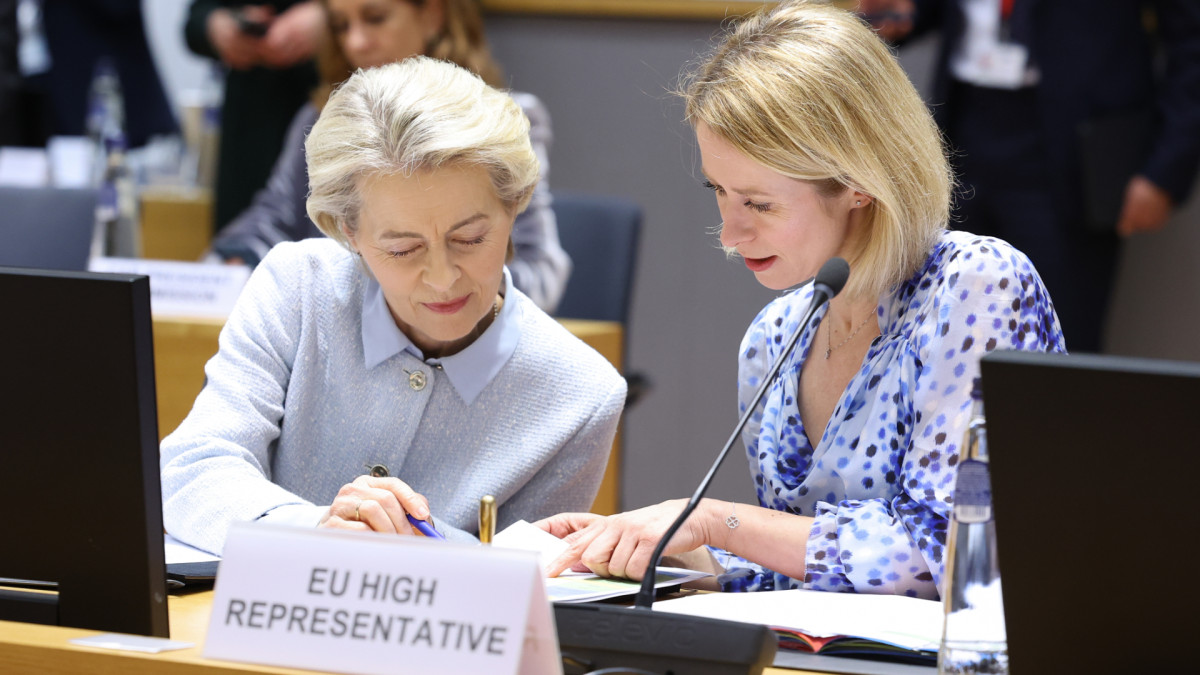
On June 11, a rather peculiar phenomenon occurred: two media outlets published headlines that were completely at odds about the same internal document. In the morning, the Financial Times ran a high-impact report with the title “EU countries weigh [to] dismantle the bloc’s diplomatic service.” “France, Germany and other European countries are debating proposals for a radical reform of the EU’s diplomatic service,” the paper previewed on social media, noting that the service had been created fifteen years earlier and could even have its powers taken away from the bloc’s top diplomat.
That same day, later, Reuters published a piece entitled “France proposes a reform of EU diplomacy with an expanded role for Kallas.” The document, Reuters wrote, captures a widespread perception among EU officials and diplomats: the union was too slow and too uncoordinated in reacting to the war in Gaza and other emergencies, amid the divisions among its institutions, leaders, and the twenty-seven national governments. Reuters highlights that the French proposal would “strengthen the role of the EU’s top diplomat, Kaja Kallas,” in an effort to improve the bloc’s response to crises.
Even more astonishingly: both pieces referred to the same internal document. So what explains the discrepancy? Four words: Ursula von der Leyen.
“The Von der Leyen team filtered the document to the Financial Times in a way that biased it as much as possible against Kallas.”
The President of the European Commission, who has spent a year entangled in a very public power struggle with the EU’s high representative for Foreign Affairs, maintains a direct line to the Financial Times. It is the go-to newspaper when the Commission wants to leak something. My reading—though it is just a hypothesis—is that von der Leyen’s team filtered the document to the Financial Times, steering the coverage toward the option most hostile to Kallas. What the Financial Times highlighted is only one of several options laid out in the document for reforming the European External Action Service (SEAE), which is headed by Kallas. Another option, in fact, envisions strengthening the role of the high representative to bolster Europe’s weak standing on the world stage. Reuters dwelled on this latter possibility; the Financial Times, on the former.
Analysts on social networks who dislike Kallas for what they see as a particular fixation on Russia and for her rather measured remarks on Gaza did not waste time praising the Financial Times report. “The best news of the year,” wrote the French analyst Arnaud Bertrand. “Kaja Kallas’s sole diplomatic achievement may end up being uniting Europe around the need to get rid of her and dismantle her own office.”
But there is something important: this isn’t just about Kaja Kallas. This is about a flawed institutional design whose responsibility lies with the EU’s national governments. Three elements have aligned to reveal the weakness of that design: dangerous geopolitical circumstances in which EU countries are being humiliated; the first high representative with the ambition to use the post as originally conceived; and a Commission president hungry for power who views her with suspicion.
“EU countries are very good at finding scapegoats for their own failures in European foreign policy,”
observed Ricardo Borges de Castro on June 11 in response to the Financial Times piece. “Kallas is certainly not the problem. But the way the Commission and the SEAE have always coexisted—hybrid and fragile—has become a bigger problem under a presidential and centralized von der Leyen.”
“The post arrives with power expectations, but without the authority to exercise it.”
The current position of high representative was created by the Lisbon Treaty in 2009. Its aim was to give the EU a louder voice on the international stage by creating a kind of “EU foreign minister” who could speak for the Union. Yet almost immediately after agreeing to create the post—recognizing its theoretical need—national governments began to undermine it. First, by refusing to call it the EU’s foreign minister and giving it a cumbersome and confusing title instead. Then, by appointing as the first holder a Brussels bureaucrat with little political experience rather than a former foreign minister.
As Julien Hoez explained on June 11 on Substack: “The institutional design is deliberately ambiguous. The architects of Lisbon wanted a stronger voice for EU foreign policy, but they could not agree on who would command it. So they built a service that answers to everyone and to no one in particular. The treaty didn’t just create the post; it placed it at the head of a new institution, the SEAE, occupying a peculiar position, straddling the Commission and the Council. It was the result of a compromise between the drafters of the European Constitution—later transformed into the Lisbon Treaty—who wanted executive-level foreign policy powers, and wary national governments who insisted that the high representative be accountable to the twenty-seven foreign ministers and could only take positions with their clearance. The outcome has been a disaster. The post has become a poisoned gift that none of its four occupants has managed to use successfully.
The blame does not lie mainly with those who have held the post but with the almost impossible task assigned to it. As I put it in the twelfth chapter of my book The Owned Continent: “The post comes with the expectation of power, but without the authority to exercise it.”
“European foreign policy is defined in the EU treaties as a fully national competency. The creation of a high representative for Foreign Affairs has always been at odds with this. The next treaty reform should redefine the EU’s relationship with foreign policy and establish that it is a shared competence between the Member States and Brussels. The most obvious reform would be to remove the unanimity requirement for foreign policy decisions. If Kallas could adopt policies by qualified majority voting—weighted by each country’s population—she would have more room to maneuver.”
The internal French document—unclear whether it also had German backing, as the Financial Times claimed—essentially acknowledges that mistakes were made in creating the SEAE. An internal email sent on June 11 by Kallas to the SEAE’s 5,000 staff also concedes this. “The relationship between the SEAE, the Commission, and the Member States has been debated since the Service’s creation,” she wrote. “Given the unprecedented geopolitical challenges we face, it is natural that these debates should gain renewed attention and intensify.”
“Next treaty reform should redefine the EU’s relationship with foreign policy and establish that it is a shared competence.”
The document, which the government says was not approved by France’s foreign minister, Jean-Noël Barrot—who was due to meet Kallas on June 12 in Paris in a calendar clash—and does not reflect an official French position, appears to outline three options to reform the SEAE: place it entirely under the Commission’s authority, transfer its core functions to the Council, or keep it as a separate institution but grant the high representative more powers. Interestingly, the option that most grates against von der Leyen—giving more authority to the high representative—does not top the Financial Times’ piece.
In his June 11 piece, Julien noted that the trouble for Kallas stems from her bold, firm positions. For example, when she answered the assault on Zelenskiy in the Oval Office by saying that “the free world needs a new leader”—a move that drew rebuke from von der Leyen’s team, a story I recount in my book—and when she spoke hard about China in May. A fresh report also suggests she compared Israel’s treatment of Palestinians to apartheid-era South Africa during a private May meeting in Mexico City, a view held by some EU states but not all. “The current wave of criticism reflects something that was baked in from the start: that Kallas states her own views on EU–China relations is not a character flaw; it’s what happens when the person in the post actually tries to use it,” Julien writes. “The overlap between the SEAE, the Commission’s foreign relations directorates-general, and the national foreign ministries is not a management failure; it’s structural.”
Yet the ideas for dismantling the SEAE laid out in this document—returning essentially its functions to the Council and the Commission and rolling back to the pre-2009 arrangement—do not solve the underlying problem. It isn’t the SEAE or Kallas who should be blamed for Europe’s humiliating response to Trump’s threats and its lack of coordination in facing Russia. The fault lies in the capitals and in a Commission president ready to stand by with cowardly inaction. As Julien concludes:
“Europeans have two options: we can keep patching a system designed for an era very different from our own, redistributing responsibilities among institutions that were never built to manage the geopolitical machinery we should be, and simply hope that the next crisis finds the right coalition willing to act. Or we can admit that true strategic autonomy requires true institutional courage: treaty reform, democratic legitimacy, strong institutions, and a foreign policy entity with the mandate, resources, power, and courage to live up to Europe’s real weight in the world.”
“Not the SEAE’s fault, nor Kallas’s, that the EU has answered Trump’s threats in a humiliating manner and in a disjointed way to Russia.”
Blaming the high representative for the current dysfunction is Brussels’ favorite sport, but it only shames us before our citizens and the rest of the world. Building the institution that would render that blame unnecessary is the hardest job. It is also the only job that matters.
The problem is that the SEAE was constructed only halfway. Each time national capitals in the EU agree to take a step forward in integration to strengthen Europe, they immediately constrain the institutions they have just created. The ideas in this document respond to the same short-sighted, self-defeating impulse that we repeatedly see in the capitals. They do not solve Europe’s geopolitical irrelevance; they merely worsen it. If the SEAE is not functioning, it should be strengthened, not weakened or destroyed.
“Defunding the SEAE now is geopolitical self-sabotage,” warned on June 11 Javi López, Vice-President of the European Parliament and an ally of Spain’s prime minister, Pedro Sánchez. “At a moment when Europe needs a stronger voice in the world, weakening precisely the service that projects our interests and values abroad is a strategic negligence. Less global presence. Fewer diplomatic tools. Less influence. Less Europe. How exactly are we supposed to defend diplomacy if we dismantle our own diplomats?”
This is a translation of Dave Keating’s Substack post from June 11.
