
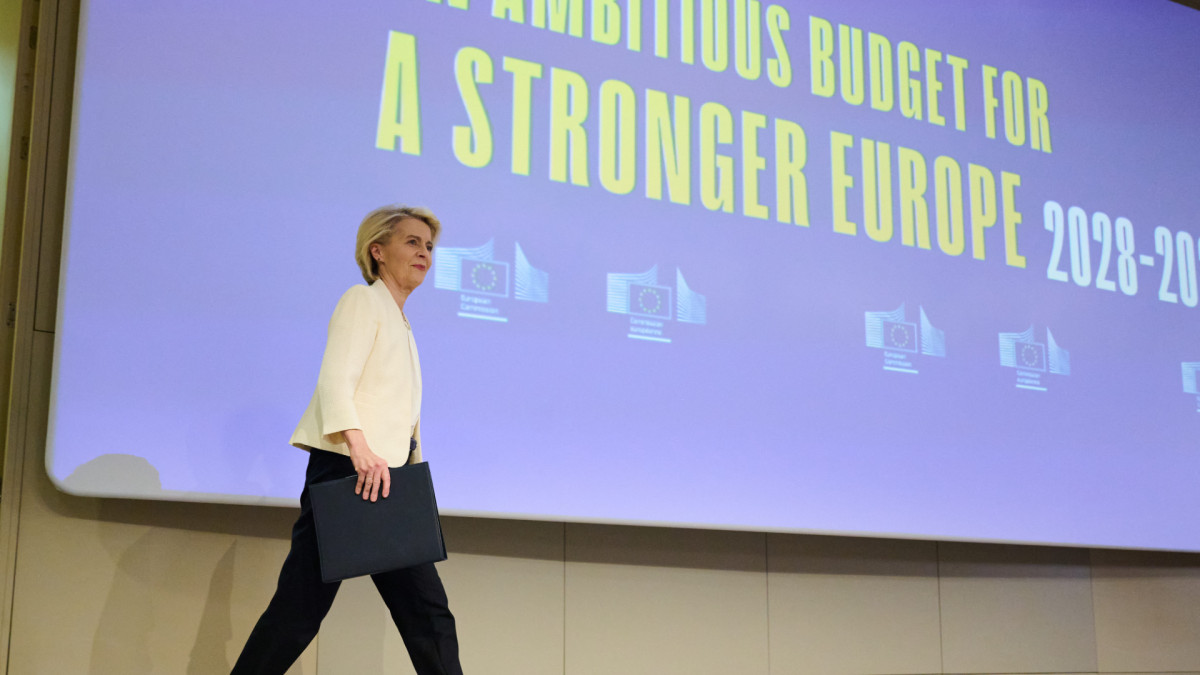
The Multiannual Financial Framework (MFF) is the European Union’s long-term budget. Every seven years it sets how much the EU can spend and on what major priorities: from agriculture and cohesion and up to climate action, research, or industrial policy.
Although it is often perceived as a technical exercise, the MFF is, in fact, one of the Union’s most consequential political decisions because it determines which problems are anticipated and which are managed when they have already become crises. The European Commission’s proposal for the period 2028-2034, close to two trillion euros in nominal terms, arrives in a context marked by the intensification of the climate crisis and by its growing impacts on the health of the European population. More frequent and deadly heat waves, persistently high levels of air pollution, the spread of vector-borne diseases, and mounting pressure on healthcare systems already stretched are part of citizens’ reality.
Although it is often perceived as a technical exercise, the MFF is, in fact, a major political decision because it determines which problems are anticipated and which are managed when they have already become crises. The Commission’s proposal for the period 2028-2034, approaching two trillion euros in nominal terms, arrives in a context marked by the intensification of the climate crisis and by its growing impacts on the health of the European population. Olas de calor more frequent and deadly, persisting levels of air pollution, the spread of vector-borne diseases, and increasing pressure on healthcare systems already strained are part of the citizens’ reality.
“The MFF arrives in a context marked by the intensification of the climate crisis and its growing health impacts.” In this scenario, the MFF cannot be evaluated solely in terms of investment volumes. The central question is whether its design enables anticipating and reducing health risks, or whether, on the contrary, it perpetuates a reactive logic that ends up being more costly, unfair, and inefficient.
Climate and health, an unaddressed link
In recent years it has become established that climate change is one of the main determinants of health. Reducing emissions, improving air quality, or adapting cities and health systems to extreme events are not ancillary environmental policies, but preventive investments with clear returns in terms of well-being, productivity, and reduced healthcare spending.
However, this consensus is not coherently translated into the European budget architecture. Although the current budget and the proposal for the next period include climate spending targets —30% initially, 35% now— health outcomes remain limited and improvable. The vast majority of the European urban population remains exposed to pollution levels higher than those recommended by the World Health Organization (WHO), and deaths associated with extreme heat have risen steadily, disproportionately affecting older people and socially vulnerable groups.
The problem is structural; it is not enough to spend “more” on climate if the current proposal is not designed to translate that investment into real reductions in risks to public health.
An insufficient budgetary ambition
The first limitation of the new budgetary framework is its scale. Independent estimates concur that, to meet climate objectives and protect population health, it would be necessary to allocate around 50% of the European budget to climate action, nature protection, and pollution reduction. Within that effort, at least 10% should be specifically aimed at zero-pollution objectives. The Commission’s proposal, with a 35% target, falls well short of the scale required. Moreover, part of the nominal increase in the proposal includes the repayment of debt from the COVID-19 recovery program (NextGenerationEU funds), which reduces the real margin for public investment.
“The real volume of resources allocated to climate action would be significantly lower than the Commission’s stated figures, landing below 700 billion euros”
All this is affected by a notable exclusion: defense and security spending is excluded from the base used to calculate the climate and environmental expenditure percentage. Given that the new European Fund for Competitiveness foresees up to 130 billion euros in this area and that Member States will be able to finance defense capabilities and security projects through their national and regional plans, the actual volume of resources dedicated to climate action would be significantly lower than the Commission’s stated amount, staying below 700 billion euros.
Budget shortfalls are not an abstract problem. In interconnected risk systems, such as those linking climate and health, the lack of preventive investment amplifies inequalities and generates exponential health and economic costs in the medium and long term.
When spending funds contradicting objectives
Beyond the amount, the MFF design poses a coherence problem. The European budget has allowed investments incompatible with health protection, such as direct or indirect support for fossil fuels or highly polluting infrastructures. At the same time, the climate labeling system used by the Commission has tended to overestimate the positive impact of certain allocations, artificially inflating green spending.
Activities labeled as having a medium or high positive climate impact, such as raw material extraction or the expansion of airport capacity, not only fail to contribute to climate action, but can exacerbate environmental and health risks.
“Without clear, enforceable, and binding conditionalities, there is a risk of continuing to fund activities that worsen health while recovery rhetoric is invoked”
A robust way to avoid coherence problems is to include strong conditionalities that align objectives with spending. The current proposal extends the ‘do no significant harm’ principle, but leaves its application to future technical guidelines. Without clear, enforceable, and binding conditionalities, there is a risk of continuing to fund activities that worsen health while prevention rhetoric is invoked.
Simplification and loss of key instruments
The Commission proposes a deep simplification of the MFF, reducing the number of programs and concentrating funding in larger, more flexible blocks. Although this reform is presented as an efficiency improvement, it also entails significant risks.
The merger or elimination of specific instruments, such as the LIFE programme or the Just Transition Fund, reduces the traceability and visibility of investments directly related to climate, pollution, and health. These instruments have been fundamental to financing improvements in air quality, adaptation to urban heat, or protection against environmental risks. In Spain, thanks to LIFE, actions have been funded aimed at reducing exposure to atmospheric pollutants and mitigating urban heat through nature-based solutions, both with expected positive impacts on public health. Diluting these programmes into broad funds oriented toward competitiveness or industrial security increases the risk that health objectives will be subordinated to other priorities.
“The MFF 2028-2034 will decide whether the EU uses its fiscal capacity to anticipate climate and health risks or whether it continues to manage crises once the damage has already been done”
From an equity perspective, the elimination of specific Just Transition mechanisms is particularly worrying, since, without explicit tools to address the social gradient of climate impacts, the green transition can reproduce health inequalities that already exist.
Every budget is a political statement. The MFF 2028-2034 will decide whether the EU uses its fiscal capacity to anticipate climate and health risks or whether it continues to manage crises after the damage has already occurred. It will decide whether the green transition reduces inequalities or, on the contrary, reproduces an inverse care law, where those most in need of protection receive less.
