
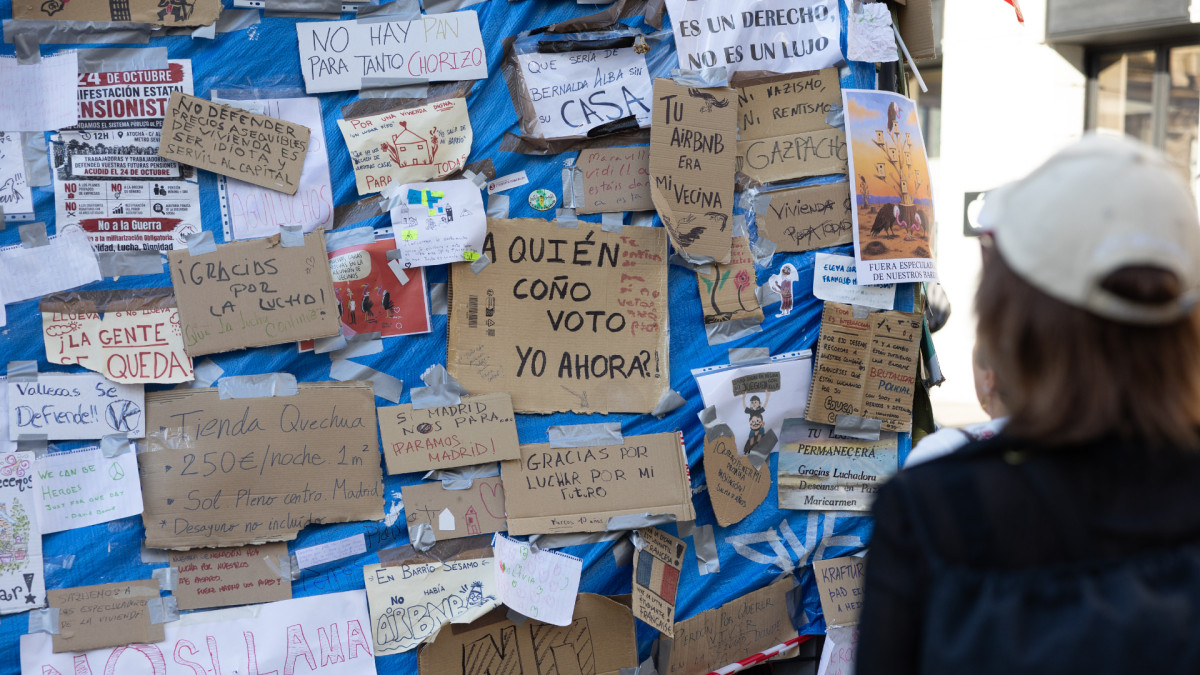
With less than four weeks to go before the 29N campaign begins, housing, which opened the opportunity window that led the president to call an early election, has become the central gathering point for the left. In the CIS microdata there is already a recognizable electorate: 1.2 million young people aged 18 to 34 who are close to the left and who today do not declare a vote for the PSOE, although three out of four name it as their second option or closest party. That group forms a housing-ungoverned vote that has already brought the issue to the fore, and for them it will be decisive to know whether the government’s measures genuinely exist when they go to vote. They decide in the last week and are moved more by a loss than by a promise, so building confidence in measures that directly and effectively address their situation will ultimately drive them to vote or abstain and to choose which option.
The first-time voters
The group emerges from the CIS barometers of July and September, with weights calibrated to the real 2023 vote, because in both waves the memory of having voted Socialist is overrepresented by between 31% and 44%. They are young people who do not declare an intention to vote for the PSOE, but maintain a connection with it, and 77% name it as their second option or closest party. They total 1,229,000, with a range of 1.03 to 1.43 million, representing 3.4% of the 29N resident census.
“That group forms a housing-ungoverned vote that already carries the issue, and for whom it will be decisive to know whether the government’s measures truly exist when they go to vote”
They are defined by their life stage, because 57% are between 18 and 24 years old, 38% are students, compared with 12% of young people who continue to vote for the PSOE; 92% are single and 60% are women. Half reach these elections without having voted in the previous ones, because 41% were not of voting age in 2023 and another 10% stayed home; many are among the 1,615,127 new voters counted by the INE for 29N, and that is why I call them first-time voters. Their average self-rating is 3.2 and 75% give Sánchez a 5 or higher, while 67% say they have little or no confidence in him, which is what is usually called swing or soft vote.
A receptive electorate
Academic scholars Stefano Bartolini and Peter Mair called in 1990 the concept of “electoral availability” the portion of the electorate that is not anchored by an identity or an organization and thus can switch its vote from one election to another. Their study of a century of European elections showed that this availability grows or shrinks depending on the strength of social and organizational ties with the parties. And, in my view, those who have never voted have hardly anything to break.
Data for this group point to that availability: 29% still do not know who they will vote for, and 15% would abstain or vote blank, while 60% say they will vote for whatever suits them best. Forty-one percent decide in the last week, on the day of reflection or on election day, compared with 30% of the youth who still vote PSOE.
“The ‘electoral availability’ is the portion of the electorate that is not anchored by an identity or by an organization and that, therefore, can change its vote from one election to the next”
Housing ranks among the top three personal problems for 63% of this group, more than double the 27% for the overall electorate, but that concern does not translate into support, since loyal Socialist youth cite it more (70%). In a regression controlling for gender, age, education, income, and employment status, the issue shows no noticeable effect, and what distinguishes some from others is whether they are still studying, which reduces the odds of appearing among the loyalists to about one third.
Housing, as written in the decree
The CIS Housing Barometer asks non-owners whether they would prefer to own and, if they do not plan to buy within two years, why not. The lack of money for a down payment is cited by 80.7% of the whole group, rising in the segments that make up the group to 88.5% among 18 to 24-year-olds and 89.7% among students. In the same survey, 77% of those aged 18 to 24 and 52% of those aged 25 to 34 say they would not meet the requirements for a mortgage.
“Housing appears among the three personal problems for 63% of the group, more than double the rate for the overall electorate (27%), but that concern does not equate to support”
The Royal Decree-Law 29/2026, published in the BOE on October 7, bundles measures whose explanatory memorandum targets, among others, “the young people who cannot emancipate themselves.” It extends rent protections for two more years, caps annual rent increases at 2% until the end of 2027 when there is no other agreement, suspends evictions for vulnerable people lacking housing alternatives up to 2030 in certain cases, and opens a public loan to cover the down payment on the first home.
Read as written, the package does not land equally across the group. The rental protections contained in that decree take effect on October 8 and shield those who already have a contract, which, in my reading, are mainly about 579,000 young people in the group who are already employed, 67% of whom cite housing. The down payment loan complements a private mortgage and leaves its requirements to a Council of Ministers agreement that, as of October 18, does not exist, so it demands what the barometer says many do not have. For about 443,000 students aged 18 to 24 (rough figure, based on 65 interviews), the entire package is a promise for the years ahead, and it only matters if it remains in place when they need it.
What could be lost
Daniel Kahneman and Amos Tversky showed in 1979 that people evaluate outcomes as gains or losses relative to a reference point, and that the curve for losses is steeper than the curve for gains. Put plainly, losing something hurts more than winning the same amount pleases you, although, in my reading, the loss weighs more when what is being lost is already in hand. On October 2 the Congress rejected the convalidation of the first two housing decrees, and the main one, 26/2026, fell by 172 votes in favor and 178 against—the votes of PP, Vox, Junts and UPN. The government approved new versions on October 6, and with the Cortes dissolved the decision passed to the Diputación Permanente. Article 78.2 of the Constitution attributes to it “the faculties that correspond to the Chambers, in accordance with articles 86 and 116,” and 86.2 obliges it to pronounce explicitly “on its validation or repeal.” The Diputación Permanente on October 16 convalidated the DANA aid and left out the housing decrees, whose voting the press places on November 12, the eve of the campaign. The second of the new decrees, the one on rental contract stability, would only come into force on November 15 if validated, and according to Maldita, the vote against announced by the PNV leaves it today without a majority.
“Put plainly, losing something hurts more than winning the same amount pleases you, though, in my reading, the loss weighs more when what is lost is already in hand”
My reading is that this vote changes what is at stake, because a parliamentary defeat only becomes an electoral cost for the side that inflicts it when the voter feels that something has been taken away from them. The rental measures of 29/2026 are already in force and would lapse without convalidation, so for the young renter November 12 could bring a loss with a date and with those responsible that does not limit itself to the right. The down payment loan, lacking agreement or a window, can only be lost as an expectation. If the measures reach the campaign as headlines, their opponents will have the charge of electoral opportunism before an audience in which two out of three distrust the president. If they are known, convalidated and functioning before the 13th, these voters will have a sense of possible lost opportunity that pushes them to the polls on the 29th.
What each bloc stands to gain
For the left, the measures working before the campaign begins to sound like success, something that for the loan depends solely on the Council of Ministers, and to push in the urban provinces and in the pressured areas where savings capacity is eroded by the rental crisis. Madrid, Barcelona, Valencia, Seville, Murcia, Alicante and Malaga together account for 49% of the group. Their temptation is to promise more than the decrees actually deliver.
“That vote changes what is at stake, because a parliamentary defeat only becomes an electoral cost for the side that inflicts it when the voter feels that something has been taken away from them”
Oriol Bartomeus wrote on October 6 in this outlet that the PP’s result “is sustained by PSOE’s weakness more than by its own performance.” The right arrives strong, around 51% on average in polls, versus 45.4% in 2023. The center-right bloc has its best chance of shifting the housing debate toward economic growth and national identity, as Ceuta’s crisis recedes from the media spotlight. In the October barometer advance, 68% see their personal economic situation as good or very good, and 58% see Spain’s as bad, the crack through which that discourse can slip in. The most effective counter to this thesis lies with the PP, because committing to maintain the rental measures, or facilitating their convalidation on November 12, would deactivate the loss, though it would force them to explain their vote on October 2 and to contend with Vox. They also have a legal argument, since several constitutional scholars consulted by Maldita doubt the legitimacy of re-approving texts that the Plenum has just repealed, and do not rule out the Constitutional Court annulling the decrees in whole or in part.
The identity frame also has a deadline. The Ceuta-based platform Mujeres Caballas takes a march to Madrid on October 25 that will end near the Congress with a rally calling for a “Safe, Dignified and Calm Ceuta.” Using it as fuel tempts those who want to shift the conversation and those who want to stir fear of the right, and both moves are costly because the price is paid by Ceuta’s coexistence.
“The most effective move against this thesis lies with the PP, because committing to maintain the rental measures, or facilitating their convalidation on November 12, would deactivate the loss”
If that framework shift works and the right wins, a mirrored legislature awaits, with a governing coalition of the right that will compete to keep its electorate within a highly competitive atmosphere, with a strong possibility of serious tensions after the honeymoon. If it does not work, the scenario is a exhausted PP after eight years in opposition that could lose even more ground toward a centrist or a radical-right proposal. For the PSOE, if the orphan vote stays home, it will have to explain why measures designed for that generation did not arrive in time, and if it wins, govern with partners who do not currently back all of them.
The objection
The most serious objection to this thesis I wrote myself in Agenda Pública on October 14. In the postelectoral CIS of 2023, those who decided late moved mostly within their own bloc and there was no late mobilization of abstentionists typical of either side. Bartomeus also warned that Vox will contest the new voters, and I do not assume the orphan vote has a single claimant.
“In the postelectoral CIS of 2023, those who decided late moved mostly within their own bloc and there was no late mobilization of abstentionists typical of either side”
The votes in dispute range from 292,000, if only the undecideds and abstentionists move, to 768,000 with everyone who maintains some link, from 1.2% to 3.1% of the 2023 valid vote, a gap that separates two definitions of the group, with no confidence interval value. The floor rests on 72 interviews, and the microdata ends on September 4, before the decrees and the call.
On November 12 the Diputación Permanente will decide whether the housing decrees arrive alive to the campaign, and seventeen days later it will be known whether anyone has embraced the housing orphan vote or if that million-plus youths spend election day at someone else’s home.
