
It seems that, in recent days, talking about the “Grandchildren Law” compels a discussion about an alleged attempt to manipulate the electoral body to benefit a particular party. But in that line of reasoning there are so many logical leaps that it is worth reconstructing, step by step, the relationship between nationality, identity, political rights, and the will of the people. Only then can we assess the electoral scope of a measure that was not created to regulate the census, but as a measure of transitional justice and historical reparations.
Nationality is the condition that allows full access to the constitutional status of citizenship and, in particular, to the political participation rights set out in Article 23 of the Constitution. The Constitution refers to the law—the Civil Code—to determine how nationality is acquired, preserved, and lost (Art. 11.1 CE), and prohibits depriving Spaniards of origin of it (Art. 11.2 CE). But nationality is also belonging, family memory, and recognition of a bond. Therefore, its loss or its impossibility of transmission carry a special symbolic weight in contexts of persecution or political repression, such as the Franco dictatorship.
“Nationality is also belonging, family memory and recognition of a bond. That is why its loss or the impossibility of transmission carries a special burden”
The Republican exile did not produce an automatic and uniform deprivation of nationality for those who left. The forced exit from Spain and asylum (or other reception regimes) elsewhere combined with rules linking the preservation of nationality to residence, to acquiring another nationality, or to return. The Civil Code reform of 15 July 1954 contemplated loss by voluntary acquisition of another nationality (art. 22) and contained discriminatory rules, such as the provision that Spanish women could lose it upon marrying a foreigner, while transmission to children remained structured around the father’s nationality (art. 23). In many families, that regime broke the continuity of the identity and legal link with Spain.
In that logic one should read the Eighth Additional Provision of Law 20/2022, on Democratic Memory, which recognizes a right of option for acquiring nationality for those born outside Spain who are children or grandchildren of people, originally Spanish, who lost or renounced the nationality as a consequence of exile. It also includes the children of Spanish women who lost it by marrying foreigners before 1978 and the adult children of those who obtained it through this law. In reality, this rule follows the pattern of the Seventh Additional Provision of the Historical Memory Law (Law 52/2007), which already recognized the option to children of origin Spaniards and grandchildren of exile, albeit with far stricter requirements that were relaxed and corrected by the 2022 law. Put differently, the “Law of Grandchildren” has existed since 2007 and it does not seem that its application has led to a change in Spain’s political map in the last twenty years.
From there begins another reasoning, one that connects nationality with the exercise of the right to suffrage, i.e., with the vote.
Being a national does not automatically make every person Spanish (by origin, by choice, by residence, by naturalization, or by possession of status, which are the modalities of acquiring nationality) an effective voter. To vote one must be of legal age, be registered on the census, and actively exercise the right to suffrage.
“The ‘Law of Grandchildren’ has existed since 2007 and it does not seem that its application has produced a change in the Spanish political map in the last twenty years”
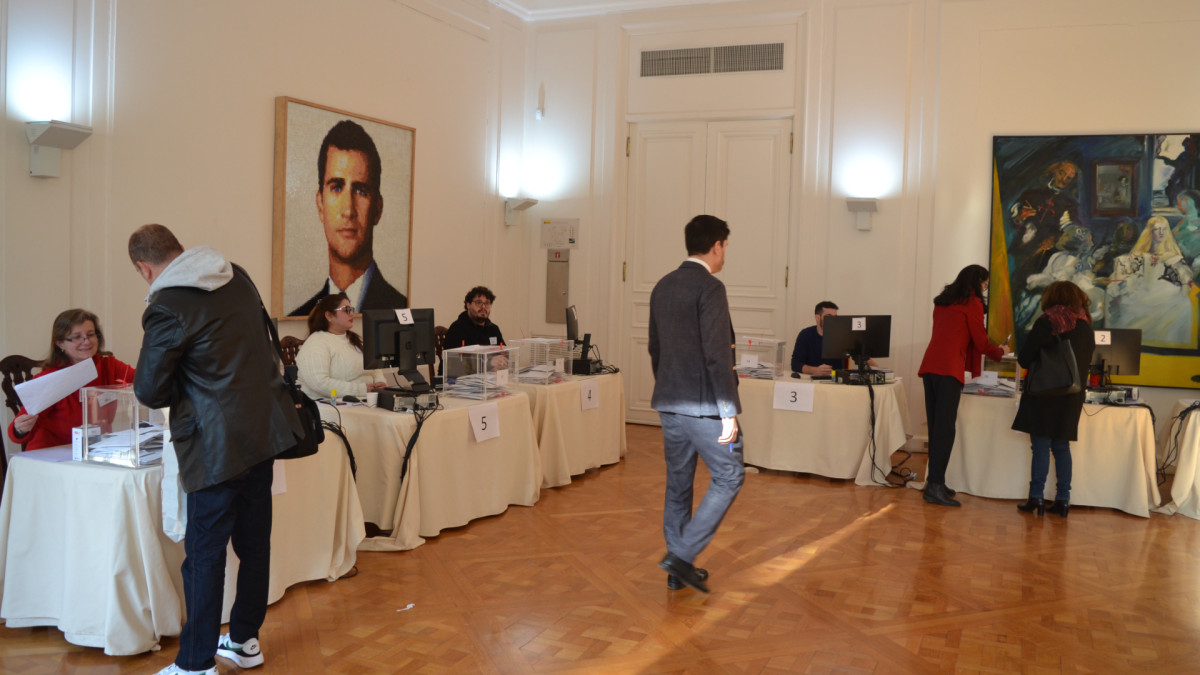
If a person lives in Spain, mere registration on the padrón entails the transmission of data to the CER (Census of Resident Spaniards) and the possibility of voting. However, Spaniards who reside outside the national territory, who cannot vote in municipal elections in any case, must —proactively— register in the Consular Registration, but not everyone does. From there, the consular offices process, ex officio, their incorporation into the Census Electoral Register for Absentees (CERA), which enables them to receive the documentation necessary to exercise the right to vote, in accordance with art. 75 of the Organic Law of the General Electoral Regime (LOREG), amended in 2022 to correct the requirement for the “voto rogado” introduced in 2011, which dramatically hindered the exercise of the right. In other words, every national is a potential voter, but the national living abroad must activate that potential.
Although we have evidence that participation rose in the 2023 general elections thanks to the new voting system, turnout remained limited and, interestingly, the consulate with the highest participation in 2023 was not in a country with many people who acquired nationality by choice, but in the United Kingdom, a country with a strong emigrant profile. Nor did it reveal uniform partisan obedience. Results varied by constituency and overseas voting even managed to shift in the 2023 general elections one seat from PSOE to PP in the Community of Madrid. This proves a basic point: citizens, including those living outside the national territory, vote in a plural and changing manner.
The thesis of the “fabrication of voters” confuses the plane of recognizing the right to access nationality for reasons of historical justice with the right to vote, which the legal order links to citizenship regardless of how it was obtained — there cannot be first-class nationals and second-class nationals — and with the free and unpredictable behavior of each elector. The technical breadth of the Eighth Additional Provision of the Democratic Memory Law, its evidentiary criteria, or the capacity of the consulates to enforce the rule can be debated. What cannot be sustained without evidence is that recognizing rights equals buying votes, nor that those who recover a family nationality become politically obliged to the Government that enacted the rule. Nor can the reasoning be simplified by imagining that the grandchildren of exiles under Franco have “inherited” with Spanish citizenship the political ideas of their grandparents. That would be as if saying that the descendants who stayed here have inherited the political position of those who did not exile themselves.
“Citizens, including those who live outside the national territory, vote in a plural and changing manner”
A democracy does not manipulate the census when it includes those whom the law recognizes as citizens. It would manipulate it if it fraudulently altered registrations, removed controls, or conditioned the suffrage. The main purpose of the “Grandchildren Law” remains to repair the loss of a bond that persecution, exile, and discriminatory norms prevented from preserving or transmitting. Turning that repair into electoral suspicion would mean treating the new nationals not as free citizens, but as captive votes. But it would also entail using nationality to decide who forms part of the “true people” and to divide the citizenry between authentic members and members under suspicion. That populist shift does not protect the electoral body; it fragments it and challenges the principle of equality among all nationals.
