
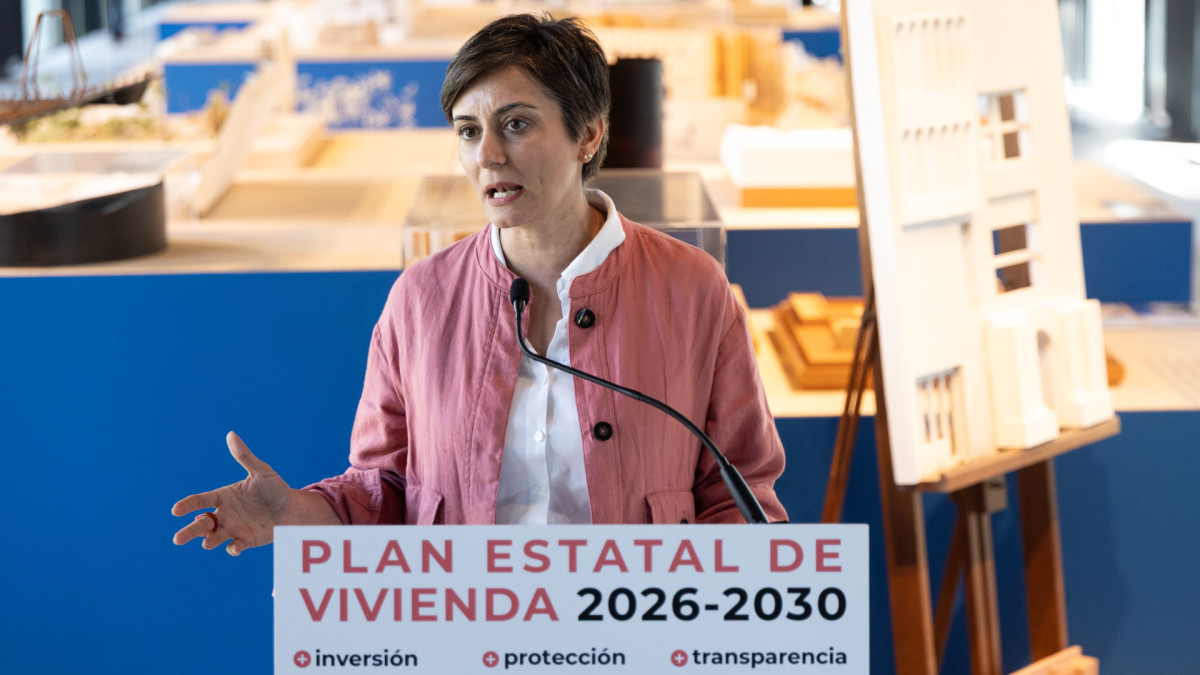
The State Housing Plan 2026-2030, recently approved by the Government with an allocation of €7 billion, structures its strategy around three pillars: increasing construction, boosting rehabilitation, and safeguarding funded housing. It is the most ambitious housing policy instrument of the democracy. However, its strategic lines do not mention an element that empirical evidence on urban well-being regards as decisive: the quality of the shared space surrounding those homes. The urgency to guarantee access to a home has narrowed the debate, leaving out a crucial part of urban life.
The Square Meters of Consensus
The structural housing deficit in Spain is estimated at between 450,000 and 600,000 units, according to the Bank of Spain. Public housing represents barely 1.5% of the housing stock, versus 9% on average in Europe, and more than 40% of the population considers housing to be the country’s main problem, according to the CIS. These figures explain why public policy concentrates its efforts on increasing supply. That consensus, technical and legitimate, becomes insufficient if it excludes the other dimensions of the urban environment.
“The urgency to guarantee access to a home has narrowed the debate, leaving out an essential part of urban life”
The Spanish housing debate concentrates on the relationship between supply and demand, land, regulation and interest rates. All are relevant factors, but they leave out a question of equal importance: once a place to live is secured, what should the city offer to those who inhabit it?
What the Evidence Says About the Built Environment
Urban design has documented psychological and social effects. Access to green spaces, plazas, and low-stimulation environments goes beyond aesthetics: they influence mental health, social cohesion, and perceived safety. Research on the so-called ‘attentional restoration’, initiated by environmental psychologists Rachel and Stephen Kaplan in the 1980s and developed by later studies, has documented that regular exposure to certain environments reduces mental fatigue and improves concentration and emotional self-regulation.
The idea was already present in 19th-century urbanism. Frederick Law Olmsted, creator of New York’s Central Park, conceived parks as spaces of psychological recovery, rather than mere “green infrastructure”. Nearly a century and a half later, environmental psychology subjected that intuition to empirical verification. Why should this knowledge, already consolidated, not appear in any of the programs of the State Housing Plan?
The Shortfall of Shared Space
A city that tackles housing but neglects the shared space surrounding it solves only part of its problems. It leaves out another aspect less visible in the statistics, though equally relevant for social and democratic cohesion.
“That capacity to meet is weakened by the growing mediation of algorithms and screens and by residential bubbles increasingly segregated by income”
European historical squares have played a role beyond transit: they allowed heterogeneous communities to share a single space regardless of class, origin, or ideology. That capacity to meet is weakened by the growing mediation of algorithms and screens and by residential bubbles increasingly segregated by income. The housing debate, focused almost exclusively on dwelling units, does not incorporate that loss either.
The State Plan itself acknowledges, within its urban regeneration lines, the need to “fix streets and public spaces” in the areas of comprehensive action. The recognition marks progress, but treats public space as a complement to residential rehabilitation. It does not incorporate criteria derived from the available evidence about which designs, proportions of vegetation, or degrees of social permeability promote cohesion and well-being, nor does it allow distinguishing spaces that foster that cohesion and well-being from those that are merely decorative.
Three Avenues of Action to Correct the Bias
Incorporating this dimension into housing policy does not require a new legislative reform. It would be enough to apply stricter technical criteria to the programs already included in the State Plan and to the associated European funding.
The integral urban regeneration projects financed by the Plan should be evaluated using minimum standards of public space quality, such as green area per inhabitant, pedestrian accessibility, or diversity of uses. These elements should form part of the project from the outset, rather than being added as aesthetic extras.
“Urban regeneration projects financed by the Plan should be evaluated using minimum standards of public space quality”
Within the 30% of the budget allocated to rehabilitating urban environments, it would be prudent to prioritize interventions that generate low-stimulation and community-use spaces. The decision should be supported by the available evidence on environmental psychology and urban mental health, and not be subordinated exclusively to construction efficiency criteria.
Large developments of protected housing financed with public funds should also undergo an evaluation of the social impact of their urban design, equivalent to the one that already exists for environmental impact. Community cohesion would thus go from being an accidental outcome to becoming an explicit planning objective.
The discussion between supply and regulation remains necessary, but it does not exhaust the problem. At the same time, a less visible difficulty grows: cities capable of housing their inhabitants, but unable to offer them reasons to stay beyond necessity. With a €7 billion investment, that absence could translate into more housing without better neighborhoods.
