
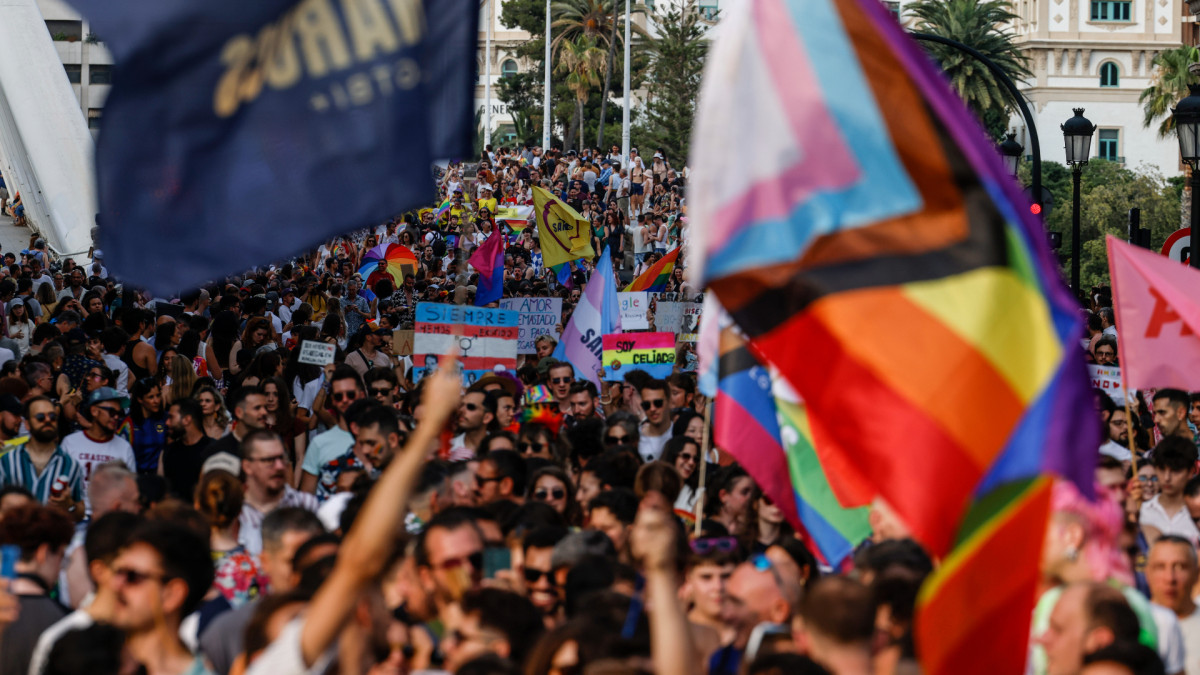
We have celebrated (and championed) LGBTQ+ Pride Day. Recalling the Stonewall Inn riots of 1969, millions of people take to the streets to reveal their way of life and to commemorate the rights won in the past decades. It is an undeniable reality that Spain, and Madrid, with its festivals at the forefront, are at the vanguard of acceptance and recognition of rights. However, we cannot fool ourselves. Although progress has been made in rights, homophobic acts such as assaults and discrimination remain commonplace, even in developed countries like Spain.
Spain has recently been recognized as the most rights-protective country for LGBTQ+ people according to the Rainbow Map, which assesses 76 criteria related to equality, family, non-discrimination, or hate speech. Spain, a country rooted in Catholic cultural heritage but open to inclusion, has always stood at the forefront of LGBTQ+ rights, being one of the first to approve same-sex marriage (2005) or, more recently, the Law for Real and Effective Equality of Trans People (2023). However, the approval of these laws was accompanied by intense debate in which humanitarian, religious, and ideological questions intertwined.
“Although progress has been made in rights, homophobic acts such as assaults and discrimination remain common, even in developed countries like Spain”
To what extent are these issues still determined by ideology? Remember that, on June 26, the deputy from the Partido Popular Jaime de los Santos proclaimed in Congress: “I am from the PP, I am gay, and I am very proud of both things”. This is an unusually explicit and affirming proclamation in the conservative world. Yet a few years ago this acknowledgment was a topic that provoked controversy among the more conservative sectors of society. Have ideological or partisan differences faded? Is there any difference between citizenship and representatives when we speak of rights of the LGBTQ+ community?
A group of scholars have conducted two surveys that allow us to compare the attitudes of parliamentary elites and the general public on a wide range of political issues. Both surveys use virtually the same questions and are calibrated to one another, so the results reflect the opinions of contemporary Spain.
Regarding the assertion “more civil rights laws are necessary to reduce discrimination against LGBTQ+ people,” the global results show a similar pattern between citizens and representatives:
As can be seen, the distributions of opinions among citizens and representatives follow a similar pattern: about 50% in both groups agree with enacting more laws to reduce discrimination against this community; that is, they favor a more inclusive society. By contrast, just under 25% would be opposed. Between a quarter and a third would have no significant position. If we look at the aggregate level, Spain appears to be a country where more people favor expanding the rights of the LGBTQ+ community. How are opinions distributed according to ideology?
In the graph, a ideological fracture around LGBTQ+ rights is reproduced. As we move along the ideological spectrum from right to left, support grows steadily. While on the right only about 30% of the public and a scant 13% of politicians are in agreement, on the left those figures rise to 67% and 86%, respectively. The center acts as a tempering point, with more evenly distributed positions and a relative majority in favor.
What is most striking, however, is the gap that opens between representatives and citizens within the same ideological bloc. On the right, politicians are considerably more reluctant than their voters (56% disagree versus 40% among citizens), while on the left the opposite occurs: parliamentarians show even stronger support than the citizens of their own tendency (86% for parliamentarians versus 67% of the citizens). This suggests that representatives, as in other issues, tend to cluster more often in positions where their electorates are more hesitant. The public opinion, as in our previous article on migration, is far less influenced by ideology than that of its representatives.
“The public opinion is much less influenced by ideology than that of its representatives”
In short, Spain positions itself as a country inclined toward LGBTQ+ rights. However, ideology, especially among parliamentarians, continues to mark a boundary between those willing to expand rights and those who consider them already sufficient. It is a boundary that strengthens, rather than dissolves, with the social acceptance of an unavoidable reality. Could this gap affect the future of the community? It is true that in Spanish politics everything seems hyperbolic, simplistic, and presented with little respect. In contexts of affective polarization like the Spanish one, this strategy can lead to hate speech and stigmatization of historically discriminated and stigmatized groups. Because in a country that has spent decades legislating for equality, the true barometer of inclusion is not only the laws passed but the atmosphere generated by the discussion of those legislative initiatives.
