

On June 7, 2023, there were 46 days left until the general elections, and the latest polls from eight private institutes gave the PP and Vox, on average, 182 deputies. It was a comfortable absolute majority, the kind that can be seen clearly from afar. On July 23, already near, it stood at 170. Today there are again 46 days left to vote, and the average of eleven institutes with fieldwork completed since September 29 assigns them 202.5 seats and 51.1% of the vote.
That majority you may have heard described in more than one debate, and with apologies to the discussants, I believe it has less cushion than the media conveys. To measure it, I have translated the results from 23J to the 52 constituencies using the published polls and the INE census, in calculations I do not present as a forecast because they are not validated against previous elections, and I have looked into the CIS microdata to see who decided late in 2023. If polls err as they did in 2023, the bloc would be at 188-190 seats with the left on a single list and at 193-194 with the left on two. With the left divided, it would only fall below 190 if the error reached between 3.4 and 4 points.
The polls from three years ago
The eight reference polls from June 2023 placed the bloc at 47.9% of the vote and at 182.3 seats. The result was 137 seats for the PP and 33 for Vox, with 45.4% of valid votes, so the average was off by twelve seats and two and a half points. The bulk of the excess was with Vox, which they projected at 42.6 seats, while the PSOE, with 25.3% in those polls, ended up with 31.7%.
“If polls are wrong as in 2023, the bloc would end up with 188-190 seats with the left on a single list”
Gonzalo Adán, director of SocioMétrica, called the comfortable majority of that campaign a mirage and attributed it to the fact that many houses had raised their projections to avoid falling behind the others, which in polling is known as herding, the herd effect, which, without jargon, means being wrong in company. Other explanations exist, such as a real shift in the vote in the final weeks or a bias in the vote recall used to weight polls, and with only one election as precedent, the published data do not allow ruling out any.
The ones now
The 46-day polls read like the 29N briefing, although no forecaster would sign off on a seven-week-ahead forecast. The eleven reference projections range from GESOP’s 193 seats, with the bloc at 47.6%, to Hamalgama’s 212, and their median sits at 203. This time Vox is the one growing, rising from 33 deputies to an average of 66, while the PP stays at 136. More in Common estimated, by late August, that this transfer involved 14% of the PP voters from 23J.
Who decided late
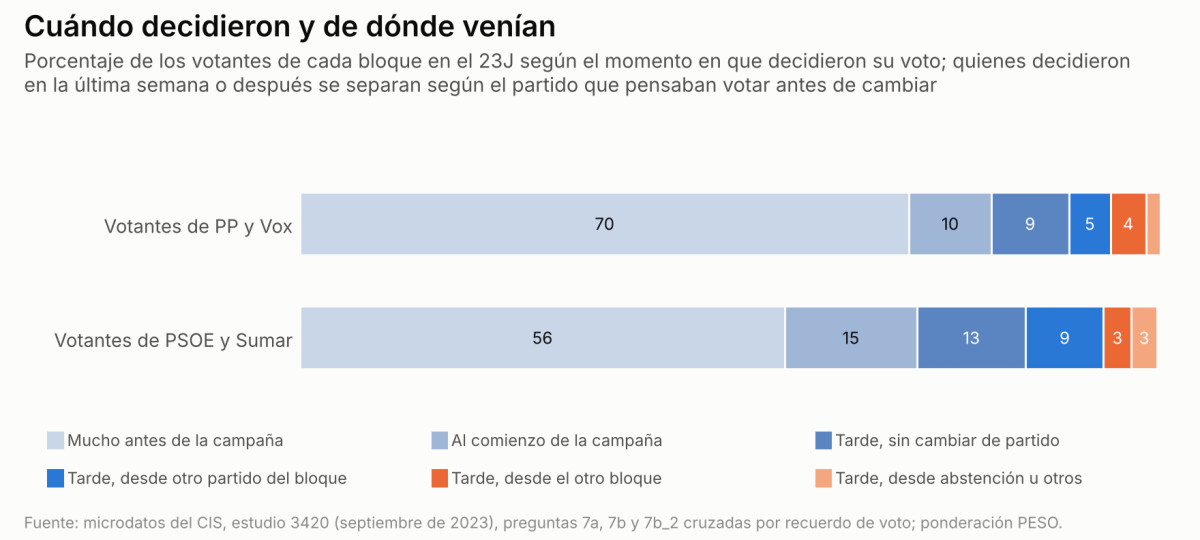
The CIS post-election survey of 2023 asked voters when they decided their ballot, and in its microdata 70% of those who recall voting for the PP or Vox had it decided long before the campaign, compared with 56% of those who voted PSOE or Sumar. If you thought, as I did, that the left arrived late and deflated the right, the survey itself allows partial verification, because it asked those who changed their mind since the start of the campaign, on July 7, which party they intended to vote for earlier.
Of every hundred left-wing voters, twenty-eight decided in the last week or later. Of them, thirteen did so without changing party and nine switching from PSOE to Sumar or vice versa, while three came from PP or Vox and another three from abstention, blank vote, or other options. On the right, 4 in every hundred arrived late from the left.
There is also no late mobilization of abstentionists typical of a bloc. Among those who decided in the last week or later, 15% of the right and 14% of the left had not voted in 2019, and more voters from PP and Vox considered not voting at some point, 29% versus 24%.
“Of every hundred left-wing voters, 28 decided in the last week or later. Of them, 13 did so without changing party”
That the left decided later means, therefore, less than it seems, because it moved mainly within its own siglas. With these data I cannot attribute the right’s decline in 2023, and even less calculate how much it could repeat. The same survey, moreover, falls short on the right, because 13% of respondents who voted do not say whom, and among those who do say, PP and Vox gather 28% and 9%, compared with 33% and 12% of the ballots.
The participation
INE published on October 9 a census of 38,728,356 registered voters, with 1,615,127 young people who will be able to vote in a general election for the first time. In July 2023 turnout was 66.6% of the total census and 70.4% among residents, according to provisional tally, in midsummer and eight weeks after municipal and regional elections.
My impression is that this time, on the total census, we will be closer to 70% than to 66%. In such a polarized environment, the right-wing voter is mobilized and so is its opponent in the communities that decide the distribution, and the call goes out without a nationwide appointment since the European elections of 2024.
“My impression is that this time, on the total census, turnout will be closer to 70% than 66%. In such a polarized environment, the right-wing voter is mobilized and also its opponent.”
With 68% of the total census, close to 73% among residents, there would be about 26.1 million valid votes, and the 51.1% median would require that PP and Vox gather 13.3 million, 2.1 million more than in 2023. If the bloc kept its total number of votes constant, without identifying which electors make up the bloc, it would stand at 43.1% and without an absolute majority, and if it only gained half of those new votes, it would be 47.1%.
Whether higher turnout by itself benefits the Government is another question. The CIS microdata’s lone hint, 585 self-declared abstainers who considered voting, points to a nearly even split, 35% toward PSOE or Sumar and 36% toward PP or Vox. It is a weak hint, because in the poll the declared abstention is 11% when the actual turnout hovered around 30%, and, weak as it is, it is not what I expected.
How many seats does each percentage point yield
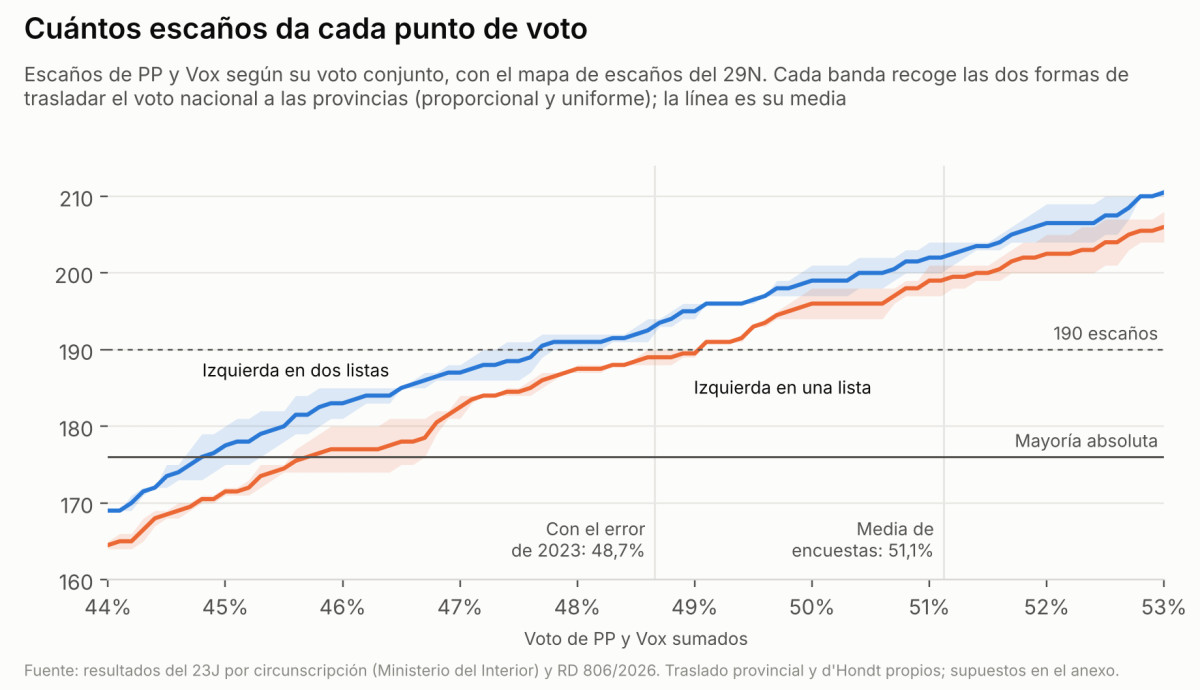
To translate votes into seats, the percentage of each party is applied to the 52 constituencies using the 23J results, with the map of Royal Decree 806/2026 and the d’Hondt method, in two ways: in proportion to the result of each party in each province or by adding the same points across all. With the 2023 votes, the distribution returns exactly the 350 seats of 23J, and with the average polls it yields the bloc between 201 and 204.
| Scenario | Vote for PP and Vox | Left in two lists | Left in one list | What it implies |
|---|---|---|---|---|
| Average of polls | 51.1% | 201-204 | 198-201 | That polls are correct |
| Repeating 2023 error | 48.7% | 193-194 | 188-190 | That repeating an error observed once would be repeated |
| Half of new votes, 68% turnout | 47.1% | 186-189 | 183-184 | That the bloc gains one million votes instead of two |
| Votes from 2023 constant, 68% turnout | 43.1% | 165-167 | 159-160 | That the bloc’s total vote does not grow |
The ranges are the difference between the two transfer models, and in all rows what the bloc loses moves to the left, as happened in 2023 with PSOE; if it were to go to other candidates, the bloc would keep more seats.
The single-list option reduces the bloc by between three and five seats in the first two scenarios, the same order that results from distributing Sumar’s 23J vote in two lists, which would have given PP and Vox 175 deputies instead of 170. With a united left, the bloc would fall below 190 if it does not exceed 48.5% or 49%, depending on the model, which implies an polling error of between 2.1 and 2.6 points, roughly the same as 2023. Divided, the ceiling falls to 47.1% or 47.7%, and the required error rises to between 3.4 and 4 points. The absolute majority would only be lost if the threshold lies between 44.7% and 46.7%.
The rain of draws
Iván Redondo asserted, according to press coverage, that the PSOE “can gain seats that do not appear in the forecasts and trigger a rain of draws.” The 2023 error simulation with a united left, which in the proportional model leaves the bloc at 188, supports him that there are many edge seats, though not in the direction he presumes, because with a transfer of less than half a point of provincial vote, four seats would switch hands from the bloc and three from its rivals. The rain, continuing the report, falls to both sides, and which side it falls more toward depends on a few tenths that no simulation anticipates.
Around 190
My bet is that on November 29 it will resemble more the repeated error than today’s average, i.e., the bloc will hover around 190 seats, and dropping below that would be much easier with a united left. In 2023, the overestimation by the polls seven weeks out was primarily due to Vox, which today is the party growing the most, and the two institutes that came closest then, GESOP and 40dB, now give the bloc 47.6% and 50.8%, below the average. If the left goes in one list or in two, it will be known soon, because Article 44.2 of the electoral law requires coalition agreements to be announced within ten days of the call.
“The 29N will resemble more the repeated error than the current average, i.e., the bloc will hover around 190 seats.”
A divided left arriving at that deadline, tempted by the tally of how many deputies each sigla keeps, could hand to the opposing bloc the seats that a single-list would hold. On the other hand, Abascal has said he has learned not to “count his chickens before they hatch,” and he has reasons, because three years ago, at this point, the polls gave the bloc twelve seats that did not appear in the ballots.
The most serious objection is that the 2023 bias does not have to repeat in the same direction. Antonio Alaminos and Antonio Alaminos-Fernández find in the Revista Española de Investigaciones Sociológicas a significant concealment of votes for PP and Vox in the recall of the CIS barometers after 23J, the same one that surfaces in the post-election. Weighing a memory like this tends to inflate those parties, but if the concealment translates to current voting intention, the error could go downward this time. They would also weaken my reading if new voters lean to the right and polls in the last weeks remain above 51%. Since November 24, it is illegal to publish them.
In all scenarios in the table, except the last, PP and Vox exceed 176 seats, and the PP, which in none of them goes above 136 deputies, needs Vox. Between 183 and 204 seats, the same bloc would govern with very different margins. With 188, a PP government would depend on a partner with between fifty and seventy deputies, with a strong bargaining power, and what that partner demands when the time comes is well known in Ceuta.
In July 2024, Vox broke its five regional governments with the PP over the distribution of unaccompanied migrant minors hosted in the Canary Islands and Ceuta. In August this year, sources from the vice presidency of Castilla y León, in their hands, warned that they would use “all their competences and legal and political resources” against a new distribution from Ceuta of the guardianship of some children the law assigns to the administrations. With 188 seats, that same partner would hold the investiture and every budget.
