
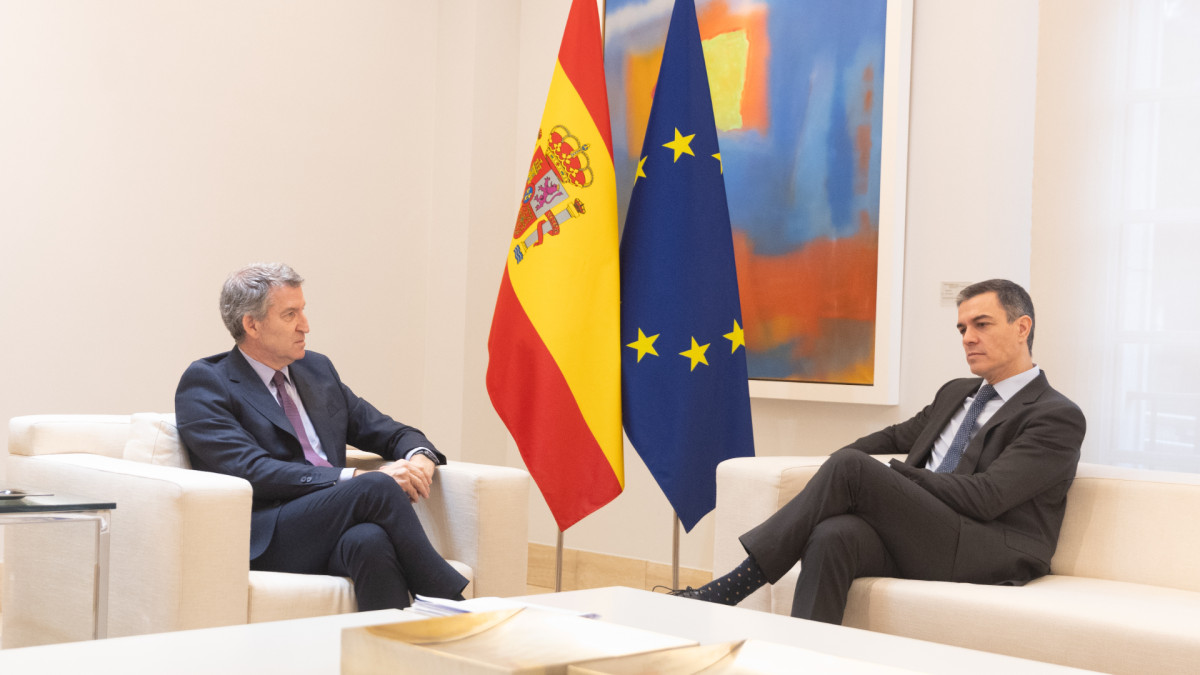
The Prime Minister of the Government, Pedro Sánchez, and the opposition leader, Alberto Núñez Feijóo, will meet on Monday, January 19 to discuss national security and defense. The immediate agenda centers on Ukraine, Greenland, and the increasingly less theoretical scenario of a European deployment once the war ends. Faced with the possibility that the meeting serves only to test strength, it is expected that from the gathering a country position could emerge that might mark a turning point.
“In the face of the possibility that the encounter merely serves to measure forces, there is an expectation that the meeting could yield a national stance.”
Spain aims to influence the international stage through international law, multilateralism, and good governance, but has avoided discussing which instruments it would be prepared to sustain when the order is broken. In a continent that is once again speaking of deterrence, borders, and sovereignty, defense has ceased to be a technical debate and has moved to the heart of the political agenda.
1. Clarify what we mean when we talk about European defense
Before getting into percentages, missions, or announcements, Sánchez and Feijóo should resolve one basic question: What does Spain understand by European defense?
A first option is reinforced cooperation: joint purchases, standardization, supply chains, ammunition, interoperability. A second, more ambitious option, is to build common command-and-control structures, doctrine, planning, and capabilities for rapid deployment. A third, the most demanding option, is to accept that the EU, if it wants to be more than a large market, needs its own military capacity and a political framework to organize it if it intends to be more than a common market. In this line, European Defence Commissioner Andrius Kubilius has spoken, to whom we spoke a few months ago. He does not speak in the same way as Nathalie Loiseau, French MEP from the Renew group, who has argued that Kubilius lacks the mandate to talk about a common European army.
Europe already shared its currency to shield its prosperity. The hinted leap now is to share defense so as not to depend on the wills of others. That discussion, central in other member states, continues to appear in Spain as an imported debate. However, given the pressures on Greenland, it is worth remembering that “defending international law without autonomous capacity to back it up is a principled stand, but strategically fragile.”
2. Ukraine does not fit the Spanish mission’s mental mold
The focus of the meeting should be Ukraine, but with a premise: a potential deployment would not fit the model of the majority of missions of the past decades. As security expert Alberto Bueno explains, “Spain has felt comfortable in peacekeeping or peace-restoration missions, in training and instruction, or in stabilization frameworks with intense interaction with the local population.” Ukraine, by contrast, pushes toward a pure deterrence and active defense mission.
It is estimated that a force of between 10,000 and 30,000 European troops would operate not merely to “verify” a ceasefire, but to guarantee security. It would have to support the Ukrainian armed forces, contribute to rebuilding the defense sector, and, above all, become a security guarantee. This changes everything: it would be an interposition force and, at the same time, a force for one side.
Sánchez and Feijóo must discuss what rules of engagement to accept: what mandate and what rules of engagement would be acceptable; what escalation risks are considered tolerable; what capabilities Spain would contribute and for how long, and what implications this would have for the Armed Forces and the defense industry.
“This is the point that should order the Spanish debate: it is not about ‘solidarity’ in the abstract, but a first-order national security commitment.”
The appropriate comparison is not Afghanistan or Lebanon, but the allied deployment on the eastern flank (as in Latvia): a tripwire force with troops in the front line that are not designed to defeat the opponent, but to ensure that an attack automatically triggers collective defense, via Article 5 of NATO or Article 42.7 of the Treaty on the European Union. In that scenario the entry into conflict does not depend on a political decision made “later,” but on the fact that the troops become a direct target. That is the point that should structure the Spanish debate: it is not about abstract “solidarity,” but a first-order national security commitment.
3. Greenland is not an eccentricity, it is the North Atlantic
The debate should not stop at Ukraine. Greenland functions as a very concrete test: if a European territory can be pressured, conditioned, or reconfigured without a clear European response, no European territory is truly safe.
Its strategic relevance is threefold: military geography (control of the North Atlantic and the GIUK Gap), critical infrastructure (radars, satellites, submarine cables, early warning), and resources tied to the energy transition and the defense industry. The most delicate element, moreover, is not who threatens but where the pressure comes from: when an ally proposes to control a European territory for its own strategic reasons, the fusion of military and political considerations becomes maximum.
For Spain there is a direct link: the security of the North Atlantic conditions trade routes, energy supply, and the geopolitical balance on which the southern European flank depends, including the Strait and the Canary Islands.
“Does it make sense to speak of a reinforced European presence in Greenland? Strategically, it is coherent if defined precisely”
Does it make sense to speak of a reinforced European presence in Greenland? Strategically it is coherent if defined precisely: to support Denmark as a member state, europeanize Arctic security so that it is not a bilateral issue between Washington and Copenhagen, and turn strategic autonomy into a reality.
4. Strategic autonomy without breaking the Atlantic link
In Spain, the debate tends to polarize easily: either total dependence on the United States, or fantasies of immediate independence. The useful conversation lies in reducing critical vulnerabilities (intelligence, logistics, cyber defense) without destroying the Atlantic alliance.
That implies bringing to the table concrete dependencies: intelligence, logistics, ammunition, air defense, satellites, cyber, and command-and-control systems. And setting realistic mid-term goals.
5. Budget, industry, and continuity
Defense is sustained by real capabilities and stable budgets, by industry and contracts, by training and stockpiles, by maintenance and supply chains. And also by political continuity.Both leaders should address a point that in Spain is avoided for calculation: which investment commitments can be guaranteed so that they do not depend on every electoral cycle, and how to translate that into an industrial policy that strengthens European capabilities, not merely scattered purchases. In this area the debate is not only about “how much we spend” but also about “for what capabilities.” There, one can discuss seriously, because it requires prioritization.
6. A minimal pact about how decisions are made
All of the above requires democratic legitimacy. If Spain wants to be the architect of international policy, it must decide, explain, and sustain its positions in a timely manner. The final question that the president, Pedro Sánchez, and the leader of the main party in Spain, Alberto Núñez Feijóo, should ask themselves is what risks Spain is willing to take today to avoid greater vulnerabilities tomorrow. Answering that question is what would turn their meeting into a true state agenda. If they do not answer, others will.
