
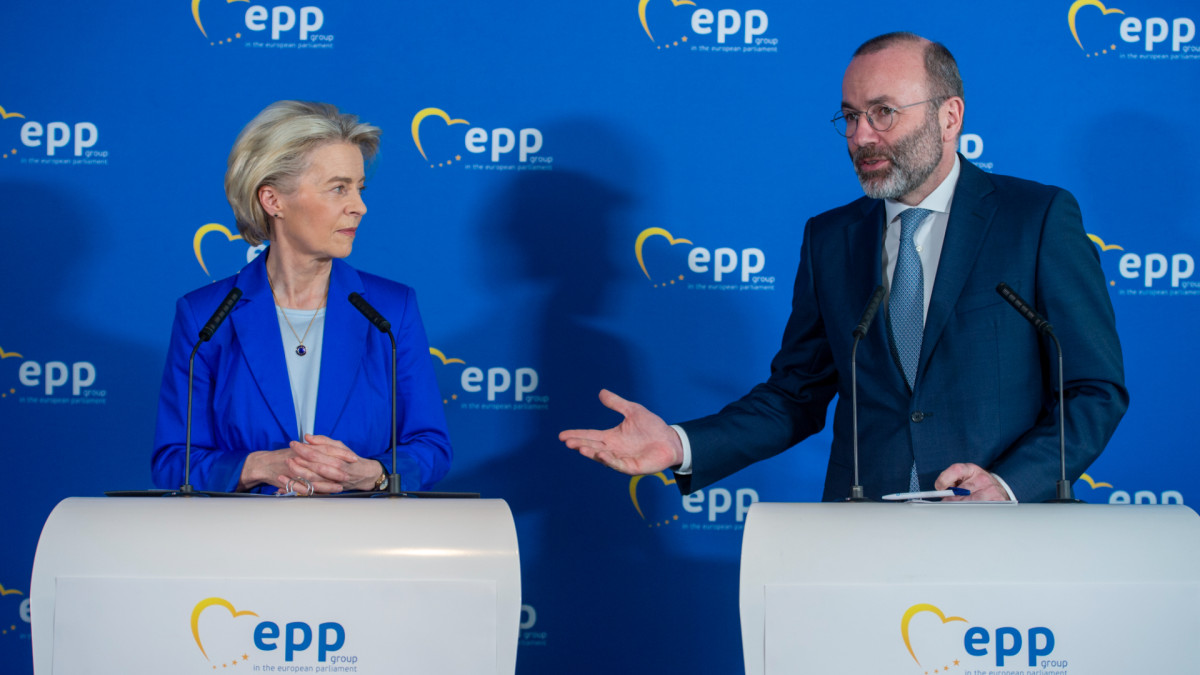
This is the most important week of the year from a European Union perspective. The debate on the State of the Union, better known as SOTEU, starts today in Strasbourg and it is the moment to hold institutions to account in a context that is particularly complex. The president of the European Commission, Ursula von der Leyen, will deliver her address as the legislature is barely mid-term. Formally, it will be a review of what has been achieved and a presentation of the priorities to come. Politically, however, it will be an opportunity to assess how much Europe has changed since the 2024 elections.
Public Agenda, which has been present in the European Parliament these days, has obtained access to some of the perspectives of the European People’s Party (EPP) ahead of this SOTEU. The hierarchy of priorities of Europe’s most important political family appears to have been defined around security and defense, border control, competitiveness, reindustrialization, regulatory simplification and artificial intelligence.
This enumeration, which leaves climate policy and also regulatory ambitions aside —although it remains situational in areas like AI— means that the PPE intends to reinterpret a large portion of the European agenda through two concepts that five years ago carried far less weight in Brussels: security and competitiveness.
“The PPE wants to reinterpret a large part of the European agenda through two concepts that five years ago carried much less weight in Brussels: security and competitiveness”
The SOTEU is read as a kind of European midterms. The EU does not hold midterm legislative elections as the United States does, but here also there are interesting changes mid-session. Internal movements within institutions, reevaluation of initiatives that have worked, those that have failed, or those that are stuck. And, especially, the race to master the agenda for the coming years begins. That agenda will shape the next European elections.
For the Christian Democrats, the first major priority is security. Ukraine remains the starting point, but the European concept of security has broadened to encompass all kinds of hybrid attacks. Physically, drones and sabotage attempts like the one in Leipzig are worrisome. Digitally, disinformation and cyberattacks continue to be a major concern. Moreover, between both realms, the instrumentalization of migratory movements, as seen in the Ceuta crisis, has risen significantly among Europeans’ concerns.
The national and international agendas seem to be merging. What happened this summer in the autonomous city of Ceuta is being interpreted in influential PPE circles not merely as a Spanish migration crisis, but within a much broader European discussion on hybrid threats and the protection of outer borders. From these circles it is stated with clarity that, if a Spanish border is a European border, its destabilization cannot be considered solely a Spanish problem.
“If a Spanish border is a European border, its destabilization cannot be considered solely a Spanish problem”
How far does that interpretation extend? The European agenda of these days will shed some light, as the European Parliament will debate Ceuta’s situation and subsequently vote on a resolution. The discussion will inevitably have a Spanish dimension, but behind it lies a much more European question: can the instrumentalization of migration become a political pressure tool against a member state?
It is not a new question. Europe already faced it at its eastern border when Belarus facilitated the arrival of migrants at Poland, Lithuania and Latvia’s borders. The precedent, widely used as the closest comparison to the Ceuta crisis, gradually changed the community vocabulary: a migratory crisis could also be a destabilization operation.
But what used to come from the east now comes from the south. This leads the Christian Democrats to a second derivative: the implementation of the Migration and Asylum Pact. After years of negotiation, the conservatives are willing to turn compliance into one of the Union’s credibility tests. Passing the legislation is just the first step, because the member states are responsible for proving that they can implement it, manage outer borders, process applications quickly, and carry out returns in line with legal guarantees.
“The conservatives are willing to turn compliance into one of the Union’s credibility tests”
On the domestic front, the PP will try to use Ceuta to challenge Pedro Sánchez’s migration policy and to portray the Government as insufficiently prepared for a crisis that, in their view, should have been anticipated better. This debate, in reality, extends across the Twenty-Seven. All the debate around border protection, returns, cooperation with third countries and the instrumentalization of migration runs through governments across the European political spectrum.
That is why immigration will be one of the arenas where the shift of the European political center will be most clearly seen in the coming years.
Alongside migration policy, the economy will play a key role. If one word dominated the previous European term, it was probably “transition.” If one had to pick a word for the current one, competitiveness would be a very serious candidate.
In the corridors of the European Parliament, the same concerns repeatedly surface: Europe grows slower than the United States, it maintains a significant technological deficit relative to the US and China, it loses companies when they need to scale, it faces high energy prices, and it keeps internal barriers that hinder fully leveraging a 450-million consumer market. What is proposed to change this paradigm? The answer is, essentially, not novel: “reindustrialization.” This concept, which had been largely absent from the European debate, has returned with resolve.
A good way to understand it is to think of the case of internal combustion engines. For the European conservatives, revisiting some of the stricter positions taken during the previous term shows that the climate transition needs a much more explicit industrial policy. In other words, this is no longer about a dichotomy between pursuing a green transition and supporting industry, but about preventing Europe from deepening decarbonization at the expense of shifting its industrial production to third countries.
That line of thinking connects directly with another major obsession driving member states: simplification.
“There is talk of avoiding Europe deepening a decarbonization process at the expense of relocating its industrial production to third countries”
Brussels is testing a turn in its traditional approach to problems: to create new rules. The change proposed does not necessarily imply a sweeping deregulation of Europe, but there is a growing pressure to reduce administrative burdens, simplify corporate obligations and eliminate barriers within the single market.
And, even if it is not usually thought this way, it is a meaningful cultural shift. Just like the expansion of artificial intelligence.
Europe was the first major regulatory power to establish a general framework for AI and, for that, it received numerous criticisms from the United States. The argument was the oft-repeated one: while Americans were innovating and the Chinese were scaling, Europeans were regulating.
“There is a growing awareness that regulating a technology developed by others does not constitute an industrial strategy”
Now, even the ideas emanating from Silicon Valley seem to somewhat vindicate Europeans. Within the PPE there is a clear desire to defend the European rights-protection model, especially when it comes to minors, personal data, manipulation or artificially generated content. But at the same time there is a growing awareness that regulating a technology developed by others does not constitute an industrial strategy.
AI is thus increasingly viewed not only as a risk to be governed, but as a general-purpose technology with economic impacts comparable to electricity, telecommunications, or the Internet. The Parliament and the Commission have shifted their mindset a bit, moving from “how do we regulate artificial intelligence?” to “how can we ensure that part of the future AI is European?”.
An end to the cordon sanitaire as a strategy?
The SOTEU is not detached from the electoral context of the Old Continent. The growth of the radical right is forcing the PPE to discuss what the center-right strategy for Europe should be. The electoral results of recent years show very different situations: from countries where traditional right maintains a dominant position to others where populist or nationalist parties directly challenge the hegemonic space of the conservative camp.
“The growth of the radical right is forcing the PPE to discuss what the European center-right strategy should be”
Within the European People’s Party there is a growing debate about the efficacy of cordons sanitaires. One thread argues that isolating parties with considerable electoral support can end up strengthening them, because it allows them to present themselves as victims of a system that seeks to exclude them. The alternative would be to directly contest those issues, respond to voters’ concerns, and offer own solutions on immigration, security or identity without necessarily adopting the radical-right program.
Spain occupies an interesting place in that debate. The PP retains a considerably stronger electoral position than many of its sister parties, while Vox continues to challenge a portion of the electorate without breaking its own ceiling. For sections of the PPE, the Spanish case demonstrates that it is still possible to build a broad center-right capable of competing simultaneously with the left and with the radical right.
For all these reasons, the president of the Commission must maintain a delicate balance: keep climate goals without sacrificing industry; regulate AI without leaving Europe caught in technological dependency; protect borders while respecting European law; bolster defense capacity without eroding the social model; support Ukraine while keeping the Twenty-Seven united; and respond to the rise of populisms without destroying the centrist political base that made European construction possible.
The conservatives around Manfred Weber have a fairly clear view of where they want to steer that balance. More security. More defense capability. More border control. More industry. More competitiveness. Less bureaucracy. And a Europe capable not only of regulating future technologies but also of producing them.
