
In the third quarter of 2026, the Spanish economy grew by 0.6% compared with the previous quarter and by 2.7% compared with the same period in 2025. Between the summer of 2023 and the summer of 2026, the number of employed people rose by 1.4 million. These figures support a favorable economic balance for Pedro Sánchez’s latest term in office. However, it is worth explaining how these improvements coexist with the uncertain evolution of living standards and the economy’s productivity. Additionally, housing prices warrant some nuance. In the second quarter of 2026, the purchase price of housing was 12.2% higher than a year earlier.
Spain has grown more, also per capita
An ordinary objection to the strong performance of Spain’s GDP is that part of the growth is due to more people being at work. Therefore, we must check how much the average production per person has grown, by dividing real GDP by the population and comparing the result across recent years. Between 2023 and 2025, real GDP per capita rose by 4.2% in Spain, compared with 2.3% for the EU-27. Portugal advanced 2.4%, Italy 1.8% and France 1.7%, while Germany hardly changed.
“Entre 2023 y 2025, el PIB real por habitante aumentó un 4,2% en España, frente al 2,3% de la UE-27”
If we take 2019 as a reference, the reading changes. By 2025, real GDP per capita had risen by 4.9% in Spain and 6.0% in the EU-27. Spain’s 2020 drop was deeper and the recovery to pre-pandemic levels took longer. Since 2023, Spain has closed part of the gap opened by that shock.
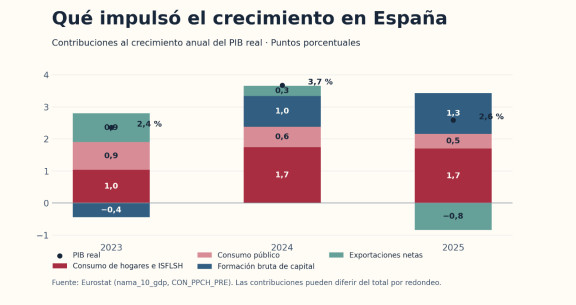
In 2024 and 2025, household consumption was the component that contributed most to the growth of Spain’s real GDP, by 1.7 percentage points in both years. In 2025, the contribution of gross capital formation rose from 1.0 to 1.3 points, while net exports went from adding 0.3 points to subtracting 0.8.
The most recent data point in the same direction. In the third quarter of 2026, domestic demand explained 2.6 points of the 2.7 points of year-on-year growth in real GDP, and the contribution from external demand was practically nil. In the current legislature, therefore, the main component contributing to growth has been private consumption, and the least has been the external sector.
The employment is the clearest improvement
Between the third quarter of 2023 and the same quarter in 2026, Spain moved from 21.45 to 22.85 million people employed. In that period, the unemployment rate fell from 11.89% to 10.18%. Employed per capita rose by 3.5% in Spain, compared with 1.0% in the euro area. There is no doubt that more people are working and that their weight in the overall population has grown.
“El principal componente que ha contribuido al crecimiento ha sido el consumo privado, y el que menos el sector exterior”
Productivity presents a less optimistic reading. In that period, real output per hour worked rose by 1.5% in Spain and by 0.8% in the euro area. It is an improvement, though smaller than the rise in employed per capita. Bringing more people into the workforce raises income and broadens the tax base. As the margin for further expansion of employment narrows, for instance due to a less favorable international cycle, per-capita growth will depend more on how much is produced per hour worked. According to the Bank of Spain, the dynamism of digital activities and professional services has accounted for a significant share of the improvement in total factor productivity observed since 2013. The challenge is to extend those gains to more sectors and firms in a country where tourism is one of the main sources of wealth.
What portion of the improvement can be attributed to the Government? The 2021 labor reform, approved in the previous term, is part of the conditions under which employment was created in this legislature. Its effect on employment stability should be assessed by tracking the actual duration of employment relationships, transitions to unemployment, and hours worked. The overall rise in employment also reflects the economic cycle, sectoral evolution and the growth of the active population. To estimate the reform’s impact one would need to compare how firms or sectors with different exposure to the changes evolved, taking into account their prior trends.
The income improves, but housing and productivity temper the optimism
Between 2023 and 2025, real per-capita disposable income increased by 4.5% in Spain. The advance was higher than in Germany, Italy and France, and lower than in Portugal, where it reached 7.8%. The measure accounts for inflation and includes in-kind services such as health care and education. It helps approximate the evolution of households’ resources overall. To understand how that improvement was distributed, one would also need to look at median income, the different income levels and the situation of those who live in rentals.
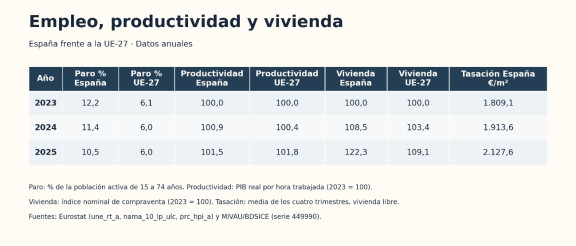
Housing helps explain the difference with citizens’ day-to-day experiences. A household that has already bought and carries a fixed-rate mortgage experiences price increases very differently from a couple trying to save for the down payment on their first home. In turn, the sales index and rental costs reflect different situations. The Bank of Spain identifies supply growth that has lagged behind demand. If new jobs concentrate where housing is scarce, part of the gain from working there may be absorbed by the cost of settling in. Access difficulties also condition labor mobility.
The balance left by the legislature
Debt is one of the uncertainties that add to the next period. According to Eurostat data from October 2026, the deficit fell from 3.3% of GDP in 2023 to 2.4% in 2025 and the debt fell from 105.3% to 100.5%. Nominal growth facilitates the fall in the debt ratio. To assess how much fiscal room has been gained on a durable basis, it also matters how the balance evolves once the effects of the cycle and temporary measures, such as transfers from Europe, are stripped out.
“If new jobs are concentrated where housing is scarcer, part of the gain from working there may be absorbed by the cost of settling in”
The provisional balance of Sánchez’s last term is favorable in per-capita growth, employment and mean real income. The European comparison reinforces that judgment, especially since 2023. Nevertheless, to evaluate the Government’s legacy we will need to see whether the jobs created translate into more stable career trajectories, whether investment raises productivity, and whether those entering the labor market can afford to live close to where they find work. All of this determines whether the macroeconomic balance translates into a lasting improvement in the standard of living.
