
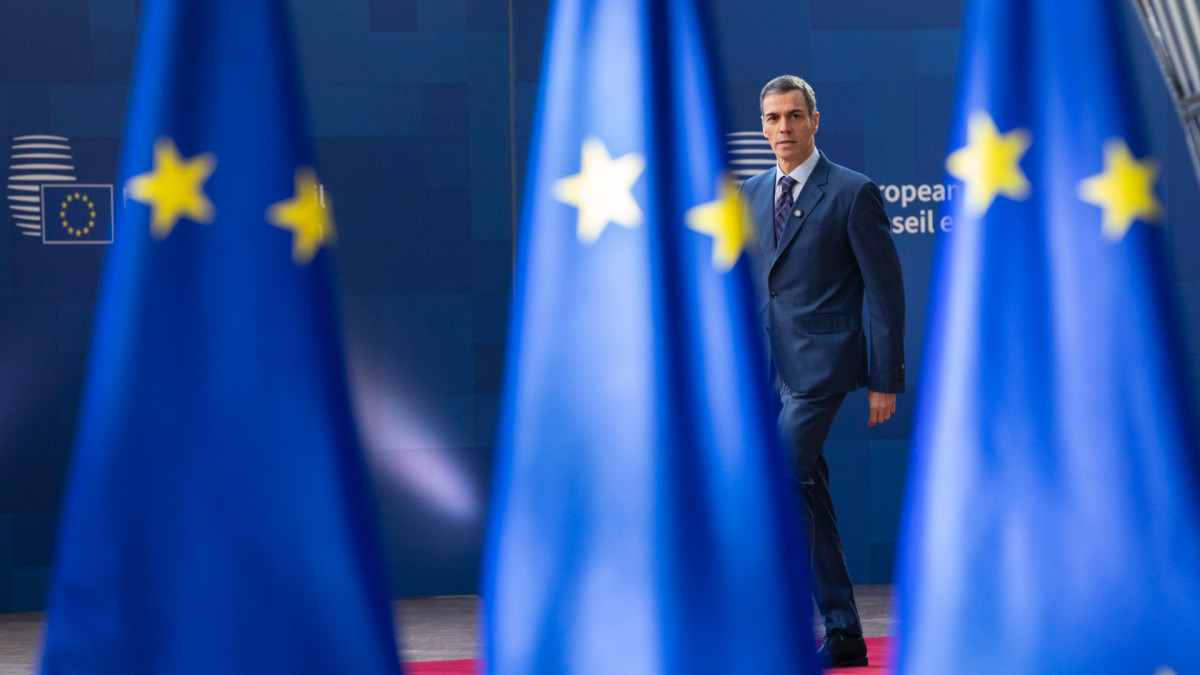
The European People’s Party (EPP), the European political family to which the Spanish People’s Party belongs, has been ruling the European Union for two decades. The EPP has won every European Parliament election since 1999, and all presidents of the European Commission since 2004 have come from this party. Throughout this period, it has also been the party with the largest representation in the European Council. However, even as its footprint in EU institutions has shrunk to a minimum, the Party of European Socialists (PES), a center-left force, has maintained a “grand coalition” with the EPP that has allowed it to share executive power. Now, a defeat for Pedro Sánchez in the Spanish elections could bring this historic arrangement to an end.
“A defeat for Pedro Sánchez in the Spanish elections could bring an end to this historic arrangement”
Even during the brief spells when it governed in the EU’s largest member states, the PES — to which Sánchez’s Socialist Party belongs — never managed to take control. The tenures of François Hollande in France and Olaf Scholz in Germany will scarcely leave a mark on history. At the level of European policy, both carried insignificant influence and drew little attention in Brussels, especially when compared with their predecessors.
The arithmetic of the European Council
Pedro Sánchez has been the sole exception to this trend. As the PES lost strength, his role as a “lone wolf” on the European Council propelled him to be a bold and uncompromising voice for the left in a Union dominated by the right. His stance marked a notable shift from the conciliatory tone of Mariano Rajoy. Yet Rajoy was surrounded by allies, whereas Sánchez has not enjoyed the same protection. Currently, he is one of only three PES leaders among the twenty-seven members of the European Council, compared with twelve from the EPP. If one adds the leaders of other conservative formations, the right holds a majority in the Council. Four other leaders are liberals and four are independents, though the latter tend to lean to the right.
Sánchez has not won all his battles. In fact, he has lost many, not particularly surprising given his minority position. Nor has he traditionally received backing from the other two PES representatives: Denmark’s Mette Frederiksen, positioned on the right flank of social democracy and who has kept her distance from the European party, and the nearly unknown Robert Abela of Malta. In Sweden, Social Democrat Magdalena Andersson is currently seeking to unseat center-right Prime Minister Ulf Kristersson by forming a coalition government, after the left bloc achieved a razor-thin victory in last month’s elections.
“Sánchez has not won all his battles. In fact, he has lost many, not surprising given his minority position”
Although Andersson’s arrival on the Council could compensate for Sánchez’s departure, the PES would be reduced to three leaders from small countries, whose commitment to the European center-left is in question. In practice, this would mean that, for the first time in EU history, the center-left would be excluded from power at the community level.
The parliamentary coalition
The consequences of a Sánchez defeat would not be limited to the European Council. They would also ripple through the directly elected European Parliament.
For decades, in the European Parliament there has existed a “grand coalition” of Germanic inspiration, similar to the one that currently governs Germany: the EPP is the senior partner of the alliance and enjoys the backing of the center-left. More recently, the liberal ALDE/Renew Europe group, to which Emmanuel Macron and Rob Jetten belong, has also joined this historic centrist coalition.
“In practice, this would mean that, for the first time in EU history, the center-left would be excluded from power at the community level”
According to Brussels outlets, within the Socialists and Democrats (S&D), the PES parliamentary group, there has been internal discussion about whether, if Sánchez loses the elections, they should stop pretending they are part of a “governing coalition” with the EPP and instead act as opposition to the European Commission. Why now? There are two reasons. They had long ceased to wield real power within this alliance, and Sánchez’s exit would make it impossible to keep ignoring it. But there is an even more important reason: Sánchez himself has been one of the main obstacles to the Social Democrats taking that step.
The MEPs of S&D are increasingly outraged by the deals that the EPP under von der Leyen has struck with the radical right. The 2024 European elections produced a right-wing parliamentary majority, but the EPP pledged not to rely on it. It could have governed with the European Conservatives and Reformists (ECR), Giorgia Meloni’s radical right, and with groups farther to the right: Patriots for Europe (PfE) of Marine Le Pen, and Europe of Nations and Sovereign States (ENS), of Alice Weidel. However, it vowed not to. Nevertheless, over the past two years, the EPP has increasingly resorted to accords with the radical right to push through certain legislative initiatives, often related to immigration.
According to reports, Iratxe García, leader of S&D, has long sought to break the coalition with the EPP and move the group to the EU opposition. Yet Sánchez has blocked her, as the Spanish president does not want his political family to be responsible for toppling the European administration. The president’s support for the agreements reached at the European Council has also aided S&D MEPs in reluctantly voting in favor of the conservative positions agreed in this body, convinced that the Spanish president helped to temper them.
European coalitions modeled on the national ones
Unlike what happened in the previous Spanish elections, this time the PP openly speaks of forming a coalition with Vox. Such an agreement would reflect what is already happening in several European countries, like Sweden, where a coalition between the center-right and the radical right narrowly lost last month’s elections. Currently, coalitions of traditional right and radical right govern in Italy, Finland, the Czech Republic, and Slovakia, and such arrangements have previously existed in Austria and the Netherlands. In Brussels, the EPP is simply following the path laid out by its national parties.
If the center-left ends up abandoning the coalition that sustains von der Leyen, the Commission President will no longer have a centrists’ majority to push her legislative proposals through the European Parliament. In that case, she could be forced to rely permanently on the far right to push forward her initiatives, especially when she seeks to push through packages of “simplification” of rules and deregulation, aimed at repealing or softening European laws passed during her previous term. This would produce, for the first time in history, a right-wing majority in the EU, though it would remain informal.
“This time the PP openly talks about forming a coalition with Vox. A deal of this kind would reflect what is already happening in various European countries”
But the risks for the President of the European Commission go further. Sources from S&D have told Brussels outlets that the group could even push for a vote of no confidence against von der Leyen. To succeed, the social democrats would need to ally with radical groups on both the left and the right, aiming to overcome the support the president still enjoys among center-right and liberal MEPs. Under EU law, adopting a vote of no confidence would entail the removal of all twenty-seven European Commissioners. A multi-month process would then unfold in which national governments would have to nominate new commissioners, while European leaders would have to agree on a new president, who would need Parliament’s approval.
Ultimately, a Sánchez defeat could unleash a period of political chaos in Brussels like nothing seen since the Santer Commission’s resignation in 1999, and all this at the most geopolitically perilous moment the European Union has ever faced.
