
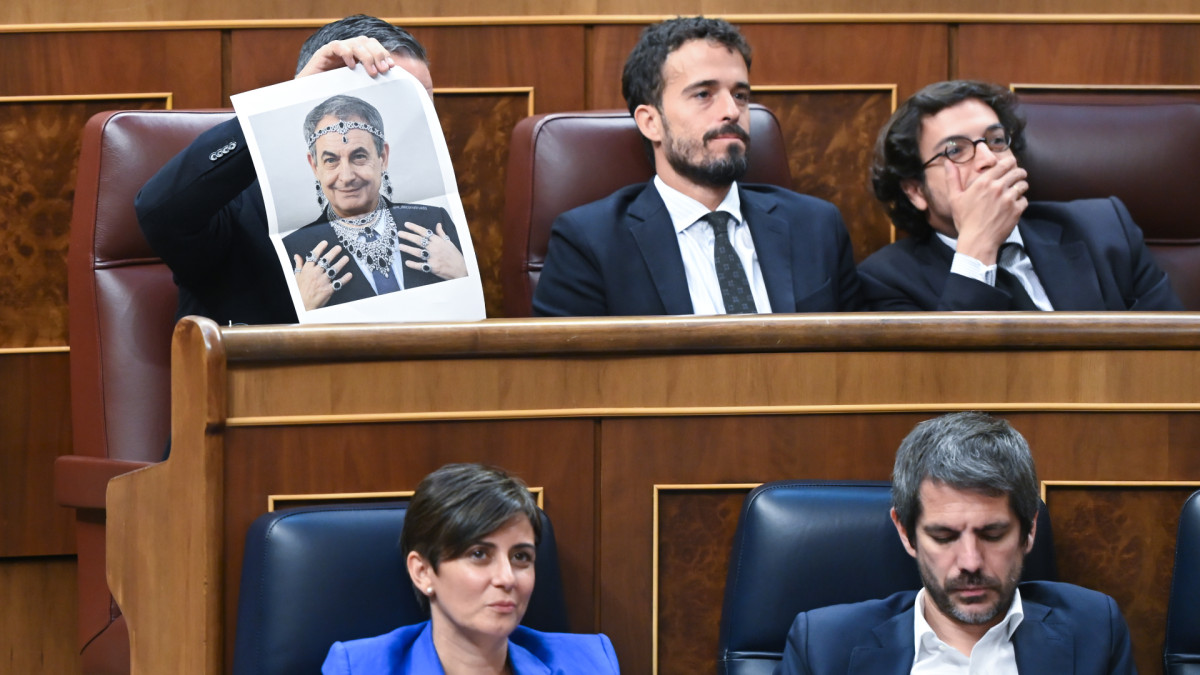
A study published recently in Parliamentary Affairs, a globally prestigious academic journal, has found that parliamentary speeches carry a higher load of hostility in plenary sessions than in the Congress’s committees and that this phenomenon becomes clearer starting in 2017.
This study confirms the idea put forward in The theatricalization of politics in Spain (2024): there is a lot of quarrelling in the chambers (two-thirds of the parliamentarians surveyed in the XIV legislature acknowledged that clashes in the Plenary are, to a large extent, theatre), but the high level of agreement with which laws are passed is often ignored. Indeed, the current Congress session is among the ones with the fewest agreements (and the least productive in terms of laws, not decrees), yet the historical record of agreements and the much-perceived brawling invite us to consider a certain theatricalization without denying one of Torcal’s arguments in Voting with hatred: hostility among political elites abounds.
“The historical record of agreements and the much-perceived brawling invite us to think of a certain theatricalization”
The study by Berta Chulvi and her collaborators confirms this idea by analyzing a random sample of 48,191 parliamentary speeches from PP, PSOE, Podemos and Vox drawn from nearly 220,000 interventions (1996-2023). Using natural language processing tools, they construct two indicators: one of negative sentiment and another of anger, based on vocabulary associated with that emotion.
The design is creative and draws on Erving Goffman’s distinction between front stage and backstage in The Presentation of Self in Everyday Life. The authors compare two spaces of the Congress that differ mainly in visibility: the Plenary, turned into a media stage (including social networks), and the legislative committees, less exposed, although everything is recorded. If there is theatre, the difference in tone between the two spaces should widen.
And what they find is fascinating. Anger is expressed more in the Plenary than in the committees in almost every year, with two peaks: 2002-2009 (especially 2007) and 2017-2023. But the most striking finding lies in the negative critique. Until the mid-2000s, deputies were more negative in committees than in the Plenary; between 2008 and 2015 there are no differences, and from 2017 the pattern flips decisively: the Plenary becomes the preferred stage for negativity, with large effects since 2018. In other words, harshness is no longer reserved for substantive debate but is openly displayed in the Plenary in the form of clashes, dismissive remarks, snappy retorts, and a long etcetera that shapes the repertoire of public behaviors shown to make visible the conflict between rivals.
“From 2017 the pattern reverses strongly: the Plenary becomes the privileged stage of negativity, with large effects since 2018”
The study offers other relevant ideas. For example, in that visibility-driven conflict arena both the opposition and the Government operate effectively. Since 2017, the governing party’s MPs harden their tone in the Plenary relative to the committees. Another example: not everyone acts the same. Since 2017, the PP is the party with the greatest gap between what it says in committee—where its level of anger resembles that of the PSOE—and what it enacts in the Plenary, where noise is higher. The authors attribute this cautiously to Vox’s competition, which records the highest values in both settings. The final example: the turn of 2017 coincides with the arrival and consolidation of new parties, and the authors interpret this in light of Juan J. Linz’s work in The Breakdown of Democracies: when actors who did not participate in founding the democratic regime enter Parliament, antagonism between parties grows and, in the long run, the legitimacy of institutions suffers.
There are limitations to this work. The authors acknowledge that they exclude the speeches of representatives from small parties, including nationalists. I would add a couple of cautions. First, the dictionaries and automatic classifiers measure the “tone” of words, not the speaker’s intention. Irony, so pervasive in the Spanish debate, escapes them easily. Second, committees are not a strictly private space: their lower media exposure is a matter of degree. None of this invalidates the conclusion, but it invites completing it with speeches in regional legislatures and over longer time frames.
This work matters because trust in the key institutions of democracy is at a low, and citizens increasingly mention in polls that politics is one of their main problems. One might think that if this perception rests partly on the brawls that citizens see and hear in the media, the core of democracy is safeguarded because, despite the clashes, institutional cooperation continues.
This optimistic reading of the theatricalization could be mistaken. Forms have their own effects. The experiments of Mutz and Reeves (2005) showed that watching televised debates filled with incivility reduces citizens’ trust in politics and in their representatives. Skytte (2020) found that the distance in programmatic positions between debating politicians did not diminish trust in politics; it was the rude tone that did. And I believe citizens tend not to watch committees as much as the Plenary, the video clips, and the viral “zings,” and I fear they often judge democracy by its stage.
“I think citizens do not usually view committees as much as the Plenary, video clips and the viral ‘zings’, and I fear they tend to judge democracy by its stage”
The most likely consequences, acknowledged even by the politicians themselves, tend to be disaffection, radicalization, distrust, rising violence, and the discrediting of politicians through a lack of credibility. I now paraphrase Joseph LaPalombara’s late-nineties observation about Italian politics: the question facing all actors on the political stage is not whether Spanish politics is a spectacle, but how much spectacle each one is willing to promote and tolerate, knowing that the consequences do not bode a acceptable outcome.
