
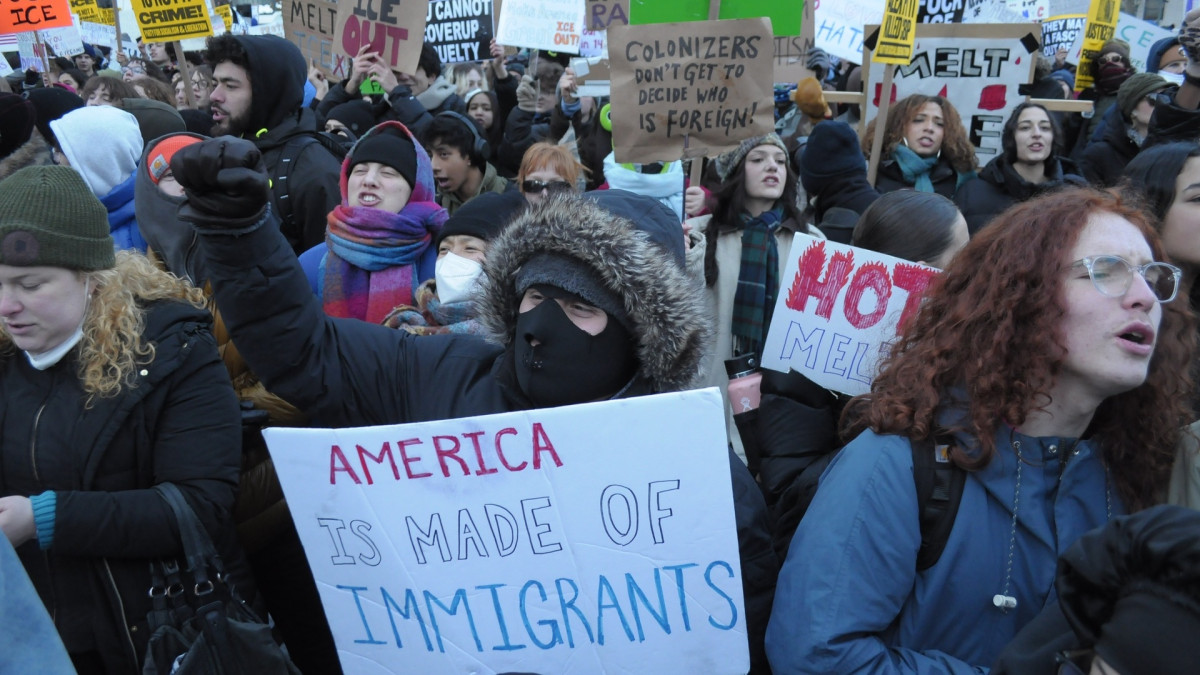
These days two stories share space in the media, directly tied to migratory governance, unfolding on opposite sides of the Atlantic. The democratic crisis in the United States, led by ICE, the country’s immigration police, which is running wild, and the extraordinary regularization just approved in Spain. It is curious that in some circles there is still a failure to recognize that both are absolutely linked and are two faces of the same coin.
Migration is not only an unstoppable natural phenomenon, but the very expression of our development as a species. All contemporary civilizations have their roots in migratory processes. Yet in recent years a hostile narrative toward migration has emerged, portraying some of those who migrate as a threat. The success of this narrative lies in constructing an othering story with a binary “them” versus “us” frame. The reality is far from that.
“Besides jeopardizing their democracy, the United States is seeing how mass deportations create a labor vacuum in sectors like agriculture, construction, and hospitality.”
Looking at what is happening in the United States at the moment, there is little doubt about the undemocratic use of the migration-as-problem narrative. Through that discourse a state police force has been built that is bypassing all of the country’s democratic and legal rules. This can be extrapolated to all Western countries, where many red lines have been crossed in the name of order and migratory security. Rights recognized in the Universal Declaration of Human Rights and international norms and agreements, such as the right to asylum or the Schengen Agreement, have been trampled. A private industry has been favored that, through securitized migratory control, fills its pockets with millions of public funds each year. In fact, this paradigm has been pushed to unimaginable extremes, financing authoritarian governments in third countries in exchange for them carrying out the illegalities, in what is known as the outsourcing of borders.
Meanwhile, trapped in that inhumane and destructive framework, some countries are beginning to suffer deadly consequences. The United States, besides undermining its democracy, is seeing how mass deportations create a labor vacuum in sectors such as agriculture, construction, and hospitality. According to a study by the Dallas Federal Reserve, these restrictions could subtract up to 0.8 percentage points from GDP this year. The same thing is happening to Italy, one of the countries with the lowest growth in the eurozone according to the OECD. This has forced Giorgia Meloni, whose anti-migration narrative was key to her electoral victory, to open regular entry for half a million non-EU workers to alleviate the shortages of labor and productivity.
A radioactive public debate
In the face of this unquestionable reality, another one rises that represents the extraordinary regularization that the Council of Ministers has approved by royal decree. An action that the toxic narrative tries to present in partisan terms. But this process was indispensable in socioeconomic terms. This regularization should have been carried out by the government of Mariano Rajoy. However, he skipped his turn out of fear of the radioactive public debate, and it has fallen to Pedro Sánchez. In reality the PP should be clapping their hands with joy, because if there is a change of government cycle they will be the ones to reap the benefits. Not to mention that, according to Funcas, 91% of people in irregular situations are Latin American, many of them Venezuelan and Colombian, whose voting tendencies are often conservative.
“When a person lives in precariousness, without rights, outside the system, that affects us all. When that person has papers, rights and obligations like any other, the whole collective benefits.”
The positive consequences are quick and tangible. Half a million people who already live and work in our country will begin contributing to Social Security and the IRPF, with a net balance estimated at around 3,300 euros per year per person. The children, over 100,000, will finally be able to travel, join a sports team, live without fear. And businesses gain legal certainty in sectors such as agriculture and hospitality, where without this labor force there simply isn’t anyone to do the work. But the most important consideration is that it is impossible to be well in a country where part of the population is poorly off. Well-being is not individual. When a person lives in precariousness, without rights, outside the system, that affects us all. When that person has papers, rights, and obligations like everyone else, the whole society gains.
So if someone strongly opposes this regularization, one must ask why. Because economic, demographic, and administrative-management arguments leave no doubt. This opposition to regular migration is what Trump is using to build an immigration police that tramples democracy and is wrecking the U.S. economy. Those who do not want migrants to have papers are not thinking about order. There is nothing more disorderly than having more than half a million people living outside the system—unregistered, without obligations, out of control. The true order is that everyone is identified, within, with the same rights and the same responsibilities. And true well-being lies in societies where all people are treated with respect, care, and humanity.
