
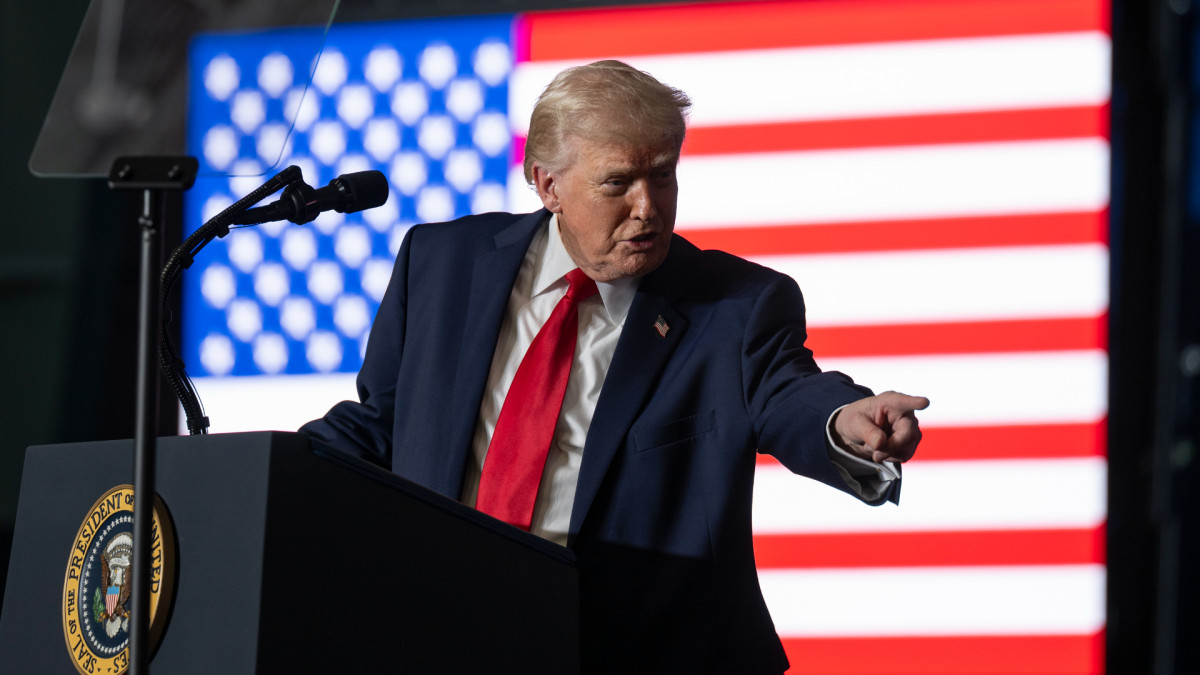
One of the most repeated compliments to Trumpist voices is the attribution to them of a direct language that points, without hesitations, to the supposed truth of things. “Mr. Trump, we have this in common: we tell the truth, we call things by their names,” Belgian Mischaël Modrikamen told him in 2018, the introducer of Steve Bannon among eurosceptic parties.
At this point it is frankly hard to suggest that the American president — whose rambling discourse displays the syntax and vocabulary of an eight-year-old — could be an example of precision in words. But it is worth considering that his success may be a symptom of a broader feature of our public sphere, which is the drift away from that exactitude. In this text we review three other symptoms whose impact conditions our daily interpretation of the reality we inhabit.
The whitewashing of the “polarization” and the fallacy of the battle for the narrative
The first symptom of the general blurring of public discourse comes from the uses and abuses of the term “polarization.” The press’s reliance on this term increases notably since 2016, and in 2023 it surpasses its direct competitor, “crispation.”
As I have noted on other occasions, the idea of polarization is misleading to the extent that it does not describe a symmetric process in which both poles participate equally; on the contrary, it is the conservative and ultra-conservative discourses that, in our country as in others, push the language to its extremes, especially toward negative polarity. The specialized bibliography, both linguistics and the analysis coming from political and sociological studies, has been underscoring for over a decade that reactionary populism relies on exaggeration and on discursive simplification, as well as on arousing base passions. The identification of alleged threats, the pointing out of their supposed culprits, and the designation of a savior leader constitute the triangular narrative that underpins these discourses, which are almost never argumentative (they reject, in fact, data-based discourse) nor dialogical. Labeling as “polarization” the verbal habits of one pole risks diluting its responsibility for the negative, visceral, and irrational atmosphere such habits implant in the public sphere.
The second of the discursive clichés that reveals a blurred perception of how discourse operates concerns the idea of the “battle for the narrative,” which the media describes in relation to leaders or parties. To pretend that things are not what they are is not a battle of narratives but a clash between reality and falsehood; if one discourse names what happens (“climate change is altering temperature patterns,” “immigrant regularization does not imply citizenship”), and another contests it (“polar cold waves disprove global warming,” “regularizing immigrants is to get them to vote for Sánchez”), it seems reasonable to think we are not facing two narratives, since this term introduces fictional and subjective nuances that are not relevant when describing reality. Calling any descriptive proposal a “narrative” implies a contempt for the evidentiary value of discourse that aligns with the fallacy of performativity, according to which language creates realities by the mere choice of words. But that is simply not true. The idea, no doubt, has a strong aesthetic appeal, for it gives us magical powers in every speech act, but it does not explain how language works.
“Language, in the end, does not create realities but interpretations; and if these interpretations align with the truth, they cannot be considered mere «stories»”
In philosophical and metalinguistic reflection, one may ask whether every speech act is merely an act of subjectivity; but the ordinary use of language — that of public discourse — rests on an intersubjective basis without which no communication would be possible. Language, after all, does not create realities but interpretations; and if these interpretations coincide with the truth, they cannot be considered mere “stories,” for doing so would not only equate the public value of true and false discourses but also grant total legitimacy to leadership that relies on fraud and lies. A legitimacy that, with the contribution of generative artificial intelligence, subtly facilitates the shift from post-truth — Steve Tesich’s idea that citizens prefer to be lied to — toward post-reality.
Should the left copy the populist emotional strategy?
Undoubtedly, reducing language to a mere nomenclature or reducing discourse to a self-contained narrative, independent of reality, follows the “linguistic turn” that postmodernity brought to the social sciences. Since the nineties, the so-called “affective turn” has added a third common distortion in public discourse. It concerns the idea that, in the face of the emotional success of reactionary populisms — in sentiment, pathos, and in moralizing ethos —, a similarly affective discourse is demanded for progressive democratic discourse. Of course, this is an explainable stance, aimed at using the same tools that prove effective across much of the public sphere. And certainly it has neglected the horizons of positive affective life offered by social utopias. But this claim forgets several things.
“We must consider that the affects that seize us collectively are, fundamentally, those of the negative pole: fear and, above all, hatred”
The first is that audiences are different, for there is a type of citizenship that cannot be swept along simply by the constant rhythm of shocks and emotions, or at least not in a sustained way. Second, we must consider that the affects that seize us collectively are, fundamentally, those of the negative pole: fear and, above all, hatred; that is, primary emotions without cognitive underpinnings. We give priority to negative messages, or to those that provoke indignation or hatred; we also tend to magnify risks and threats. Therefore, attempting to neutralize the rhetoric of hatred by reviving positive affect could be disproportionately inadequate, especially when we consider that the voices of reactionary and anti-democratic elements in the media ecosystem are more numerous and louder.
Rationality as emotion: an antidote to the reactionary noise
The third thing this proposal forgets is that the affective dimension of texts is more powerful and durable when it stems from rationality: the rational argument — including its undeniable beauty — can also achieve persuasion. Although, of course, this demands greater discursive complexity. It requires careful language, crafted rhetoric, and an understanding of how people process public discourse; being proactive, rather than surrendering the public sphere to the misinformation from reactionary broadcasters and pamphleteers; dedicating effort to building a community with discourse, engaging with citizens and addressing them by adopting their codes and formats, effectively merging information and communication. The rational conviction requires, in short, abandoning resigned preconceptions about the emotional and/or irrational preference of human beings, and prioritizing Aristotelian rationality over Platonic idealism. Perhaps what is truly revolutionary is to begin treating the citizen —from schooling onward, needless to say— as a rational, argumentative subject capable of drawing conclusions beyond slogans and chants.
In short, the “polarization,” the “battle for the narrative,” or the need for more emotion are only three symptoms of a vast distortion that, like a warped lens, filters public discourse, favoring the irrationality of the (techno)populist reactionaries. In response to them, paying attention to how things are named and from where they are spoken can become an act of resistance.
