
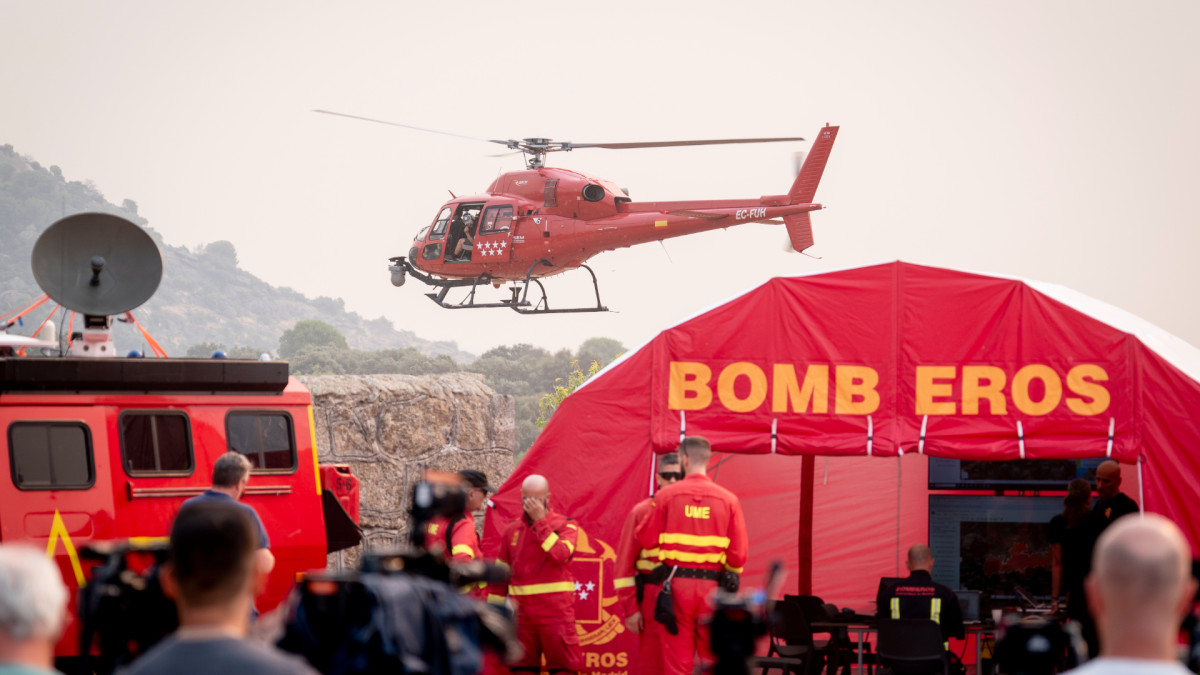
The likeness between fire and fever is highly meaningful for what I am about to share with you. Both situations can be understood as an ailment in itself or as a symptom of some process hidden from plain sight. In the first case, alleviating fever can buy us time for our bodies to react by fighting the circumstance that produced it. But a fever reducer will never cure the infection. Likewise, the fire that is currently consuming Spain can be seen as the enemy to defeat, but one must also acknowledge that it is a powerful indicator of much more troubling processes.
Spain faces two grave problems with its geography: fire (the wildfires) and water (the floods), and both are symptoms of a larger conflict. It is inconceivable that Spain does not have, nor has had, a Ministry of Territorial Planning, not even an agency bearing such a title. Ours is the second-largest country in the European Union after France and the fourth in Europe (if we include Russia and Ukraine). Yet this geographical peculiarity, its extent — which I understand as a resource conducive to its future — has never moved the central Government to promote a territorial planning agenda that would allow structuring, channeling, and organizing the economic, demographic and social processes across that space.
“The fire that these days devours Spain can be understood as the enemy to beat, but one must also concede that it is a powerful indication of much more unsettling processes“
The necessary and convenient historical process of dismantling Francoist centralism led the 1978 Constitution to include in Article 148, section 3, that the ordering of the territory, urban planning and housing would be among the competences that could be assumed by the autonomous communities. And so it was. No one should think I am advocating a recentralization by reclaiming competences, but it is undeniable that the central Government could have assumed, over time, general competences for coordinating Spain’s territorial planning within a global indicative plan (federal, if you like) that, subsequently, each autonomous community would develop in its territory. Interestingly, Article 149 reserved for the central Government —although the text speaks of the State, as if both were equivalent— competences that, without ordering the territory, have, however, a huge structuring capacity of it, such as general-interest ports, railways and land transports that pass through more than one autonomous community, hydraulic uses, the basic environmental protection legislation, or public works of general interest…
With these materials, the territorial planning of Spain disappeared as a technique through a double fragmentation: on one hand, spatially, with the establishment of territorial boundaries — those of the autonomous communities — which allowed arranging areas of competence according to criteria different and even opposed to those of the neighboring community; and on the other, linearly, with large public works of general interest that allowed the central Government to develop transport and communication networks at the margins of the particularities of the ordered territory and even, in some cases, against what the autonomous legislators had envisioned.
“Undoubtedly the central Government could have assumed, over time, general competences for coordinating Spain’s territorial planning within a global indicative plan”
From those precedents, these consequences? I hasten to say that a strictly normative interpretation of the problem of the fires is insufficient to understand their dramatic magnitude: climate change or the new lifestyles must occupy a place of prime importance in this case. And if not, just look at France, whose tradition of territorial planning — practiced with awareness at least until not long ago — has not prevented devastating fires. But it is no less true that, for lacking a meaningful territorial planning policy in Spain, processes of the Spanish human geography that have profoundly altered the territory in these recent decades have run wild and have not been addressed with sufficient promptness. There is no alarm to give when no one watches the dashboard from the institutional vantage. Meanwhile, processes such as rural abandonment, depopulation, unregulated forest growth, diffuse urbanization spreading like the tentacles of an octopus, the extreme commodification of agricultural production with machinery of every kind, the second-home model that overflowed beyond the strict metropolitan sphere, the profit-seeking in housing provision, or the dramatic transformation of our cities into unliveable spaces that push people to escape on weekends roamed freely.
If today’s fires are so hellish, they are indeed due to a climate change never seen before and still denied (by the way, it is curious the great concern of denialist and extremist parties for “the soul of the Spanish nation,” but little for its “body”). Yet there is also likely to be a role played by a disordered, abandoned territory, left to the whim of any process (laissez-faire) that has come upon us.
The fury of the fire and the devastation of the water in Spain should not be understood only as the result of climate causes, but also as a consequence of structural territorial base conditions that magnify environmental change to unprecedented magnitudes. There is a dramatic parallel between the flames of the fires in Madrid, Ávila or Castellón and the thousands of cubic meters of water and mud that ravaged Paiporta, Torrent or Picanya with the DANA. Both show that we have an out-of-control territory. And this fact is a danger to the lives of our fellow citizens, as evidenced by the 231 fatalities of Valencia’s DANA or the 13 from the Los Gallardos fire in Almería.
“Processes of the Spanish human geography that have deeply altered the territory in these last decades are running wild and have not been attended with sufficient promptness”
Spain needs order and concert, it is true. But I fear that what some extreme forces are desiring is not that. First, it needs order (planning). The mainland Spanish territory, of almost 500,000 km², must not be observed fragmentarily, segmented between autonomous communities’ competences and those of the central Government. A general scheme of territorial planning “federal” integrated, in turn, into a higher scale —the European Union, increasingly relevant— is needed, and the same logic that urges having common planning criteria between, say, Madrid and Castilla y León would urge dialogue between Spain and Portugal. And, second, it also requires concert (concertación). The Spanish constitutional structure obliges it, even though we close our eyes to the evidence. Either we modify the Constitution or there must be more and better conversations between the central Government and the autonomous communities so that the territory is not a stage where things happen (now it floods, now it burns), but an actor and producer of well-being and the future for all of society.
