
In March 2027 (or perhaps in March 2028; there is no certainty about the date) the first global mechanism to price carbon ever imposed on an entire industry was to come into force. The International Maritime Organization’s Marine Environment Protection Committee had been negotiating it for years. In October 2025, in London, it was postponed by a vote of 57 to 49, after a motion by Saudi Arabia that many delegates privately attributed to U.S. pressure. Washington had even threatened with sanctions, visa restrictions, and port surcharges against countries backing the rule. A year later, at the reconvened session, the result was the same: to wait and wait.
While the IMO debated the timelines, Chinese, Korean, and Japanese shipyards signed the largest naval-construction contract in recent history: 1,592 containerships, 12.98 million TEU, the equivalent of 38.3% of the world fleet already in service, awaiting delivery slots. Alphaliner has calculated: between 2027 and 2028 roughly a thousand new ships will arrive, 8.5 million TEU, four times the volume the market has absorbed in comparable periods of its history. In the worst-case scenario (moderate demand growth, insufficient scrapping, full return of traffic to the Suez route), excess capacity could approach 25%, a figure that had only been seen during the freight-rate crisis of 2014 to 2017.
Here it is worth pausing for a moment, because the usual logic says that an excess of supply lowers transport costs. However, this time it might not be so; the Ormuz Strait crisis has structurally increased the cost of fuel, insurance, and the risk of each voyage, raising a floor of costs that no overcapacity can fully absorb. This is the central contradiction of contemporary shipping: never has there been so much shipping capacity, and yet moving it has never been so expensive.
“The Ormuz Strait crisis has structurally increased fuel, insurance, and the risk of each voyage”
Alphaliner itself, in its assessment of the second-hand containership market, has noted an anomaly. The number of deals fell from 199 to 126 between the first half of 2025 and the same period this year, and the market “retains its strength”. It is not a market shrinking because there are not buyers, but one where sellers have decided not to sell. Shipowners prefer to continue operating profitable vessels rather than part with them, while they wait to see what price they will fetch when the 2027–2028 delivery wave starts to hit the market. MSC has capitalized on that foreign prudence to cement its position as a dominant buyer, with 23 acquisitions in the semester. The other side of the coin is CMA CGM, which has withdrawn almost completely, with only one deal compared to nineteen in the previous year. That contrast, a carrier buying while another watches, is the portrait of an industry that no longer shares a unified outlook on what lies ahead.
The IMO delays its rules and divides the shipbuilding industry
What lies ahead is a blind bet. Elena Seco, chief executive of the Spanish Shipowners Association (ANAVE), argued that it is essential that the Marine Environment Protection Committee “agree global and ambitious rules for maritime transport that end European regional regulations”. The phrase reads more as a complaint about fragmentation than a demand for environmental action. While London delays decision-making, Brussels legislates on its own, and each shipowner is managing a mosaic of national obligations that no international summit has managed to replace with a single framework. Germán de Melo, president of the Spanish College of Merchant Navy Officers, called the October 2025 session a “black day for the IMO”, and openly asked whether the body was already “in the hands of the United States and against the decarbonization of maritime transport”. The fact that two voices from the Spanish shipping sector describe the postponement as an institutional defeat says something about the magnitude of the problem that goes beyond mere bureaucratic international consensus.
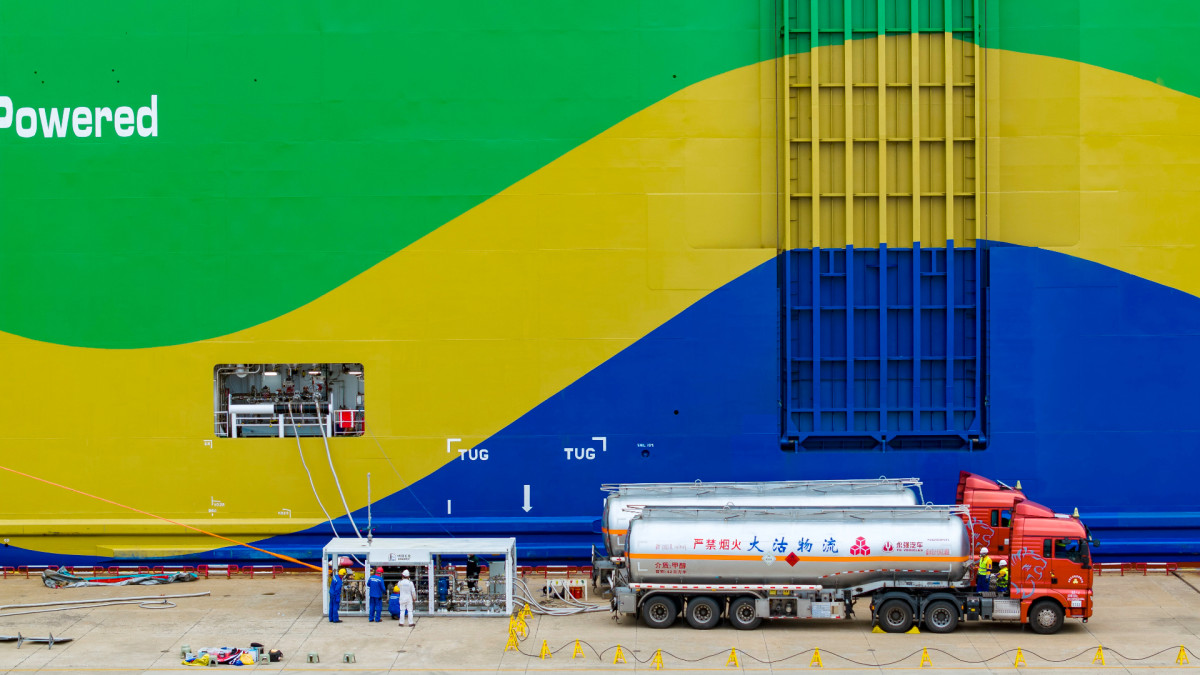
The industrial consequence is already observable. TradeWinds has documented how Chinese shipyards are gaining ground on their South Korean rivals precisely after the failure of the Net-Zero Framework. Korea had pushed more decisively toward cleaner propulsion designs (LNG, methanol, ammonia) that today lack a framework to make them mandatory or profitable compared with the conventional option. Seoul has responded on its own, with a plan to convert 889 ships to ecological models before 2035, without waiting for the IMO to agree. Greek shipowners, a key player in maritime networks, have chosen to back Panama and Liberia’s joint proposal for the upcoming round in an attempt to salvage a consensus that dissolves session after session. And yet, construction does not stop even a single quarter. Yang Ming has ordered six dual-fuel containerships with LNG from Hanwha Ocean; K Line has placed three VLCCs at Nihon Shipyard; Winning and CSSC Qingdao Beihai have signed a construction and repair pact. None of these contracts waits for London to resolve its calendar. They are signed under today’s rules, for ships that will operate for twenty-five years under rules that do not yet exist.
“They are signed with today’s rules, for ships that will operate for twenty-five years under rules that do not yet exist”
It is in that gap between the fleet’s timing and policy timing where uncertainty diverges the strategic decisions of the major shipowners. A containership takes between two and four years to build and then operates for two or three decades. The IMO, meanwhile, measures its timetable in semiannual sessions that it can postpone at no apparent cost. José Rafael Díaz Hernández, an engineer specializing in public management and maritime-port strategy, places the problem in an even more material plane: the energy crisis stemming from the Ormuz blockage, with Brent around $125 a barrel, which triggers shortages of coatings and petroleum-derived lubricants just as Asian shipyards must absorb the largest order book in their history. This situation leaves a moral that, if the shipbuilding industry continues to suffer these choke points, it will be difficult to meet strict emissions controls even if those rules are eventually approved. In other words, even if London were to decide tomorrow what it has been postponing for two years, the industrial system that must execute that decision already carries a bottleneck that no vote resolves.
The system’s operational reliability already reflects this accumulation of frictions: the punctuality of container line itineraries fell in July and again in August to its lowest level across all of 2026. Beyond the looming overcapacity, European ships are still being scrapped mostly in South Asia, despite Europe having spare recycling capacity that is not being used. The industry, in short, knows it has too many ships, knows it has no clear rules for what it is building, and knows that the energy environment makes every decision more expensive. Yet it continues to build, to postpone, and to wait.
“The industry, in sum, knows it has excess ships, knows it has no clear rules for what it is building, and knows that the energy environment makes every decision more expensive”
When those rules are fixed, the line between winners and losers will not pass only through shipyards or flags, but through who controls the supply of fuel that the rule will end up rewarding. If the framework favors methanol or green ammonia, major supply hubs like Rotterdam and Singapore will reinforce their position, while other ports could gain prominence if they manage to develop a competitive supply of alternative fuels. In Spain, the Huelva and Algeciras projects could contribute to that shift, although their actual supply capacity still needs to be demonstrated.
The Net-Zero Framework’s own surplus mechanism, designed to reward those who reduce emissions before it is mandatory, also introduces a winner category that has nothing to do with moving goods: the shipowner who accumulates surplus credits can sell them to those who fall short, turning regulatory compliance into a parallel financial business to the transport itself. Insurers and classification societies, which until now priced a vessel’s risk by age and route, will have to learn to price it also by regulatory exposure, and that reclassification could prove as decisive as any vote in London. The game, ultimately, is not decided only among those who build the ships, but among those who manage to place themselves at the exact point in the chain where the new rule concentrates value.
