
Transparency advocates contend that this move represents another effort to conceal more of the executive branch’s activities from both the public and congressional probes.
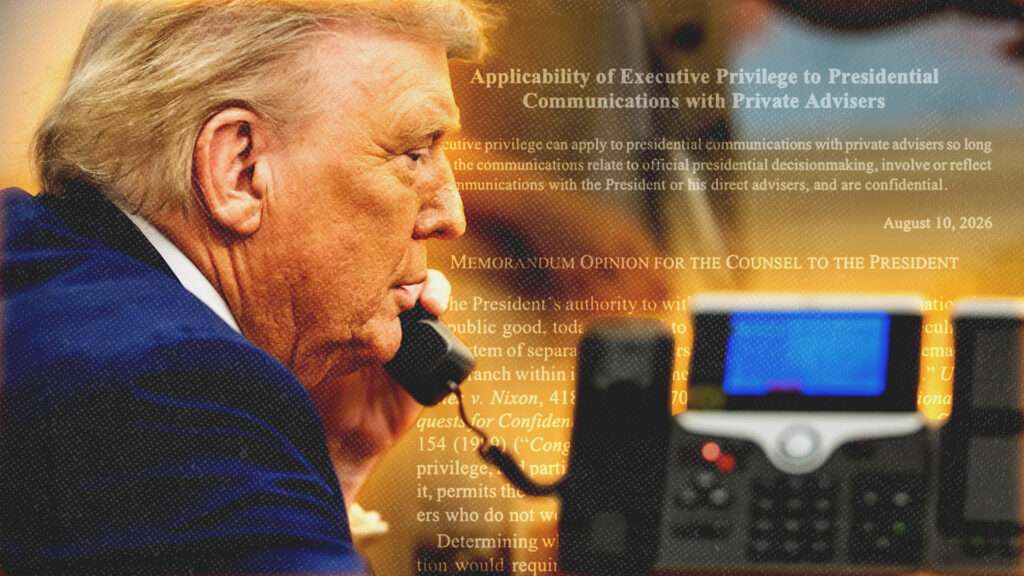
The Justice Department’s Office of Legal Counsel released a memo on Monday that broadens the president’s executive privilege to apply to White House discussions with private advisors.
The memo asserts that the White House may withhold conversations with private consultants as long as those discussions pertain to official presidential decision-making and involve or reflect dialogue with the President or his direct aides.
Officials say the new policy could impede Democrats in Congress from probing White House actions if they regain a majority in the House during the 2026 midterm elections, an outcome forecasts suggest may be likely.
The document has also drawn concern from government watchdogs and organizations that promote transparency.
“This is the latest bid by this administration to curb transparency,” said Scott Amey, general counsel for the Project on Government Oversight (POGO). “The executive branch has reduced resources that ensure public access to government information and has removed information from public websites. It has argued that the Presidential Records Act is unconstitutional. And now it claims that presidential communications with private individuals can be shielded as privileged. It’s hard not to read this as anything other than an attempt to shield past decisions and actions from congressional oversight of the last two years.”
Supporters at the Office of Legal Counsel counter that disclosing private advisers’ communications would hamper the president’s ability to seek broad input.
“Restricting executive privilege to strictly intra-government communications would deprive the President of an array of important sources that may be necessary for the effective execution of his duties,” the OLC opinion stated. “Such a result would not only hinder the President’s Article II responsibilities, but ultimately would harm the public.”
The OLC, part of the executive branch, often concludes that the law supports a more expansive presidential authority.
Executive privilege is the legal doctrine that certain exchanges between the president and certain senior aides should remain confidential and insulated from public disclosure via subpoenas of records or personnel. The privilege has been invoked by presidents since George Washington, but its reach and limits have never been decisively settled by the Supreme Court.
For instance, in 1977 the Supreme Court indicated that former presidents retain some right to invoke executive privilege. Yet attempts by Richard Nixon and Bill Clinton to invoke executive privilege in the Watergate and Monica Lewinsky episodes were rejected by federal courts, which have held that executive privilege is not a blanket shield against investigations into the Oval Office.
The Obama White House also failed in its bid to use executive privilege to withhold records connected to the Fast and Furious controversy from Republican-led congressional committees.
Historically, executive privilege has not extended to private parties, a principle noted by both the D.C. Circuit Court of Appeals and the U.S. Supreme Court in rulings in 2021 that denied President Donald Trump’s request to block the release of presidential documents to Congress relating to the January 6 riot.
As George Mason University law professor Ilya Somin wrote on The Volokh Conspiracy in 2022, “Executive privilege would not grant Trump the power to bar the testimony of private citizens.”
“Executive privilege cannot stretch to control individuals who are not part of the executive branch,” Somin explained. “If President Biden calls me to discuss an issue (which he should do more often!), he cannot then use executive privilege to prevent me from informing Congress about it.”
All things considered, the notion of an expansive presidency that Trump exemplified, and that past administrations helped to cultivate, demands greater public scrutiny and oversight, not more secrecy and privilege.
