
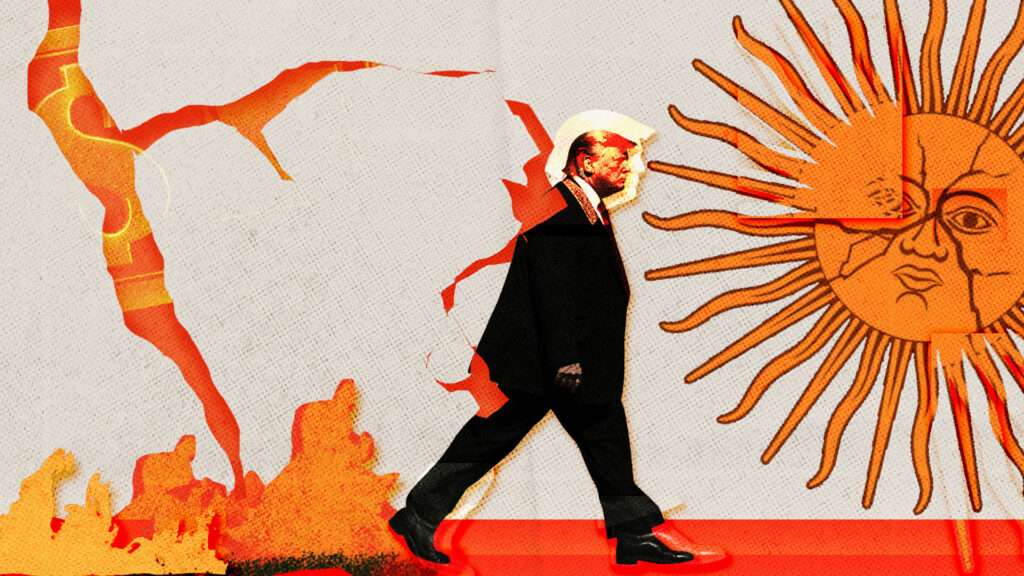
The Trump administration is prepared to use taxpayer money for political campaigning and to gamble with the nation’s fiscal health, mirroring tactics once seen from left-wing forces in Argentina opposed to Milei.
On September 9, President Donald Trump revealed a plan to hand every adult in the country a $5,000 payment if Republicans seize both the House and the Senate in the forthcoming midterm elections. He framed it as a direct payoff, saying, “If the Republicans win, you win with us and you get $5,000,” and he dubbed the initiative the so-called Trump Dividend.
The proposal drew widespread condemnation, with many labeling it as income redistribution and even socialism. Yet Americans weren’t the sole audience for the backlash. In Argentina, observers noted a strikingly similar maneuver in 2023 when Sergio Massa, then the economy minister and a Peronist candidate for the presidency, unveiled a program aimed at purchasing votes before the election. Trump’s tactic echoes the approach that played a part in pushing Argentina toward a severe economic crisis, thereby risking the United States’ economic trajectory.
As I have argued before, numerous Trump policies resemble those of the Kirchnerist regime that governed Argentina for nearly twenty years. The Kirchnerist era concluded in 2023 under President Alberto Fernández and Vice President Cristina Fernández de Kirchner, a period marked by inflation soaring to about 211 percent annually, largely the consequence of the administration’s unsustainable fiscal practices.
A portion of that fiscal recklessness can be traced to Massa. Among other inflationary steps, Massa introduced a pre-election handout package sometimes called Plan Platita (Little Money Plan). It essentially involved monetary transfers to voters: one-off payments to most workers, bonuses for retirees and the unemployed, targeted tax relief and exemptions for some, expanded food-card benefits, and price caps on thousands of products, among other measures.
Some estimates put the program at more than one percent of Argentina’s GDP. With the nation cut off from credit markets, the government financed the plan by printing pesos—injecting new money into the economy, devaluing the peso, and pushing up prices. Economists at the time argued that the plan signaled desperation and a short-sighted effort to sustain real buying power amid rampant inflation. They predicted the move would worsen economic problems, and history bore out their warning.
Massa’s plan was widely viewed as an attempt to buy votes and keep Kirchnerism in power. Critics likewise labeled Trump’s plan a bribe intended to secure Republican support in Congress. Massa’s approach differed in that it did not hinge on winning the election; Trump’s plan is more audacious. Massa’s package was broader as well, comprising a range of costly measures rather than a single one-time check.
But just like Massa’s plan, Trump’s proposal is seen as imprudent and detached from economic reality, a judgment even some conservatives have voiced. The dividends would amount to roughly $1.2 trillion, according to a report from the Committee for a Responsible Federal Budget. The projection suggests deficits rising from an expected 5.8 percent of GDP this year to about 9.4 percent in 2027.
Massa ultimately financed his plan through monetary emission. But where would Trump fund his proposal? Vice President J.D. Vance asserted that tariff revenue would cover the costs, claiming that the penalties from tariffs have generated substantial revenue. Yet such explanations remain dubious.
Revenue from tariffs—effectively taxes on Americans—will not come close to covering this proposed expenditure, argues Eric Boehm of Reason magazine. Tariff receipts have been negative in recent months as the Trump administration issues refunds for tariffs deemed illegal from the previous year.
Vance also seems to acknowledge the wealth-distribution aspect of the plan, saying the administration aims to ensure that wealth returns to the American people, a line that echoes Kirchnerist rhetoric.
Massa’s expensive vote-buying scheme failed; it contributed to his loss in the presidential runoff to Javier Milei, a fiscally conservative, pro–free market, self-described libertarian candidate. Argentines did not escape calamity—inflation remained astronomically high at the end of 2023—but they voted the Kirchnerists out of office and narrowly avoided total collapse.
The U.S. economy is not as dire as Argentina’s was in 2023, but proposals like Trump’s push the country closer to trouble. The question now is what alternative exists to fiscal recklessness when the so‑called “small-government” faction accelerates that recklessness, and the Democratic Party appears equally imprudent and shortsighted.
There is little meaningful difference between the left and the right on fiscal discipline. Even if Trump’s plan never comes to pass, it demonstrates that his administration is willing to appropriate public funds for campaign purposes and gamble the nation’s fiscal trajectory, just as Argentina’s left did. Americans would be wise to heed the warning before their country treads further down an Argentina-like path of failed economic policies.
This column was first published in The Orange County Register.
