
“I am the code,” he reportedly told the architect, according to The Washington Post.
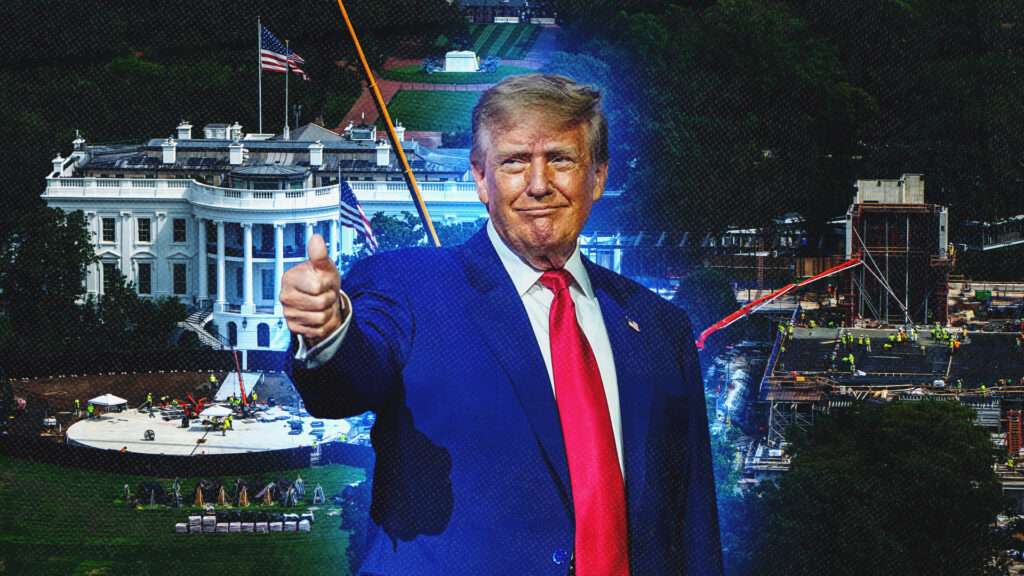
Last year, President Donald Trump moved to erase the East Wing of the White House to make room for a sprawling formal ballroom that would dwarf the rest of the residence.
The endeavor has sparked litigation: Federal law limits major structural changes to the White House to Congress, while Trump contends that his preferences should prevail.
It appears that Trump’s mindset extends even to the building standards themselves.
“In the weeks before his departure last year, the initial architect assigned to the White House ballroom clashed with President Donald Trump over design elements that the architect believed violated safety regulations,” The Washington Post reported. “James McCrery II disengaged from the project last October after repeatedly warning that Trump insisted on a preliminary design that did not provide adequate emergency egress or fire containment.”
The project’s flaws should perhaps have been anticipated. The New York Times noted in March that the proposal had “barely undergone scrutiny,” and there were significant design deficiencies—for instance, “its portico is oversized, its stairs lead nowhere, and its columns will obstruct views from within the ballroom.”
The Post had also reported last year that Trump and McCrery had clashed over the scope of the project, with the architect warning against creating an addition far larger than the core structure.
New reporting indicates that the problems went beyond aesthetics.
“McCrery informed the White House that Trump’s ballroom plan did not comply with fire safety codes, which require most guests to be able to exit quickly through the main entrance during an emergency,” according to the Post. The architect also noted that alternative emergency egress routes were insufficient, and that the design offered little to prevent a kitchen fire from rapidly spreading into the event space on the floor above.”
Trump allegedly responded in a troubling manner: “The president asserted that no building codes apply to White House construction,” as the Post continued. He is also reported to have said, “I am the code.”
The Supremacy Clause and the doctrine of sovereign immunity broadly shield the federal government from state and local regulations, including zoning and building codes. Yet 40 U.S.C. 3312 requires that all construction of or alterations to federal buildings comply with “one of the nationally recognized model building codes.”
That is not to say these laws are inherently sound—byzantine building codes often complicate and raise the cost of constructing housing and other structures. Members of the Trump administration have correctly criticized these burdensome regulations.
It would be one thing if Trump used the topic to critique the downsides of these laws—or if his administration had shown more than cursory attempts to reform them.
Instead, Trump’s interest in the issue appears to stop at how it affects him personally. According to the Post, citing “two people with knowledge of the discussions,” Trump asserted that his authority supersedes the law—a recurring motif in the ballroom saga.
“Major renovations and construction on the White House are supposed to be managed by the General Services Administration or the National Park Service,” the Post notes. “Instead, the work has been routed through the White House Executive Residence, an unusual arrangement that has given the president the power to dictate the terms of the project.”
Earlier this year, Judge Richard Leon of the U.S. District Court for the District of Columbia issued an injunction halting construction, a move upheld by the U.S. Court of Appeals for the D.C. Circuit. In both instances, the judges concluded that, under the law, the authority to make major alterations to federal buildings lies exclusively with Congress, not the president.
Earlier this month, the Supreme Court, in a 5–4 decision, allowed construction to proceed for the moment. Chief Justice John Roberts, writing for the dissent, criticized the court’s decision to endorse what he called a likely unlawful project.
Reason’s Jacob Sullum recently described the ballroom as “a monument to [Trump’s] disregard for the rule of law and the separation of powers.” Given that record, it is hardly surprising that Trump seems to believe he should be exempt from the onerous rules that others must follow.
