
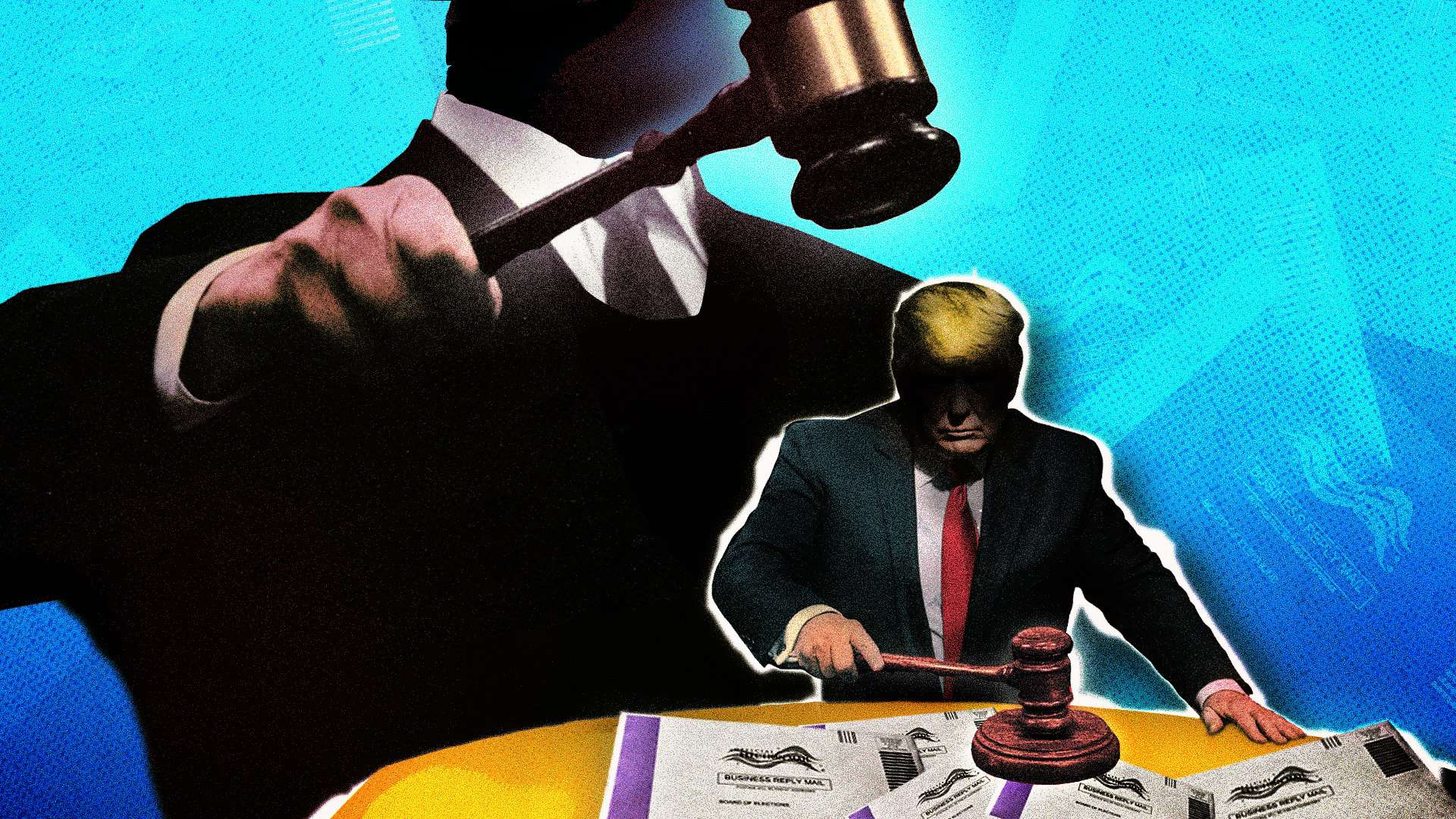
A notable legal defeat for the Trump administration.
Last month the U.S. Supreme Court issued a 6–3 decision permitting the executive branch to begin enforcing President Donald Trump’s directive aimed at curbing the use of mail-in ballots as the midterm elections loom. Yet the Court also signaled that this ruling is not the last word on the matter. The unsigned majority opinion explained that approving the application does not guarantee that every action taken to carry out the Order will be lawful, and that only time will reveal the ultimate legality. In short, the central legal fight over Trump’s mail-in ballot directive had merely begun.
Over the weekend, the administration recorded a notable setback in this developing battle. Even more, the loss came at the hands of a federal judge whom Trump himself had appointed to the bench.
“Less than three weeks ago,” observed Judge Carl Nichols, a Trump appointee on the U.S. District Court for the District of Columbia, “the United States Postal Service adopted a Final Rule requiring that all absentee and mail-in ballots for federal elections—including those occurring in less than sixty days—be transmitted only in envelopes meeting new design requirements and be transmitted only to voters verified by the Postal Service as enrolled in a newly created ‘Federal Ballot Mail Portal.'” The issue, Nichols noted, is that “the Postal Service could issue (and enforce) the Rule only if Congress granted it the authority to do so, but here no statute grants the Postal Service the power to issue key parts of the Rule.”
Nichols therefore issued a preliminary injunction that entirely blocks the Postal Service’s new mail-in-ballot rule from taking effect while the litigation proceeds. The “plaintiffs have demonstrated that, absent an injunction, there is an increased risk that a significant number of otherwise appropriate absentee or mail-in ballots will ultimately not be counted in the upcoming elections,” Nichols wrote. “The public has a strong interest in ensuring that doesn’t happen.”
At the center of this dispute is a straightforward provision of the Constitution. Article I, Section 4 states that “the Times, Places and Manner of holding Elections for Senators and Representatives, shall be prescribed in each State by the Legislature thereof; but the Congress may at any time by Law make or alter such Regulations.” Put differently, the Constitution entrusts the making of rules and regulations for federal elections to the states and Congress; the executive branch is not granted such authority.
That is the substantial constitutional hurdle Trump would have to clear if his executive crackdown on mail-in voting is to take effect. The fact that a Trump-appointed federal judge has just issued a ruling that blocks the president’s order does not bode well for his efforts to circumvent the constitutional separation of powers.
