
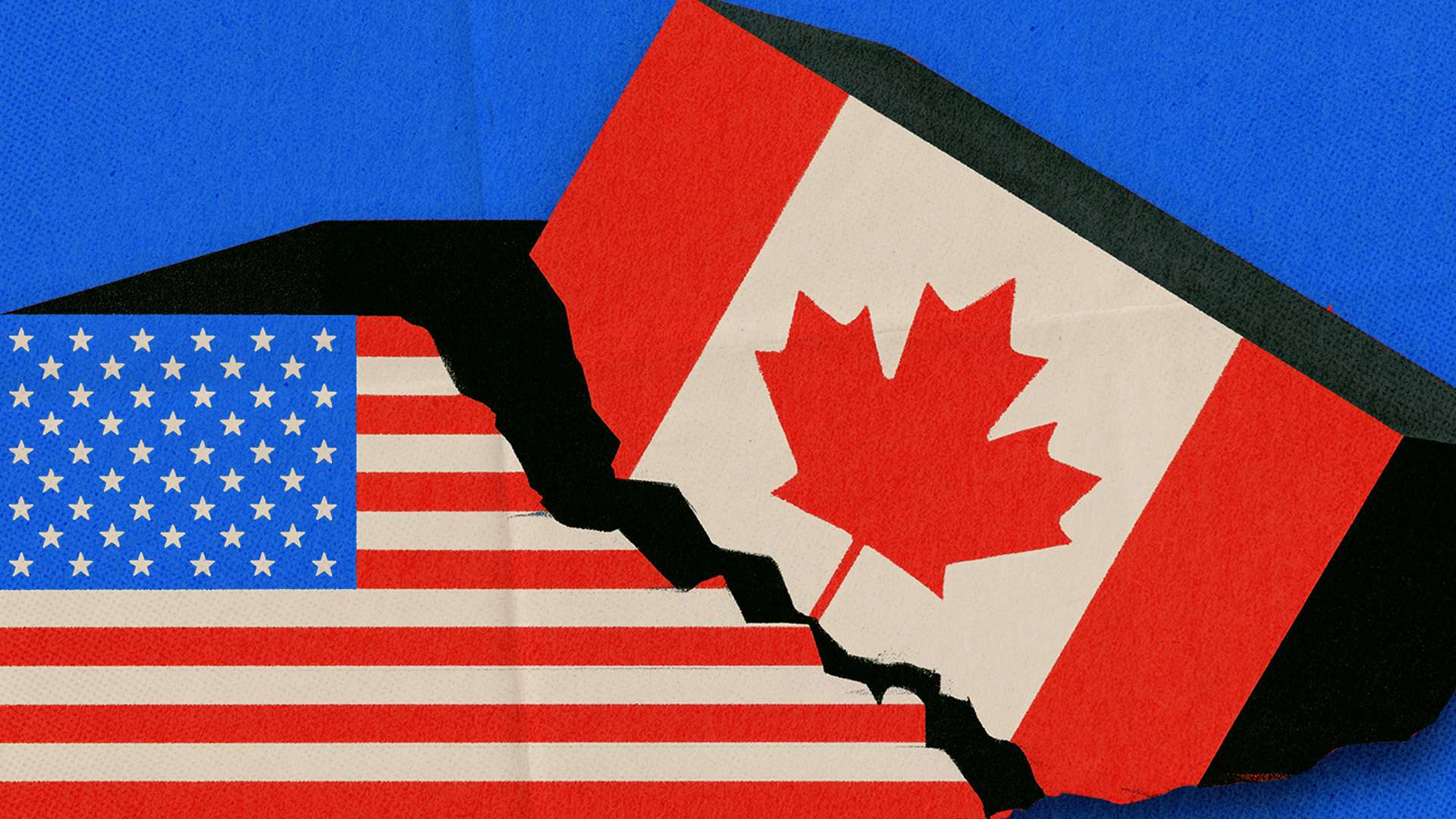
Canada ranks among the United States’ most important trading partners, and the president has levied a 50 percent tariff on vehicles, wigs, and hockey sticks.
Over the weekend, President Donald Trump’s latest wave of tariffs aimed at Canada took effect as talks between the two nations collapsed after weeks of negotiations.
As has been the case before, Trump’s protectionist approach is short-sighted and self-defeating. This round risks driving a wedge into relations with a close ally and trading partner, offering little in return to justify the move.
Last month, Trump announced a 50 percent tariff on a range of Canadian goods, some of which were already subject to duties.
The measure was expected to cover roughly $20 billion worth of goods, representing just under 5 percent of all U.S. imports from Canada, yet the list was a perplexing mix: lumber, alcohol, dairy, and textiles formed its core, but it also included flags, Christmas ornaments, hockey sticks, dog leashes, and wigs.
In a Truth Social post on Monday, Trump claimed he had added “all Cars, Trucks, both large and small, Automotive Parts, and Steel” to the tariff roster.
In February, the U.S. Supreme Court invalidated Trump’s previous attempt to impose tariffs on nations beyond the United States. Other legal mechanisms—such as Section 338 of the Smoot-Hawley Tariff Act of 1930—could have permitted tariffs, albeit with tighter constraints.
Trump’s new tariffs invoke Section 338, a provision not used in more than seven decades. It is almost certain to attract further judicial scrutiny: “This part of Smoot-Hawley was superseded long ago” and “has never been used to impose a tariff,” wrote Philip Zelikow, a senior fellow at Stanford University’s Hoover Institution, last year.
“Even by the standards of Trump’s second term,” added Reason’s Eric Boehm, “this latest maneuver against Canada appears economically imprudent and legally dubious.”
Canada and Mexico have long been flashpoints for Trump, dating back to his first term when he scrapped the quarter-century-old North American Free Trade Agreement (NAFTA) and replaced it with the U.S.–Mexico-Canada Agreement (USMCA), a treaty he hailed as “the best agreement we’ve ever made.” Then last month, the administration announced it would not renew the agreement, and Trump imposed fresh tariffs merely weeks later.
Trump has offered a variety of explanations—many of them far-fetched—from curbing fentanyl trafficking across the northern border to insisting that Canada must become the 51st state. (After negotiations fell apart last week, Trump stated that Canada desired “the benefits of being a State, without actually being one.”)
Even if the new tariffs yield additional revenue—which, of course, comes from American consumers—it’s hard to see it as worth the damage being done to the United States’ relationship with one of its most important trading partners.
“The United States and Canada enjoy the world’s most comprehensive trading relationship, which sustains millions of jobs in both nations,” notes a 2022 U.S. State Department fact sheet, highlighting that goods and services trade totals nearly $2.6 billion per day. “Canada and the United States are each other’s largest export markets, and Canada is the top export destination for more than 30 U.S. states.”
“Canada has consistently ranked among America’s top two trading partners,” adds the Office of the United States Trade Representative. “Most recently, in 2024, Canada was the leading destination for U.S. exports and the third-largest source of U.S. imports. Canada shipped more than three-quarters of its goods to the United States and sourced almost half of its goods from the United States.” The two-way trade was projected to reach about $872.3 billion in 2025.
Yet Trump seems prepared to gamble the entire relationship over—well, over what exactly?
In several proclamations, Trump pointed to actions Canada had taken against certain American products, such as dairy and alcohol. Yet as Alfredo Carrillo Obregon of the Cato Institute notes, “these policies originated as retaliation for earlier, unwarranted American tariffs on Canadian goods.” He adds, “The Trump administration is weaponizing Section 338 in response to policies born from its own misuse of other executive trade powers.”
In response, Canada is withdrawing nothing in principle from the relationship; it is making clear its stance.
“From the outset, we understood that America has changed, and we are not returning to the old pattern of relations,” Prime Minister Mark Carney stated. “Our government saw coming that America would alter all its trade ties, imposing tariffs on its closest allies and demanding access to its vast market.”
When the U.S. tariffs take effect, Carney announced he would “mirror those tariffs dollar for dollar.”
Carney is not alone among Canadian officials in viewing Trump’s reliability with skepticism. “Everyone knows the American president by now—erratic, irresponsible, and not to be trusted,” Wab Kinew, Premier of Manitoba, observed last week. “This is the person with whom we were supposed to strike a deal, and yet we’ll be making further concessions for it. You can’t craft a good deal with a bad person, because who’s to say it won’t be reversed?”
“He underestimates Canada. We’re all in,” added Ontario Premier Doug Ford, accusing Trump of having “declared an economic war against his closest friend and ally.” Ford later added, “He can kiss my ass.”
One can hope that when Trump eventually leaves office, his successor will value free trade. In the meantime, there’s no telling how many international agreements he might jeopardize, often without delivering meaningful gains in return.
