
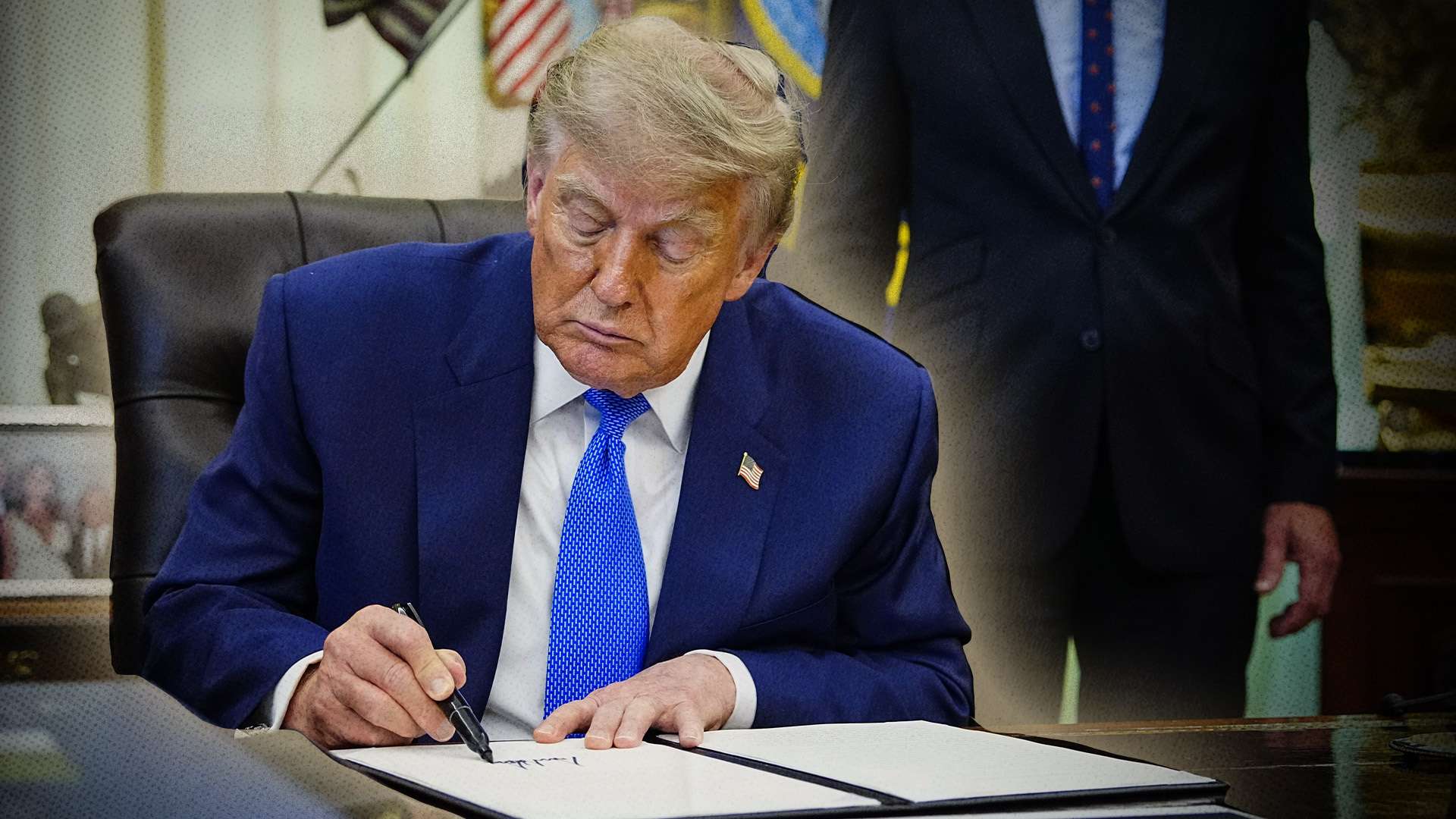
Less than two months after the Supreme Court declared his birthright citizenship executive order unconstitutional, President Donald Trump has unveiled two fresh orders on the same topic. The two new measures largely recycle the same legally flawed arguments that the Court already rejected in Trump v. Barbara.
Is this merely a tantrum from a stubborn loser, or might his latest move have a slimmer chance of success in court this time around?
Removing the sign-up form and related boilerplate aside, the substance remains. Trump’s latest pair of orders attempts a partial do-over focused on children born in the United States to parents who are legally but temporarily in the country. Specifically, they would deny birthright citizenship to several categories of U.S.-born children whose parents are on U.S. soil only for a temporary, lawful reason—such as a commercial transaction intended to ensure the birth mother’s presence in the country.
The central problem for Trump is that the Supreme Court has already faced and rejected these kinds of arguments about so-called “birth tourists.” In the April 1 oral argument for Trump v. Barbara, Solicitor General John Sauer claimed that birth tourism had spawned numerous modern problems that the framers of the Fourteenth Amendment could not have anticipated. Chief Justice John Roberts responded by noting that the administration’s focus on contemporary policy concerns does not alter the Constitution’s original meaning. “You do agree,” Roberts pressed, “that that has no impact on the legal analysis before us?”
Sauer faltered briefly before insisting the country lives in a “new world,” one in which eight billion people are a single plane ride away from a child who possesses U.S. citizenship. Roberts shot back, succinctly: “Well, it’s a new world. It’s the same Constitution.”
The Court reinforced this stance in its ruling on Trump v. Barbara. It explained that children born to parents who are unlawfully or only temporarily present in the United States meet both prongs of the Citizenship Clause: they are born in the United States and are under the jurisdiction of the United States. Consequently, they are citizens at birth. The new executive actions do not alter these constitutional facts.
A first lawsuit has already been filed against the newly issued orders. As Amy Howe observed on SCOTUSblog, the plaintiffs’ lawyers—who previously challenged Trump’s earlier birthright order—brought the case again. The filing, by the American Civil Liberties Union and other civil rights groups, asks U.S. District Judge Joseph Laplante to clarify that the latest orders extend beyond the diplomatic exception to cover birthright citizenship in line with the Supreme Court’s decision in Trump v. Barbara.
If this matter, or any closely related suit, reaches the Supreme Court, there is little reason to expect a different outcome from the Court this time around. Trump’s evident disregard for the Court’s recent decision could, if anything, undermine his chances further.
In short, the new orders attempt to reframe existing policy concerns as a constitutional rebuke, but they confront the same unyielding legal framework the Court has already laid out. The question remains whether the courts will permit a further whittle-down of birthright citizenship or uphold the principle that birth within the United States remains a constitutional entitlement.
