
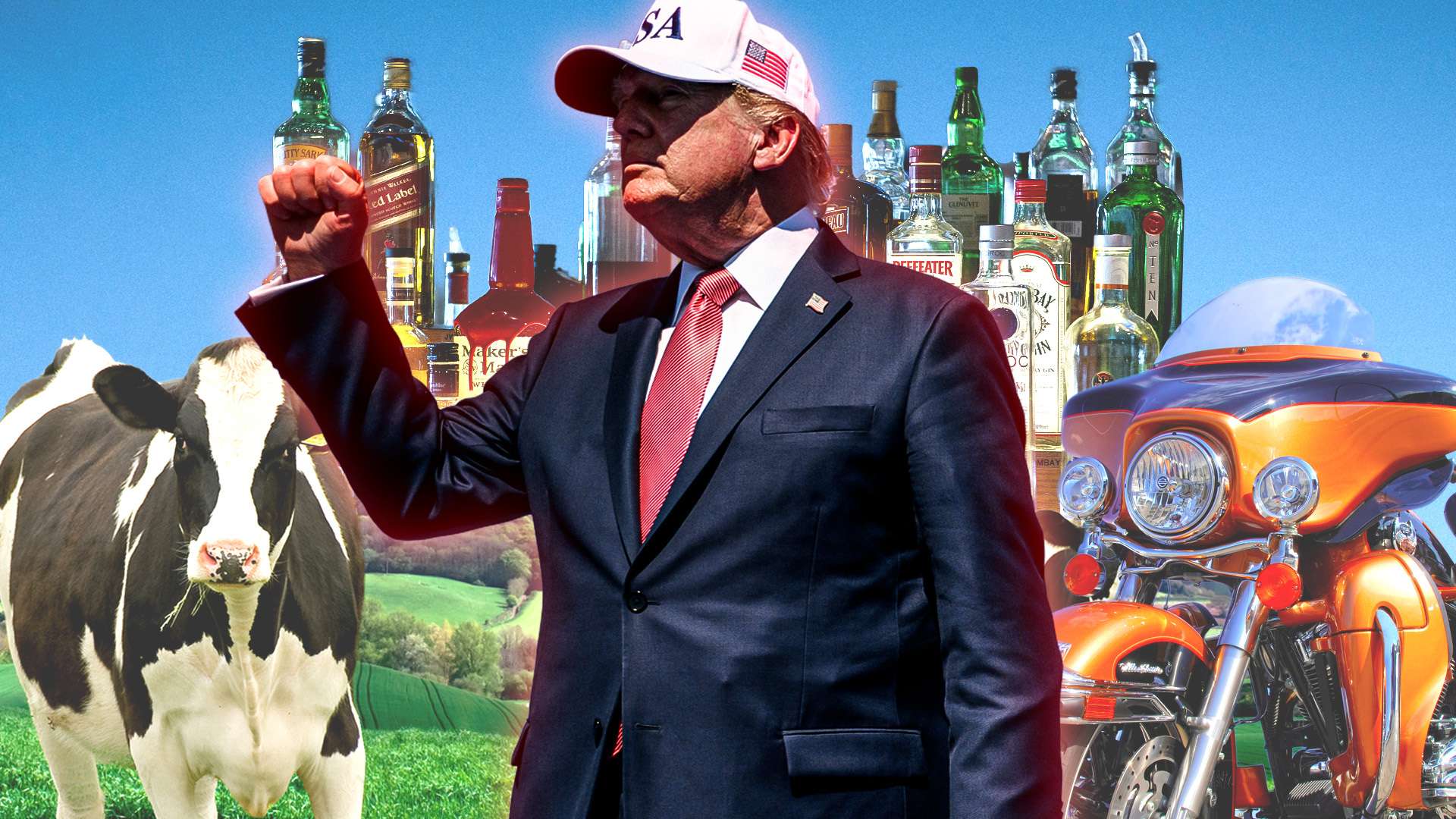
The ban was accompanied by a new wave of tariffs aimed at Canadian motorboats, cheese, and a broader set of goods, signaling another chapter in what has become an increasingly farcical trade conflict.
No longer content with simply raising duties on imports from Canada, President Donald Trump has advanced to what he calls the next logical step in his broader war on free trade.
On Tuesday, the White House announced that dozens of Canadian products would be banned from entering the United States, taking effect later this month.
The import ban spans a range of alcoholic beverages, motorcycles, several varieties of molasses, and some dairy byproducts like whey. It was issued alongside a new set of tariffs targeting Canadian motorboats and engine components, as well as cheese and other dairy goods.
In short, the latest escalation of this needless trade confrontation means Americans will no longer have the option of paying a substantial tariff to import Canadian beer, wine, or spirits. That option has now been revoked by the whim of a single person—someone determined to substitute his preferences for the free will of American businesses and consumers, the vast majority of whom do not feud with their northern trading partners.
The ban arrives just days after Trump told reporters that the United States would be wealthier if it did not engage in trade with Canada at all. “If we end all trade with Canada, we’d save ourselves $90 billion,” he claimed. “If we were playing hardball, all we’d do is say that we’re doing no trading with Canada.”
That line of reasoning is nonsense. For one, it is not the United States that trades with Canada; it is Americans and Canadians exchanging goods, and those transactions should not require consent from political leaders in either country.
It also misreads the value of trade for both sides. If I opt not to go to the grocery store, I might save a few dollars I would have otherwise spent, but I am not wealthier because of it. Trump’s fixation on the trade deficit is even more misguided here, because the United States has historically run a trade surplus with Canada, provided you set aside gasoline and other energy products.
Carrying this ban to such extremes is so far-fetched that it risks obscuring how foolish this entire trade conflict has become.
Trace the dispute back to its origin. Just weeks after resuming the presidency in 2025, Trump imposed new tariffs on Canada (along with Mexico and China). Officially, those duties were meant to curb the illegal flow of fentanyl into the United States. The problem: very little fentanyl is imported from Canada—and how tariffs on legal imports were supposed to stop illegal ones is unclear.
“There was almost nothing Canada could do to eliminate fentanyl manufacturing or stop exports of fentanyl, because they basically didn’t have a fentanyl trade to stop in the first place,” writes Justin Wolfers, an economist at the University of Michigan, in his newsletter. “So from Canada’s perspective—and from reality’s perspective—this was an arbitrary set of tariffs imposed because of something they hadn’t done.”
In the months since, Trump has used Canada’s responses to those tariffs as justification for further escalations. In the process, he’s torn up the trade deal that he negotiated—and called his “best deal”—during his first term and forced Americans to bear the cost of the conflict.
A trade war that was started under false pretenses now continues spiraling into the absurd.
Cutting off Americans’ access to Moosehead beer won’t do anything to staunch the nearly nonexistent flow of fentanyl from Canada. But chopping up American automakers’ supply chains—ones that have freely crisscrossed the continent since 1965—will be costly and chaotic. Trump’s tariffs have cost American automakers more than $12 billion, according to an analysis by the Anderson Economic Group. Meanwhile, states and industries that depend heavily on exports to Canada figure to be harmed by the loss of that market as the trade war continues.
We should not tolerate a system where one person, no matter how powerful, can arbitrarily decide what goods can enter the country. This is madness—and if the past 20 months are any indication, worse is yet to come.
