
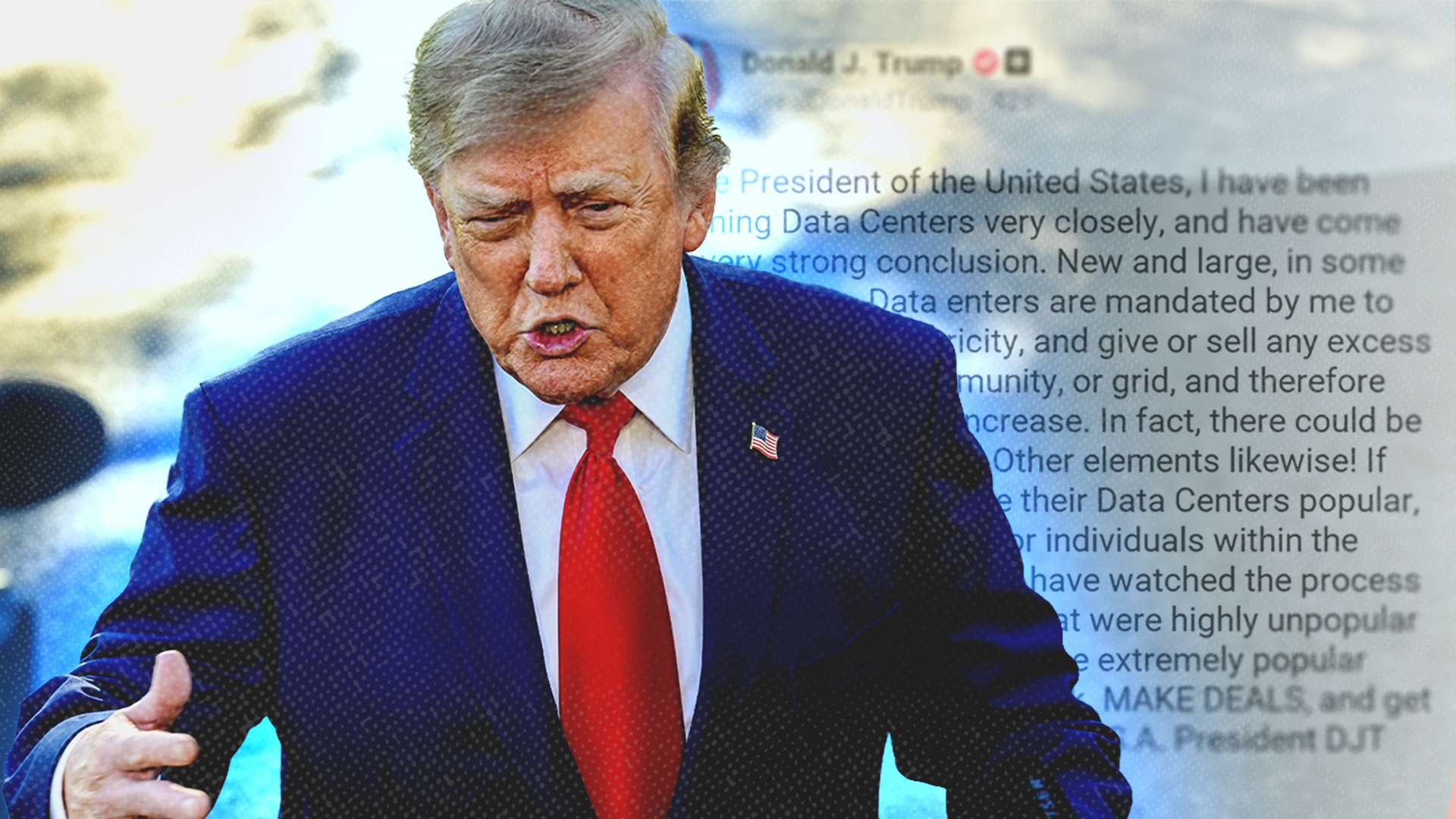
The president adds his name to a growing roster of lawmakers who contend that government knows best when it comes to data-center development.
With public opposition toward data centers growing and midterm elections approaching, politicians from across the political spectrum have introduced sweeping measures aimed at slowing the expansion of data centers and comforting voters. Among them now is President Donald Trump, who has historically been a strong backer of the sector.
“New and large, in some cases colossal, Data Centers are mandated by me to generate their own electricity, and to provide or sell any surplus back to the local community, or the grid,” Trump stated on Truth Social on Wednesday. “If companies want to win the favor of communities for their Data Centers, they should compensate the community, and/or individuals within the community, with a ‘dividend.’ I have watched the process closely, and Data Centers that were once highly unpopular in a given area have become markedly popular when a financial deal is struck.”
While Trump has previously floated the idea that power plants should cover their own power costs, these remarks contrast with his earlier comment less than a few months ago that “the only reason that communities throughout the USA should not want Data Centers is if they want to end up being backward and poor.” Nonetheless, the president is not entirely incorrect in suggesting that such a strategy could boost centers’ popularity; polling repeatedly shows that worries about higher energy prices are among the primary reasons people oppose data centers in their communities.
However, mandating that these facilities generate their own electricity is not the right path—partly because the cost of generation is not the main driver of higher electricity prices, whereas transmission infrastructure—lines, poles, and related systems—are. Regulatory obstacles, as well as a lack of competition in constructing and maintaining this infrastructure, are major contributors.
That said, if the objective is to push data-center operators to produce more of their own power, relaxing regulations would likely have more impact than imposing a mandate. As Travis Fisher, director of Energy and Environmental Policy Studies at the Cato Institute, explains to Reason, “If a tech company purchases electricity from the owner of a power plant, in most states the plant owner becomes a public utility (even if the transaction takes place off-grid), which invites heavy scrutiny in the form of economic regulation.”
To reduce these regulatory barriers, Fisher and other experts have advocated for a Consumer Regulated Electricity model that would allow large-load customers to link directly with unregulated power producers off the grid.
Fisher also notes that lower power costs do not automatically translate into lower utility rates. He tells Reason, “Even if a data center could supply as much as its demand or more, based on how retail rates are structured, I am not convinced that prices will fall.”
On top of not addressing the main drivers of higher electricity prices, the mandate isn’t necessary because many data centers have already begun producing their own power. A report from energy research firm Cleanview shows that operating power capacity dedicated to data centers has nearly doubled since June, while capacity under construction has roughly quadrupled. In addition, companies such as Anthropic and Microsoft are already volunteering to cover consumers’ electricity costs.
By urging power producers to generate their own electricity, Trump joins the growing chorus of policymakers convinced that government, rather than the market, is best positioned to set the pace and shape of data-center growth and operation. And, in classic Trump fashion, a social-media-based mandate without any accompanying legal action leaves the public and investors guessing about what, if anything, will materialize.
Constructing power plants requires long-term planning and investments that span decades, making Trump’s pattern of abrupt policy shifts less than ideal. “The fact that rules can change, not just every four years but sometimes overnight via a tweet,” remarks Fisher, does not create a favorable investment climate.
