
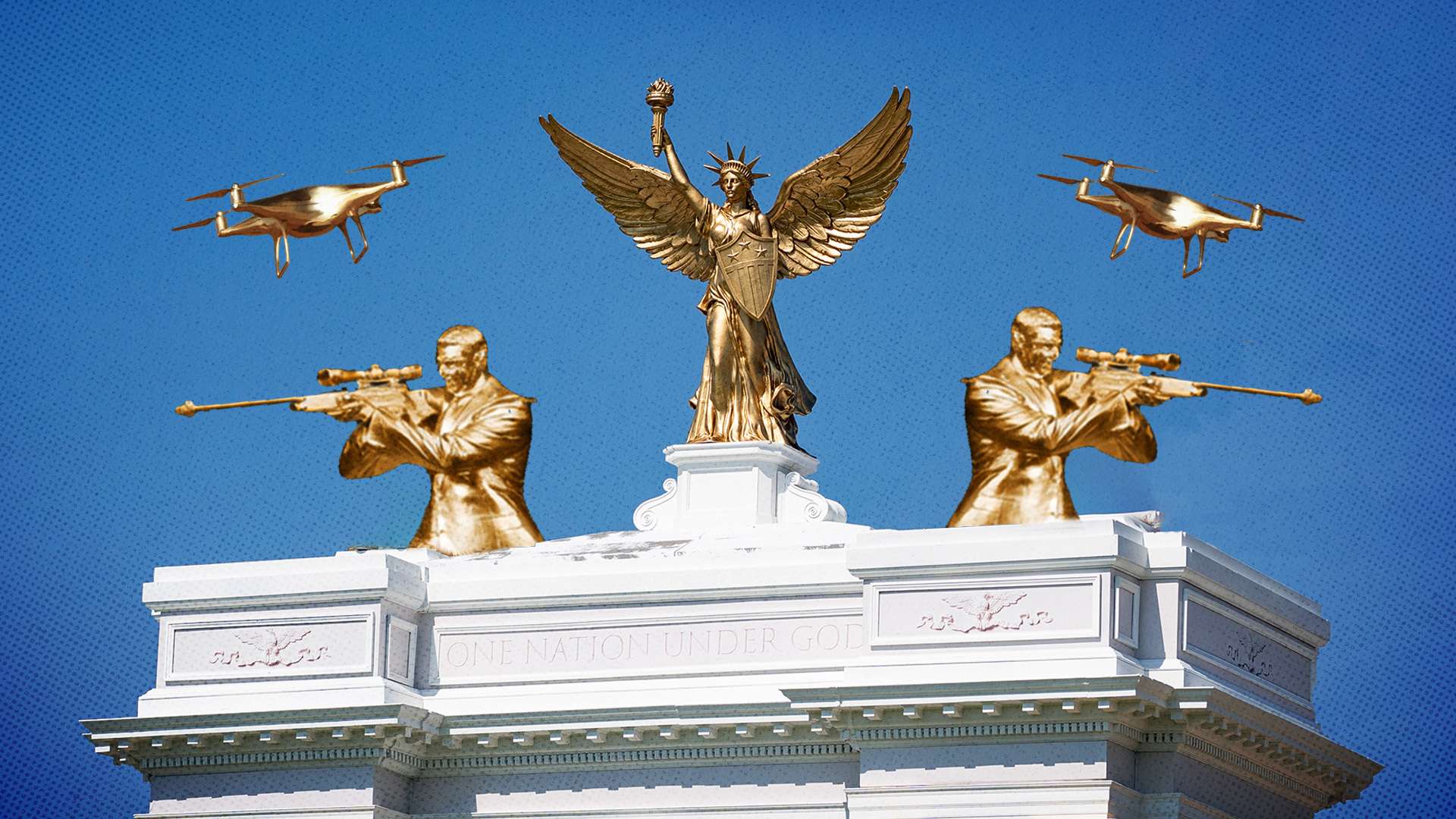
The arch has yet to receive final approval—and Trump’s newly announced military use was not part of the original federal review.
Since last year, President Donald Trump has been pushing for a 250-foot ceremonial arch to rise in Washington, D.C.. Over the weekend, he announced that the monument would, in fact, function as a “Military Complex” equipped with “a sizable drone contingent, along with sniper teams.”
“At the strong request of the United States Military, and for National Security purposes, I have agreed to convert the magnificent Triumphal Arch… into a top-grade Military Complex/Triumphal Arch,” Trump wrote on Truth Social. “Among the 59 major cities and capitals, Washington, D.C., IS THE ONLY ONE IN THE WORLD WITHOUT A TRIUMPHAL ARCH, but it will now have one, and it will undoubtedly be the greatest of them all!”
The concept of placing a triumphal arch at Memorial Circle, near the gateway into D.C. from Virginia, first surfaced publicly in 2024 by Catesby Leigh, a former research fellow at the National Civic Art Society (NCAS). He contended that although a temporary arch might be more practical to finish before America marks its 250th anniversary, a “handsome permanent arch” would “be the most pleasing outcome of all.” The idea was presented to Trump in 2025 by Justin Shubow, president of the NCAS. It was intended to be a temporary project to commemorate the nation’s 250th anniversary, but late last year officials were reported to be weighing a permanent arch. D.C.-based architect Nicolas Leo Charbonneau, who is overseeing the venture for the White House, shared on his social channels previews of what the permanent structure might look like.
“I don’t think an arch that large belongs there,” Leigh, who had contemplated a comparatively modest arch in his 2024 essay, told The Washington Post earlier this year. Indeed, if the White House (70 feet) and the Lincoln Memorial (99 feet) were stacked, they would still fall short of Trump’s proposed 250-foot arch.
While no official price tag has been released for public display, estimates suggest a potential cost of up to $100 million. Trump initially hinted at covering the expense with leftover private donations from his White House ballroom project, but taxpayer funds are already being allocated for the arch. The National Endowment for the Humanities has already reserved $15 million for the arch. Separately, the agency has awarded $30,000 to the NCAS to develop “architectural plans, renderings, and models” of “the Independence Arch” and to explore “how form, scale, and symbolism can convey historical meaning in public space.” Meanwhile, the National Park Service awarded Portland-based engineering firm OTAK a $500,601 contract to perform environmental assessments and compliance work for Memorial Circle.
The arch has encountered a series of legal hurdles. In February 2026, a group that included Vietnam veterans and an architectural historian sued the administration, seeking to block construction unless Congress authorizes the arch and the administration completes the required statutory review processes. Indeed, under the Commemorative Works Act, new commemorative projects within “Area I” (which includes Memorial Circle) generally require approval from Congress.
The Trump administration maintains that Congress provided authorization in 1925, when it approved plans tied to Arlington Memorial Bridge that envisioned two monumental columns at a nearby site. Of course, that authorization covered two columns, not a 250-foot arch.
The legal entanglements intensified earlier this month, when U.S. District Judge Tanya Chutkan ordered the Trump administration to provide 48 hours’ notice before beginning any work at the site. The project also awaits final approval from the National Capital Planning Commission for an exemption to Washington’s 130-foot building height limit.
The site’s closeness to Reagan National Airport has sparked aviation-safety concerns as well. The structure would sit roughly 3,000 feet from the airport and within an established approach and departure corridor. The Federal Aviation Administration recently concluded that the arch itself would not constitute a hazard to aircraft but would be required to feature an “eternal flame” at its apex. Yet, Trump’s new plan to operate “large numbers of drones” from the site introduces a separate set of questions not contemplated in the earlier proposal.
Trump’s announcement marks a major departure from the project as it has been presented to federal agencies for months. Until Sunday, the arch was described as a commemorative tourist attraction. Transforming it into an active military facility, capable of storing munitions and deploying drones and snipers, would demand a substantial expansion of security infrastructure.
It could also complicate the project’s authorization and funding. As a commemorative work on federal land, the arch falls under the Commemorative Works Act, whereas construction tied to an operational military facility could implicate a separate body of military construction law. In general, federal law states that military construction projects must be “authorized by law,” though the Pentagon maintains narrower authorities for certain smaller endeavors. It remains unclear what legal authority or funding stream the administration would invoke for the newly proposed military functions.
Only 21 percent of Americans supported the president’s plan for a commemorative arch in April, with 41 percent saying they strongly opposed it, according to a Washington Post-ABC News-Ipsos poll. Naturally, residents may feel more strongly about a “Military Complex” looming over their morning commute.
If the president succeeds, military drones and snipers could become a fixture along the capital’s border for good.
