
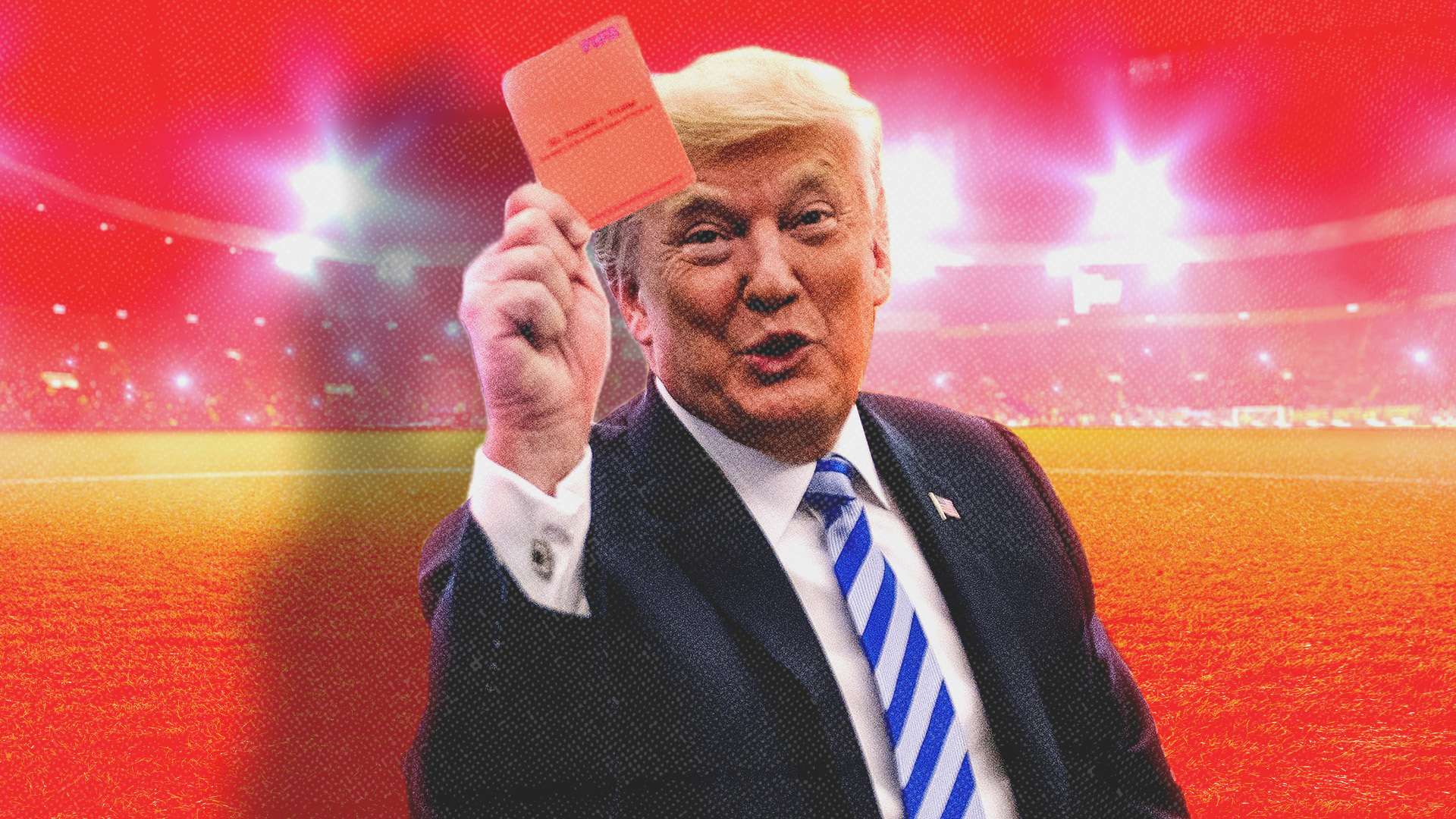
In both sports and diplomacy, his attitude toward rule-breaking is that it can be virtuous, even when the tactic ultimately fails.
It would have been extraordinary to witness the United States win its first World Cup on the occasion of the nation’s 250th anniversary—and during the year the tournament was hosted on American soil. Unfortunately, that dream was crushed on Monday night as Belgium defeated the U.S. in Seattle by 4–1. The setback felt more humiliating because President Donald Trump had attempted to tilt the odds in America’s favor.
FIFA, the global governing body of football, announced on Sunday that it would lift the ban on U.S. star striker Folarin Balogun, following pressure from the White House. Balogun had been shown a red card for stepping on the ankle of Bosnian player Tarik Muharemović during his previous match. Some observers, including former elite referee Andy Davies, argued that the contact was a routine accident and Balogun’s suspension should never have happened.
Trump expressed his grievance to the coach, assembling lawyers and dredging up an old complaint against one of the referees to present to FIFA President Gianni Infantino. FIFA acquiesced and overturned the decision. (Infantino denies any improper political influence.) It marked the first reversal of its kind since FIFA’s infamous 1962 ruling regarding Brazilian star Mané Garrincha.
Supporters of Trump tried to cast the episode as a display of American tenacity, while Belgians viewed it as cowardly and un-sporting. After Belgium’s fourth goal, Romelu Lukaku mimed a phone call in a mocking gesture, and the Belgian team uploaded his image to Instagram with the caption, “Overturn this.”
The core issue isn’t whether referees made a questionable decision in Balogun’s favor—a frequent occurrence in this World Cup. It is that the U.S. government intervened in a grievance-fueled, sore-loser fashion. (Trump didn’t threaten the referees with violence in the manner of a classic American mobster; he chose a more underhanded route.) Balogun himself hadn’t requested Trump’s assistance and was prepared to accept the referees’ verdict before kickoff.
“There are still countless people we’re inspiring, kids watching from every corner, and we have to demonstrate the right way to respond to what feels unjust,” Balogun told reporters on Friday after receiving the red card. On Monday night, Belgian coach Rudi Garcia said Balogun “came to speak with me, which I really appreciated. It isn’t his fault, he isn’t the one to blame, and that’s what I told him.”
The politicization of FIFA mirrors Trump’s broader approach to foreign policy: faith in good faith and fair play is for the naive, while breaking the rules becomes a tool for leverage. What starts as a quest to remedy inefficiencies can spiral into a cheating strategy with dubious returns. Ultimately, a handful of unfair advantages often aren’t enough to salvage a flawed plan, and the United States still comes up short.
Of course, there is a certain allure to bending rules. Many political norms are merely bureaucratic obstacles or establishment quirks, and skirting them can seem tempting when people’s lives are at stake. At the start of the second Trump term, I found myself attracted to the notion that his disregard for political pieties might unlock world peace. Likewise, voices from the left—from New York City Mayor Zohran Mamdani to Jerusalem Demsas, editor of The Argument—appeared ready to see corrupt FIFA officials get their comeuppance.
Yet some rules do real work: they keep conflicts bounded, force opponents to stay honest, and shield the vulnerable from harm. Trump has criticized so-called politically correct rules of warfare that prevent torturing prisoners or killing the innocent relatives of enemies. He has used negotiations as a ruse to spark wars, entertained the idea of “shooting the messenger” as leverage, and boasted about failing to uphold his own commitments. It goes without saying that loosening geopolitical constraints carries dire consequences for real people—from Caribbean fishermen to schoolgirls in the Persian Gulf.
A bad-faith strategy also runs into a practical snag: perfidy advantages only one side because the other side still expects good faith. Breaking the rules helps only if the other side continues to observe them. Attacking the messenger works only if the other side believes messengers won’t be harmed. Most world leaders aren’t naïve enough to sit around waiting for Lucy to yank away the football again and again. When a government behaves as an unreliable actor, others treat it as unreliable.
The results bear this out. Even after two years to test his theories of war and peace, Trump has not achieved his aims in Ukraine, Yemen, Greenland, Iran, or China.
Ironically, Trump’s method produced results in business—and in soccer, at least to the extent of overturning the red card—through stronger enforcement of rules. In business, contracts must be backed by the courts, because in most cases the courts will enforce them. If Belgian players had tried to step on American players’ ankles, FIFA would presumably punish them, despite its leniency toward Balogun. Cheating is only advantageous within a system of rule-followers.
From this arises the notion that corruption in such a system thrives when there is some plausible deniability. Past attempts to corrupt FIFA often relied on winks, nods, and back-room payoffs, since cheating only pays when everyone else assumes fairness. Trump may have overstepped by making his pressure on Infantino public. In international politics, he has aimed to replace the notoriously compromised United Nations with a openly biased “Board of Peace” composed of donors who promise tribute into a slush fund under his control. Unsurprisingly, the promised billions never materialized.
Soccer isn’t merely a mirror of Trump’s foreign policy; it has served as a stage where he has pursued his particular agendas. Infantino and FIFA have eagerly supported this “Board of Peace,” even proposing a peace prize for Trump and pledging to erect stadiums on the ruins of Gaza. The Trump administration has leveraged the host nation’s status to flex political muscles against other World Cup participants, typically through humiliating border procedures.
After all, the World Cup began not long after Trump signed a peace memorandum with Iran. Hosting the Iranian squad could have conveyed several messages—an end to war and a shift toward a new era; backing for the Iranian people despite their government; or a display that American commitments as a sports host outrank politics.
Instead, the Trump administration imposed a string of petty obstacles on the Iranian players: delaying their visas until the last minute, forcing them to travel in and out of U.S. cities on the day of matches, and taking away their fans’ ticket allotments. These acts aren’t monumental in the grand scheme, but they reveal an attitude that neither embodies sportsmanship nor graciousness.
Iranian players, for their part, thanked Los Angeles for its hospitality and spoke of peace among nations after their final game against Belgium, while the Trump administration reveled in its leverage over the players off the field. “I was thrilled when we managed to pull their visas,” said Homeland Security Secretary Markwayne Mullin at a briefing after Iran’s exit from the tournament. “I might have sung a song or even danced a happy dance.”
Unlike war, victory isn’t the sole objective in football. Consider Cape Verde versus Paraguay. Even though both sides were eliminated over the weekend, Cape Verde was remembered for tough play and admirable sportsmanship throughout the tournament. “Regardless of yesterday’s result, Cape Verde has emerged as a winner,” Portuguese player Nelson Samedo told reporters.
Paraguay, by contrast, earned notoriety for dubious conduct against France and for a Paraguayan senator’s racist outburst directed at French star Kylian Mbappé.
American players themselves thankfully did not descend to Paraguay’s level. The squad performed well against Belgium and met the defeat with grace. “I accepted the red card, and I accepted again when I was told I could play,” Balogun said. “There isn’t much more to add. In the end, Belgium were the better team today. They played much better than us, I feel.”
Yet the Trump administration and its supporters did not hesitate to sink low, signaling that they view sports as an extension of their covert diplomatic tactics toward friends and adversaries alike. And the disappointing truth is that this approach didn’t deliver the intended outcomes.
