
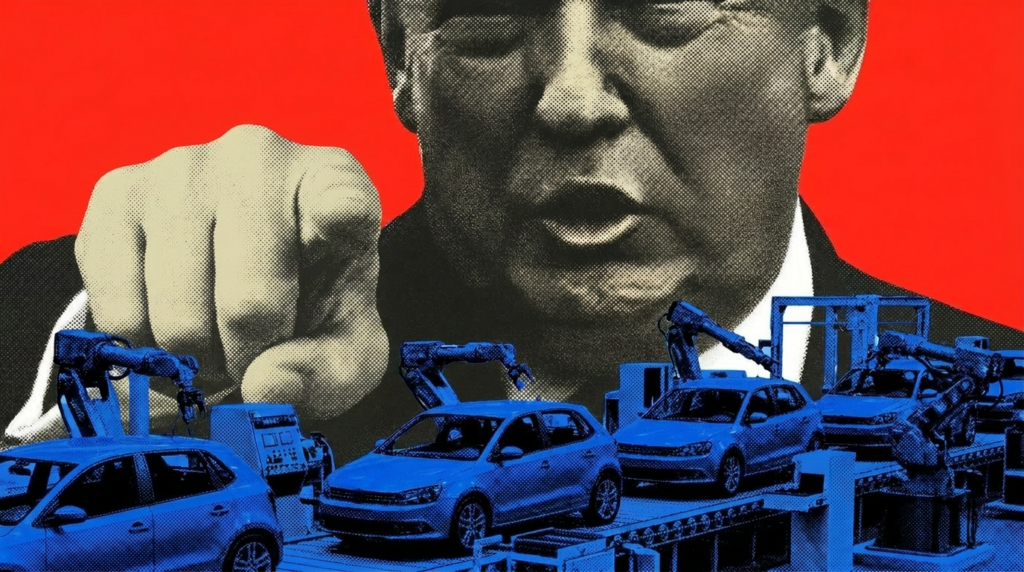
A trade agreement that can be canceled by a single individual at any moment and for any reason hardly qualifies as a genuine trade deal.
When President Donald Trump sealed a trade pact with the European Union in July, officials on both sides stressed how it would bring lasting stability to transatlantic commerce.
The Trump administration labeled the accord a “generational modernization of the transatlantic alliance.” European Commission President Ursula von der Leyen said it “restores stability and predictability” by locking in a 15 percent tariff on most European goods exported to the U.S., while most American imports into Europe would be exempt from duties.
In effect, Trump achieved what he sought from the agreement: a reduction in tariffs on American exports and the establishment of a new, permanent baseline tariff on European goods. European leaders also felt they had gained something: the 15 percent tariff was lower than the 25 percent Trump had threatened, and the arrangement would prevent Trump from raising tariffs the next time he was in a foul mood.
So much for that.
On Friday, Trump announced a plan to raise tariffs on European-made cars to 25 percent. (Those duties are authorized under Section 232 of the Trade Expansion Act of 1962, so they fall outside the Supreme Court’s February ruling that limited some of the president’s power to impose tariffs unilaterally.)
Those steeper tariffs could cost automakers as much as $4 billion this year.
In a post on Truth Social, Trump said the tariff increase was in response to the E.U. “not complying with our fully agreed to Trade Deal.”
Yet the trade agreement isn’t fully ratified, so it’s hard to see how the Europeans could be breaching it. The E.U. is still in the process of ratifying it—even though it cleared the main legislative hurdle in March—and the Trump administration has not yet asked Congress to approve it. Complicating matters is the fact that European trade officials visited the White House just weeks earlier, and relations appeared cordial. Following that meeting, the U.S. and E.U. announced a new joint partnership for several strategically important minerals.
Trump’s sudden move to raise tariffs now jeopardizes the entire deal—and once again raises tensions with Europe.
Bernd Lange, chair of the European Parliament’s International Trade Committee, wrote on Twitter that Trump’s sudden tariff hike was “unacceptable.”
“Trust is good, but against arbitrariness, only clear rules help,” he added.
He’s right. Friday’s announcement demonstrates, once again, how little any trading partner can rely on Trump. The president’s word is effectively worthless, and his “deals” can be altered at any moment, for any reason. Who would enter into serious negotiations with someone like that?
Convincing other countries to negotiate more favorable trading terms with the U.S. had been a central promise of Trump’s tariff regime. But this latest dispute over imported cars reveals that Trump still doesn’t grasp why trade agreements matter in the first place.
The entire purpose of a trade agreement is to provide predictability for individuals and businesses planning transactions and capital investments. A 15 percent tariff is burdensome, but a 15 percent duty that could be jolted up to 25 percent (or higher) on a whim will have consequences far beyond the higher taxes.
That means Trump’s threat to derail the E.U. deal also undermines the ability of private citizens and companies in other parts of the world to invest in the United States.
A tariff increase would “threaten the progress that has already been made to open EU markets and grow the U.S. auto industry,” Jennifer Safavian, CEO of Autos Drive America, an industry group, told the Associated Press.
Those tariffs would be another blow to an auto sector already coping with America’s steel and aluminum tariffs, and with the ongoing costs of Trump’s confrontational policies toward Iran. Thanks to the tariffs and the closure of the Strait of Hormuz, aluminum prices are about 90 percent higher than they were a year ago, The Wall Street Journal reports.
It’s not clear what Trump hopes to achieve by slapping higher tariffs on European cars. Indeed, it isn’t even clear why he made this decision.
Regardless, a so-called “deal” that any one person can tear up at the drop of a hat isn’t really a trade deal at all. That’s why Congress must curb presidential power over tariffs.

Natalie Foster
I’m a political writer focused on making complex issues clear, accessible, and worth engaging with. From local dynamics to national debates, I aim to connect facts with context so readers can form their own informed views. I believe strong journalism should challenge, question, and open space for thoughtful discussion rather than amplify noise.