
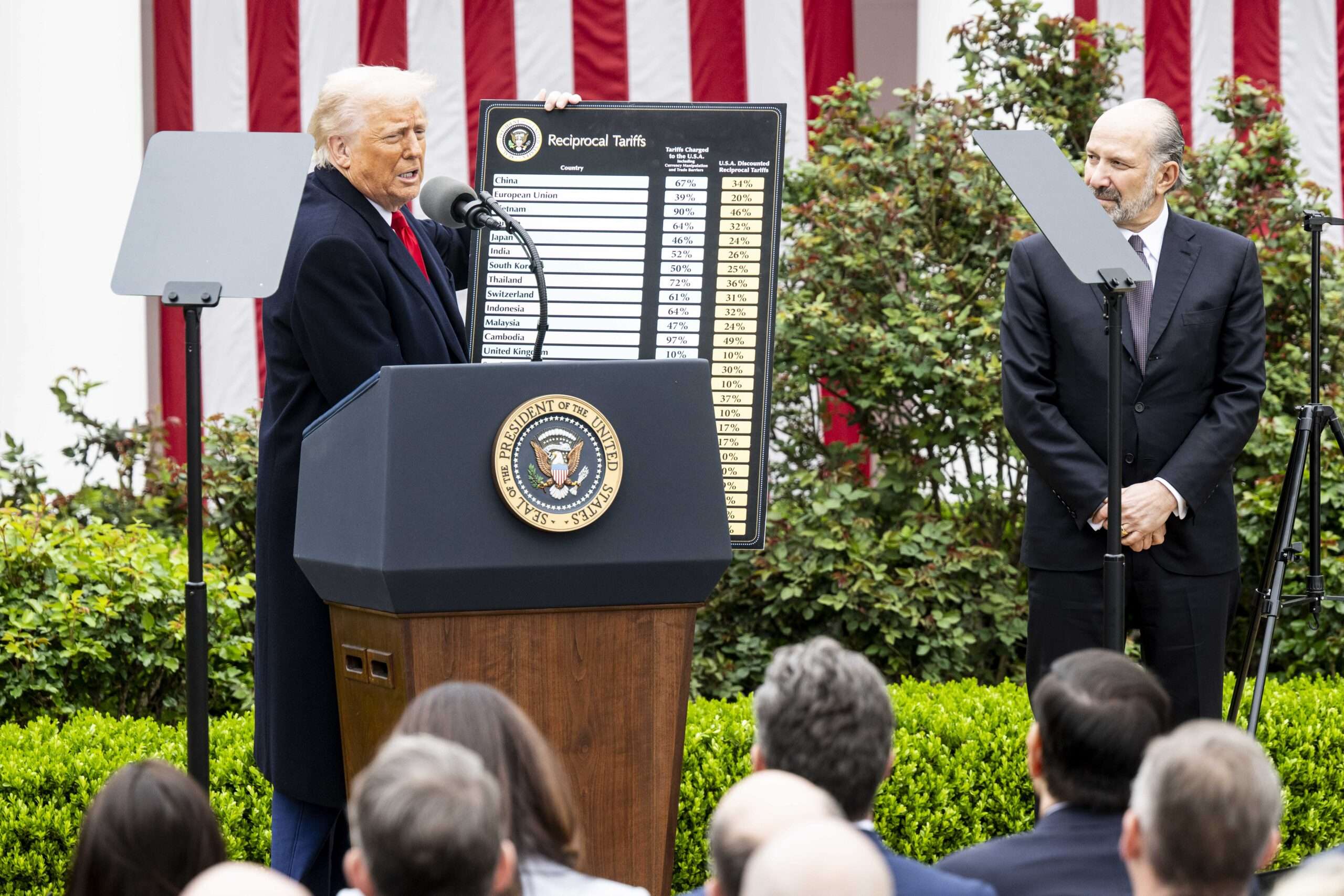
An economist draws attention to a largely overlooked peril tied to Trump’s tariff fervor. It is a serious danger, though one that can be mitigated to some extent.

In the past I have argued that Trump’s new Section 301 tariffs are unlawful and harmful. The same critique applies to his earlier IEEPA tariffs (struck down by the Supreme Court in a case I helped litigate) and to Section 122 tariffs (invalidated by the US Court of International Trade in May, with litigation ongoing). A perceptive recent analysis by an economist highlights a particular kind of harm produced by Trump’s tariff program that courts alone cannot fully repair:
There exists a more deeply damaging consequence that cannot be undone by courts, elections, or policy reversals. The new tariffs and their justifications have only managed to erode the ties with allies and trading partners that we once treated as given. The costs of this erosion will outlive every tariff schedule, every court ruling, and this administration. They won’t show up in standard economic metrics, but they will be felt by every American for years to come….
Canada, the European Union, the United Kingdom, and Mexico now face 10 percent tariffs for alleged forced labor practices. Canada and Mexico are, of course, parties to the USMCA—a trade agreement that this president negotiated, signed, and extolled as “a colossal victory” before turning away from it. In the same week, the President imposed an additional 50 percent tariff on a broad range of goods—from wine to hockey sticks to cement—whether or not those goods fall under the USMCA.
So, in the span of one week, the White House effectively told Canada—our closest trading partner and ally—that America’s word no longer holds weight, and then accused them of complicity in forced labor.
Ordinary tariffs are taxes. Trading partners may grumble, retaliate, or seek negotiation. These tariffs are different. We did not merely impose a tax on Japanese goods; we announced to the world, in official terms, that Japan benefits from slavery and deserves punishment. Norway, Switzerland, Australia, the United Kingdom, and South Korea are described in the same way. Then a penalty was set that happens to resemble the expired Section 122 tariffs.
Foreign officials must now face a stark reality: not only is any US agreement potentially meaningless on paper, but we will level grave accusations if it serves to justify reimposing tariffs. They have learned that findings of investigations can be tailored to fit administration priorities rather than the actual facts on the ground. They have learned that the United States can appear not only protectionist but willing to brand a friend with moral charges when it is politically convenient.
This alters how other nations will engage with us going forward.
The ensuing decline in U.S. reputation and trust translates into a reduced willingness among foreign partners to strike new deals. Likewise, businesses and investors abroad become less inclined to engage with the United States for fear that commitments will be disrupted whenever the current president feels like it.
I would add another restraint on courts’ ability to fix this problem: the judicial process moves slowly. A great deal of damage can occur while a case is winding its way through the system. During the IEEPA litigation, I spoke with businesspeople who asked how soon the case would be resolved. The response was that, by federal standards, it was moving quickly, but from a business perspective, it felt too slow—because money was being lost every day.
The US Court of International Trade, the Federal Circuit, and the Supreme Court did indeed decide the case faster than is typical, yet the litigation stretched over more than ten months, during which the government collected roughly $166 billion in unlawful tariff payments, and both the U.S. and world economies endured significant harm. We are not finished refunding those unlawful payments yet.
Beyond the lost sales caused by higher prices, the uncertainty about future tariff schedules impeded long-term planning. That ambiguity may persist as long as there remains a fear that a president can unilaterally impose massive new tariffs, triggering months of litigation to overturn them. This is another cost of undermining the rule of law by letting a single person’s impulses steer tariff policy and influence a large slice of the economy.
Yet the courts and Congress are not utterly powerless to address the issue. First, the very fact that unlawful tariff power grabs are struck down—even if slowly—creates some degree of stability. If stakeholders believe such measures will last only a few months, that affects expectations and planning. Judicial opinions that clearly signal tighter scrutiny for future tariffs can further reduce uncertainty.
Second, as argued previously, courts can mitigate the damages caused by unlawful tariffs by not staying initial rulings blocking them. If that happens, the tariffs would be in effect for only a few weeks rather than many months. Moreover, declining to stay initial injunctions signals that the likelihood of success on appeal is high, which again lowers uncertainty.
When the Federal Circuit stayed the initial ruling against the IEEPA tariffs, it enabled the Trump administration to collect about $166 billion in illegal tariff payments and substantially amplified the harm caused by the policy. Courts should learn from that error and refrain from repeating it (though the Federal Circuit did choose to repeat it in the Section 122 case).
Congress could do even more. Ideally, it would repeal all statutes granting the president discretion to impose tariffs—Section 122, Section 232, Section 301, and so on. All of them should go. Basic economics teaches that tariffs are almost never an effective tool for solving problems. While Trump has stretched these authorities beyond their proper bounds, they remain pernicious even when used as Congress originally intended, and the statutory language permits.
Such repeal is not politically impossible. The tariffs launched by Trump are deeply unpopular, and historical data show that public opinion can swing against tariffs once people are reminded that they raise prices. For these reasons, a broad majority could back a serious push to eliminate the enabling statutes, though opposition from protectionist interests may be formidable. It cannot happen while Trump remains in the White House with a veto pen. But a future administration that favors freer trade could quite possibly win in 2028.
Even if discretionary tariffs are abolished, Congress would still retain the power to authorize tariffs through new laws. It could also simply ban the import of certain categories of goods (as it already does with products produced by forced labor). But trade policy would no longer be subject to the whims of a single individual.
If complete abolition proves unachievable, Congress could at least reform the remaining delegations of tariff authority to 1) limit them to a narrow set of circumstances and 2) remove judicial deference to executive determinations that those circumstances actually exist. The government must bear the burden of proof.
Even if all of this were accomplished, a rogue, ignorant, or reckless president might still attempt to push through illegal tariffs. Yet businesses and trading partners could have confidence that such efforts would lack legal effect and would be promptly struck down by the courts. He could still level baseless charges of forced-labor complicity, but allies and trading partners would recognize that his rhetoric will likely have little impact. A reckless executive might still inflict some damage to U.S. trade policy and credibility, but the scale would be far, far smaller than what is possible today.
