
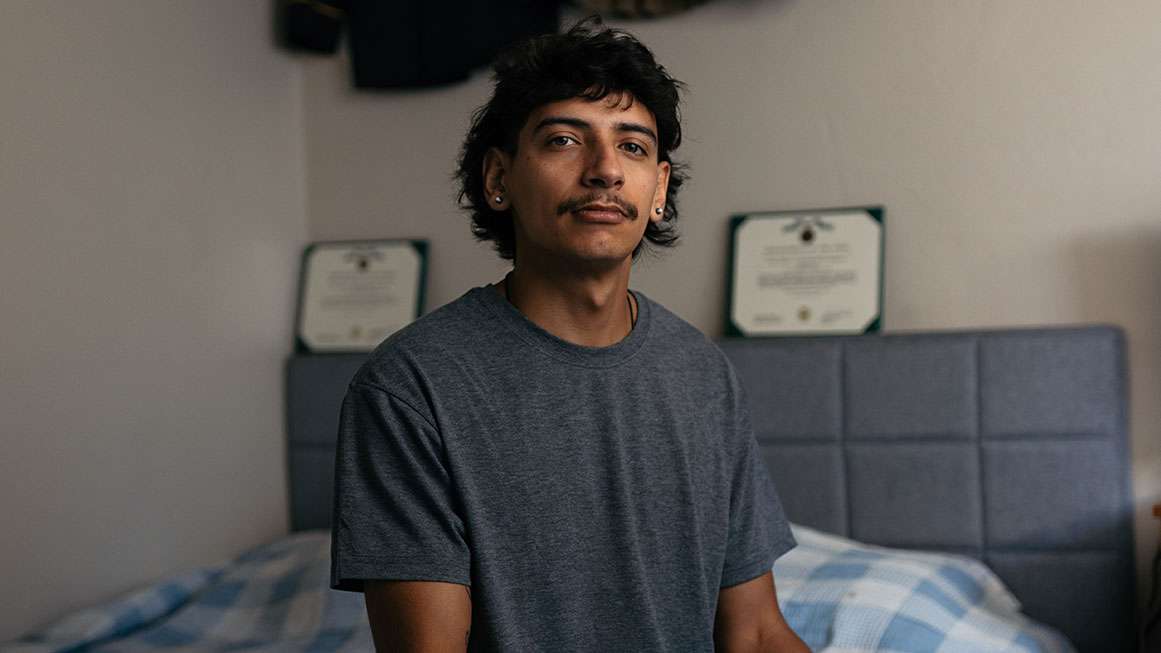
“I didn’t do anything wrong,” George Retes, a U.S. citizen jailed for three days, tells
Reason.
George Retes woke up on July 10, 2025, hoping the day would mark a turning point for him. Retes, a veteran of the U.S. Army, worked as a security contractor at a licensed cannabis operation in Ventura County, California. After seven months on the night shift—from midnight until 8 a.m.—he was eager to shift to daytime hours so he could spend more time with his family.
“I do everything for my kids,” says the 25-year-old father. “That’s what life is about.” When the new schedule finally came through, he viewed it as a prime chance to improve things.
The morning began with ordinary routines as he navigated the back roads toward his first day on the day shift. Yet when Retes reached the entrance to his workplace, he encountered chaos: cars everywhere, some unmanned, drivers weaving around other vehicles. Alongside officers from various federal agencies, Immigration and Customs Enforcement (ICE) had a strong presence, while demonstrators filled the scene.
Earlier in 2025, President Donald Trump had begun a sweeping deportation push. By mid-year, workplace raids spread across Southern California as agents pressed toward an ambitious target of 3,000 arrests per day, spurring fear and disorder. After protests erupted in Los Angeles, Trump dispatched around 4,000 National Guard troops to restore order.
Yet, lacking any work-related warning not to come in, Retes pressed onward. “I still have to report for work like any other day,” he explains. “I need to get paid. I need to keep a roof over my kids’ heads.”
Such narratives became commonplace during the latter years of the Trump administration. People left their homes for jobs, classes, or appointments, only for a routine trip to devolve into upheaval when an immigration raid surfaced en route.
Working through a sea of parked cars and protesters, Retes eventually found a blockade of agents closing in on him in the middle of the street. Determined to arrive on time, he inched forward and stopped his car, stepping out to request permission to pass. “I was still a fair distance away, and I put my car in park,” he recalls. “I exited, stood beside my vehicle.”
The agents began shouting, Retes recounts. “Get the fuck out of here!” “Leave!” “Get back in your car!” “Pull over to the side!” “You’re not going to work.” “Work is closed.” Retes asked for a badge number to relay to his supervisor when he didn’t show up on time. That simple request only seemed to inflame the officers further.
According to a November 2025 report from the Cato Institute, roughly three out of four ICE detainees have no criminal history and are otherwise law-abiding undocumented immigrants—but some of those arrested are citizens, like Retes.
“The moment I spoke up as a U.S. citizen, that I was simply trying to get to work…they didn’t care,” Retes says. “From the outset they were openly hostile.”
Rather than escalate, Retes climbed back into his car to comply with the officers’ instructions and depart. But the agents advanced abruptly, closed in on his vehicle, and began striking the windows and tugging at door handles, ordering him to exit. Another officer commanded him to reverse, and yet another instructed him to pull aside. “They were all yelling contradictory orders while I was just trying to leave the way they told me,” Retes recalls. “What was I supposed to do?”
Retes backed into the right-hand lane to clear the path. As he did so, the agents set off tear gas behind him, enveloping his car and leaving him trapped.
‘Just a Ragdoll’
“I’ve trained with tear gas in basic training, so I’d experienced it before,” Retes says. “But this felt completely different because I wasn’t on a controlled base… I was a civilian now.” For a brief moment the agents left him alone. Unable to see through the fumes and unwilling to strike at those behind him, he decided to stay put and hope for a safe outcome.
But the officers returned, pounding on the car windows and yanking on the door handles. Retes, coughing and trying to catch his breath, pleaded that he was trying to leave. Then glass shattered. An officer reached through the broken window to pepper-spray his face. A moment later, Retes was dragged from his vehicle.
Not knowing what the armed officers would do next, Retes offered no resistance. “In that moment I felt like a ragdoll,” he says. Nevertheless, one agent pinned his back with a knee, another pressed against his neck. “I kept begging that I couldn’t breathe,” he notes. “They wouldn’t listen.”
He was restrained with zip ties and carried to the farm where he works. Officers began passing him to other agents, asking aloud, “Who’s going to be responsible for this?” as they walked him along.
Puzzled about what had just occurred and why, Retes waited to demonstrate his citizenship. “I didn’t do anything wrong,” he says. “I assumed they’d finish up and let me go.” He remained tied up on the ground for four hours. “They only asked for my ID once during that time,” he explains. He told them his ID was in the car—the one bearing a disabled-veterans license plate. “I don’t know if they ever checked it.”
DHS officials had argued that their raids targeted the “worst of the worst criminal illegal aliens,” so Retes—who might have faced racial profiling—reasoned that once he proved his citizenship, he would be released.
But a new pattern was emerging. By October 2025, ProPublica identified at least 170 Americans who had been detained—sometimes violently—and held by immigration agents. (The total remains unknown, as the federal government does not collect data on how many U.S. citizens are detained during immigration enforcement.) One man detained twice in Alabama reported officers telling him his REAL ID was fake; a woman in Los Angeles was tackled to the ground when her mother dropped her off for work near a sting.
Eventually, agents placed Retes in an unmarked vehicle and drove him to a Navy base. There, officials took his fingerprints, photograph, and a mouth swab for DNA. “They ended up reading me my rights and told me they were merely investigating the entire incident and why I was there,” Retes recalls. “They never said I was being charged with anything. They never said I was under arrest.”

‘There Was No Explanation’
Retes says he complied with every instruction. He figured that once officials obtained sufficient verification of his citizenship, they would release him. Instead, they transported him to the Metropolitan Detention Center in downtown Los Angeles.
“When they took me to the facility… it was one successive moment after another, and I was utterly confused,” Retes explains. “There was no justification.” He was processed and subjected to a strip search like any other inmate. When he asked if he could contact his family or a lawyer, Retes says he was simply ignored. The same echoed for his requests to take a shower to rinse away the lingering tear gas and pepper spray.
“That entire Thursday night, my body felt on fire,” Retes recalls. “My hands, my face… it was a warmth beyond description. Imagine burning while you’re powerless to do anything.”
The next morning, following a medical evaluation that included some mental-health questions, Retes was placed in a suicide-watch cell—an orange-yellow concrete chamber with a narrow window, a slim mattress, and constant lighting. “A guard stays with me around the clock, noting my every move every ten minutes, and I’m stark naked in a hospital gown,” he notes. Despite numerous pleas, he was never allowed a phone call.
“That Sunday morning, close to midday, a officer approached and said I was removed from suicide watch and would be released. Then he walked away,” Retes recalls. Hours later, another officer finally opened the cell door. As he dressed and collected his belongings, officers told him he would be free to go after more than three full days in custody.
“So I asked, ‘So you had me locked up here, and I missed my daughter’s birthday for no reason?'” he says. What followed was the loudest silence he could imagine.
‘This Is Much Bigger Than Just Me’
Retes didn’t receive an explanation for his arrest until he described the traumatic incident in a September op-ed for the San Francisco Chronicle. The Department of Homeland Security replied with a post on X claiming Retes had been arrested for assaulting law enforcement officers.
“That was the only explanation I got from the whole episode…a tweet… and it was false,” Retes says. “I was stunned.” Although video footage of the incident was widely available, the agency persisted in avoiding accountability.
“From the moment I was inside, I knew something about what happened wasn’t right,” he says. “If I ever get out, I need accountability and an explanation.”
This wasn’t the first time the agency had used false statements after its aggressive immigration enforcement tactics were scrutinized. Throughout Trump’s second term, DHS has increasingly resorted to claiming—without evidence—that those arrested, injured, or even killed by immigration officers were “violent” or even “terrorists.”
Those fabrications gained notoriety after the killings of Renée Good and Alex Pretti in January 2026, when DHS officials wrongly asserted that both had planned domestic terrorist acts. But DHS had been routinely misinforming the public long before then.
For example, in Chicago, after an immigration officer shot an American woman five times, DHS claimed the agents had been “boxed in” by domestic terrorists and acted defensively after their vehicle was “rammed” by the woman. The woman survived, and federal charges against her were dropped when evidence contradicted the officer’s account.
As of this publication, DHS has not retracted its statements about Retes.
Regrettably, holding government agents accountable remains an uphill climb. Suing federal officers for constitutional rights violations is notoriously challenging. Although the U.S. Supreme Court’s decision in Bivens v. Six Unknown Named Agents of the Federal Bureau of Narcotics (1971) acknowledged that Americans may sue federal officials for damages tied to Fourth Amendment violations, that precedent has been effectively undermined in recent years. This lack of redress is a reason some lawmakers are attempting to codify the Court’s Bivens ruling into federal statute. By amending a federal law known as Section 1983 to cover federal officers, legislators would establish a pathway for citizens to sue law enforcement for misconduct.
When Retes learned from his lawyers at the Institute for Justice, a nonprofit legal organization, how difficult it would be to hold the officer involved in his case accountable, he was stunned. “If someone infringes on your rights, you should be able to obtain accountability and justice for what happened to you,” Retes says. Yet after grasping the legal obstacles ahead, he described it as a turning point. “This goes far beyond me,” he states. “There are so many others going through this.”
Rather than dwelling on it, Retes and his lawyers filed suit under the Federal Tort Claims Act against the federal agencies implicated in his three-day detention, arguing that their actions violated his Fourth and Fifth Amendment rights. They are also leveraging a California statute to sue unnamed officers who interfered with Retes’ constitutional rights. While awaiting court decisions, Retes has traveled to Washington, D.C., on multiple occasions to meet with lawmakers about strengthening Section 1983. He gave testimony at a bicameral public forum last December and attended the State of the Union address in February to represent those harmed by unconstitutional actions taken by federal agents.
“I know my case resonates with a lot of people,” Retes says. He doesn’t just want redress for himself; he aims to create a path for others to obtain justice. “It shouldn’t matter if you’re a veteran, what your skin color is, or whether I’m an immigrant,” he adds. “We all deserve fair treatment and human dignity.”
