
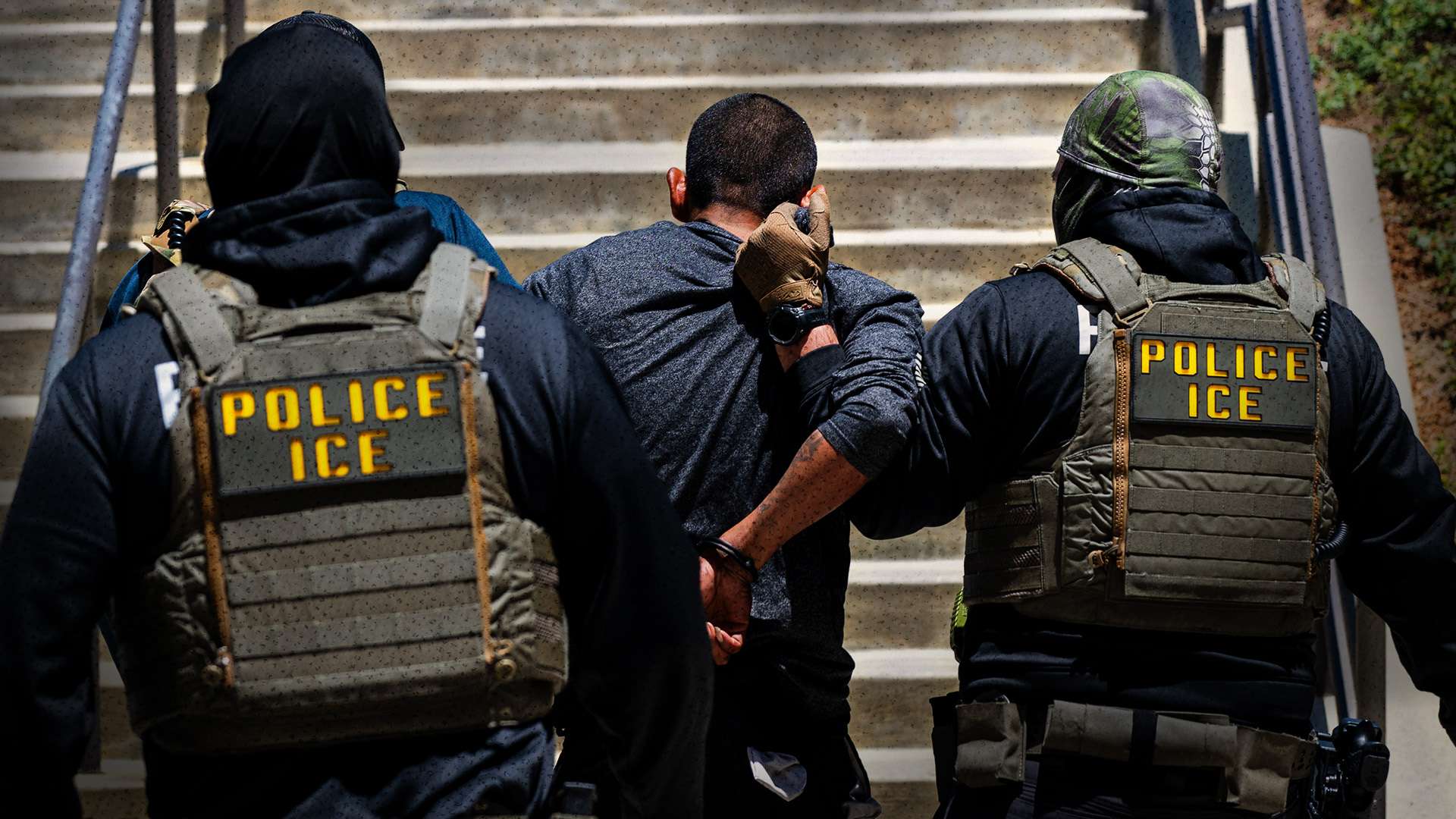
A lawsuit filed last week by several California institutions contends that the Department of Homeland Security (DHS) operates a program that harasses and pressures American citizens exercising the essential right to vote.
The Unlawful Voter Initiative, a program rooted in the Trump administration, aims to identify noncitizens who allegedly vote in U.S. elections. Earlier this month, Senators Chuck Schumer (D–N.Y.) and Alex Padilla (D–Calif.) released evidence from an unnamed whistleblower indicating that the initiative is deliberately sweeping up known U.S. citizens for possible investigation and interrogation by Homeland Security Investigations (HSI) agents.
A transcript from a training video describes DHS cross-referencing data from U.S. Citizenship and Immigration Services (USCIS) with voter rolls and other information “brought in through supplemental magic.” (The meaning of “supplemental magic” is not explained.) The video notes that the USCIS database includes naturalized U.S. citizens and even American-born citizens married to foreigners, but directs officers to verify whether naturalized individuals had registered to vote before acquiring their citizenship.
Officers are assigned a quota of five subjects per hour to review and potentially add to TECS, a federal criminal watchlist, according to the whistleblower’s report. HSI—which typically handles cases involving human trafficking, drug trafficking, and child exploitation—has been ordered to begin interrogating people suspected of voter fraud as part of a “surge” starting on September 1, a document leaked to CNN states.
Just as the whistleblower warned, Americans have found themselves in the crosshairs of the operation. DHS sent a list of 185 alleged noncitizen voters to Nevada, only to discover that every single person on the list was actually a U.S. citizen, The New York Times reported on Thursday afternoon.
San Francisco’s city and county government, along with Santa Clara County, have filed suit, joined by the California Nurses Association— which asserts that at least one of its members was intimidated from voting in person—and Voto Latino, a get-out-the-vote nonprofit founded by actress Rosario Dawson and businessman Phil Colón. The lawsuit alleges that HSI agents “will engage in coercive confrontations with American citizens in a manner that intimidates voters.”
The plaintiffs are asking the court to bar DHS from “deploying DHS agents to the homes of U.S. citizens to interrogate them about voter eligibility” or to otherwise “interfere with the midterm elections.”
Asked by Reason for comment on the lawsuit, the DHS press office said it needed more time to respond and had not replied to several follow-ups as of publication time.
Secretary of Homeland Security Markwayne Mullin told Fox News on Saturday that the department is “looking into” 300,000 cases and has 1,620 cases “under investigation,” with 151 arrests reported. But Acting Deputy Attorney General Trent McCotter told reporters that the Department of Justice (DOJ) has charged only 70 people in total with unlawful voting since the start of the second Trump administration in January 2025.
DOJ spokesperson Kiersten Pels admitted to AP News that some of HSI’s arrests from “voter fraud investigative leads” were not tied to illegal voting. In other words, HSI is using the voter rolls and the USCIS database to conduct a broader probe into potential federal offenses.
The California lawsuit contends that DHS immigration-enforcement agents “have also in other contexts shown an inability to target only non-U.S. citizens. They have, on numerous occasions, profiled, harassed, and unlawfully detained U.S. citizens,” and argues that such conduct has created widespread fear among ordinary citizens—especially those perceived to have ties to immigrant communities—even though, in theory, U.S. citizens should have nothing to fear from immigration agents.
