
UK Speech Regulators Aim to Expand Restrictions Across the World
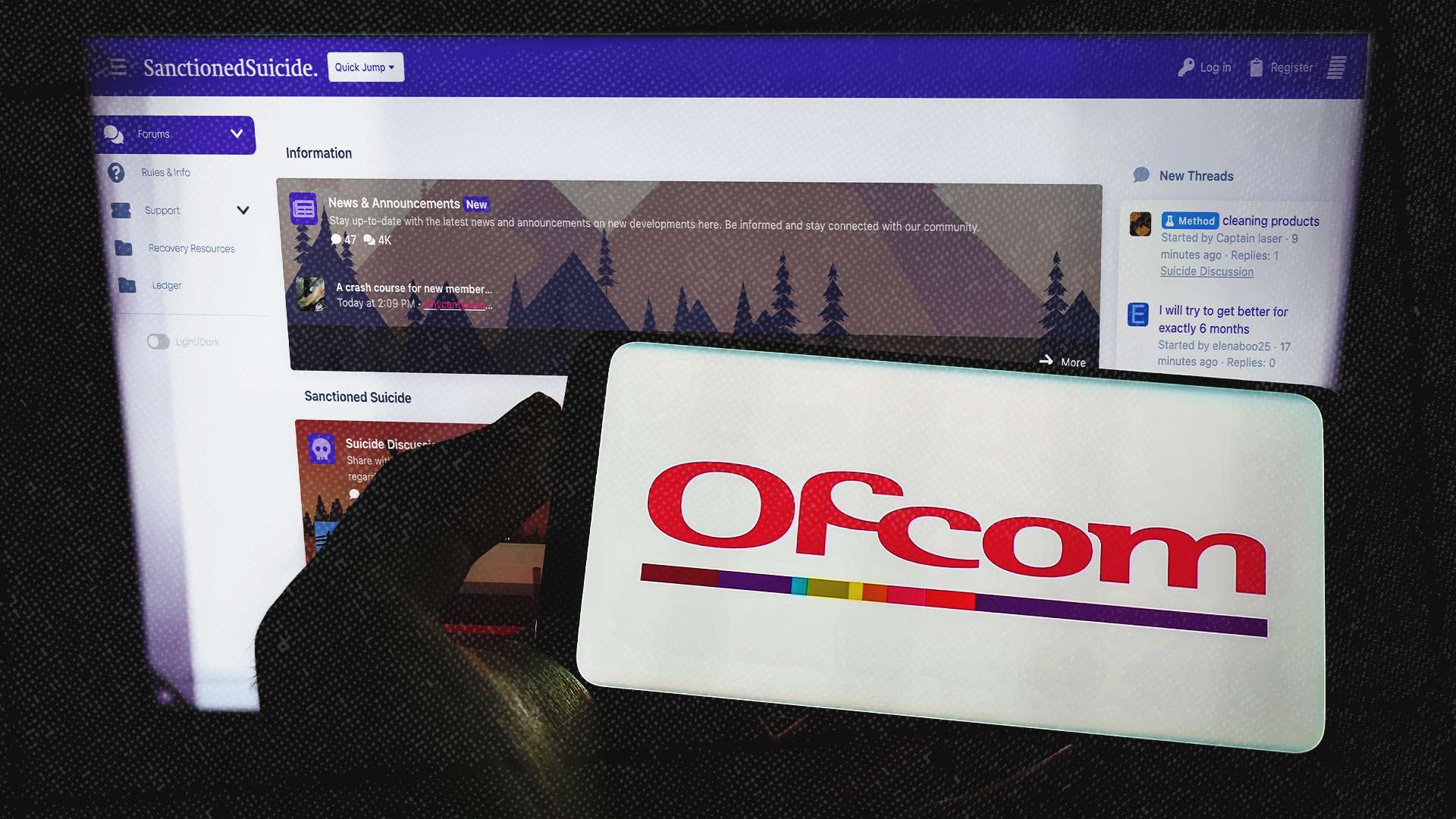
Britain’s online regulators are at it again, aiming to penalize American websites for content that is perfectly lawful on the other side of the Atlantic yet runs afoul of the UK’s tightening rules on free expression. In this instance, Ofcom—the nation’s telecoms regulator—imposed a £950,000 ($1,273,000) sanction on a U.S.-based forum where some discussions center on suicide, even though the site had tried to block access for British users. While the regulator is unlikely to ever recover the money, its drive to police speech beyond the UK’s borders threatens to create a restricted, walled-off online space for residents of Britain.
You are reading The Rattler from J.D. Tuccille and Reason. Get more of J.D.’s commentary on government overreach and threats to everyday liberty.
£950,000 Fine for Content Legal in the U.S.
“Ofcom has today fined the provider of an online suicide forum £950,000 for not complying with duties under the Online Safety Act to protect people in the UK from illegal content,” the censorial agency announced May 13. “It is a criminal offence in the UK to intentionally encourage or assist suicide. Under the UK’s Online Safety Act, providers of ‘user-to-user’ services are required to assess and mitigate the risk of UK users encountering this type of content on their platforms. This includes swiftly taking down illegal content when they become aware of it.”
That’s useful information to know in the context of British law. But the online suicide forum in question, Sanctioned Suicide or SaSu (unnamed in the Ofcom announcement “due to its nature”) is based in the U.S., where such content is protected by the First Amendment. Ofcom addresses this inconvenient situation in its announcement:
The fact that the provider is based outside the UK does not mean the forum is outside the scope of the Act. It is capable of being used by people in the UK, including without a VPN, and presents a material risk of significant harm. The Act is clear that this means it must comply with our online safety laws.
That’s a bold claim of jurisdiction over any website that’s accessible through a browser to the people of the U.K. Taken seriously, it would suggest that Saudi Arabia, for example, could punish Britons for posting risqué beach photos of themselves on the internet, or that China could do the same to anybody publishing Winnie the Pooh images mocking President Xi Jinping.
That is, it’s preposterous.
Interestingly, Ofcom claims that SaSu is accessible in the U.K. “without using a VPN,” which isn’t true. The forum geoblocked U.K.-based internet users months ago, as a courtesy to the country’s laws. After the fine was announced, confused Britons posted images of the “unavailable for legal reasons” notices they saw when trying to access the forum.
SaSu’s attorney, Preston Byrne, writes that in digging through Ofcom’s legal documentation of its case against SaSu, “we found, buried deep in the document and its footnotes, that Ofcom’s evidence-gathering in this case was based on deliberate circumvention of the geoblock, both by Ofcom investigators and by the NGOs” with which it works to target offending internet content. “The bulk, if not the entirety, of Ofcom’s evidentiary file was gathered via VPN use.”
Principled Opposition to Overreaching Censors
Remember that imposing a geoblock was a courtesy. SaSu and the other U.S.-based websites Bryne represents enjoy America’s robust protections for free speech.
“Keep in mind that, under U.S. law, SaSu violates no law,” notes Byrne. “It is completely within its rights to ignore Ofcom’s demands entirely and choose to allow users to access the site, without restriction, from anywhere on Earth.”
Byrne is a practicing Catholic who objects to much of SaSu’s content, as well as that of other sites he represents, including 4chan, Gab, and Kiwi Farms. But he strongly believes in free speech, and he calls out “the gravity of Ofcom’s attempts to censor Americans.”
Reclaim the Net, a free speech advocacy group, reports that “Ofcom confirmed that as of February 26, 2026, it had issued 197 Section 100 notices to US businesses,” bypassing formal channels for cross-border criminal complaints. Of course, Ofcom is filing complaints about things that are not crimes in the U.S. and, according to Reclaim the Net, appears to have achieved 98-percent compliance from the businesses it contacted just by sending scary emails. “A British regulator sent nearly 200 demands to American companies, bypassed every established legal channel, and almost all of them appear to have simply done what they were told,” the group comments.
Those compliant businesses don’t include Byrne’s clients, who have refused to cooperate with Ofcom. They’ve famously responded to Ofcom’s demands with hamster imagery, which began with the lawyer’s comment in a letter that the censor’s correspondence “will make excellent bedding for my pet hamster.”
Censors’ Real Goal May Be To Wall Off the U.K.
Such exchanges, and the so-far-unsullied track record of Byrne’s clients in ignoring Ofcom’s fines, suggest that American sites are at little danger from foreign censors if they choose to assert their rights. In fact, Ofcom may not really expect much else from Americans. The agency’s real goal is more likely to cut Britons off from parts of the internet through technical barriers against forbidden content.
“In the most serious cases of ongoing non-compliance, where appropriate and proportionate we can make an application to a court for ‘business disruption measures’, through which a court could require third parties to take action to disrupt the business of the provider,” notes Ofcom. “This could require payment providers or advertisers to withdraw their services from a platform, or require internet service providers to block access to a site in the UK.”
The broadcast regulator appears to be setting the legal ground for requiring British ISPs to block whole sections of the online world.
Reinforcing Speech Protections With Legislation
Ofcom’s censorship efforts have inspired Byrne and his allies to author legislation which would penalize foreign censors that threaten the rights of Americans, including allowing the seizure of foreign government assets. A version was introduced in Wyoming and Sen. Eric Schmitt (R–Mo.) says he’ll do something similar at the federal level.
Byrne also wants to go on the offensive by bringing something like American free speech protections to the U.K. He and his colleagues at the Adam Smith Institute, where Byrne is a senior fellow, drafted a Freedom of Speech Bill for consideration by British lawmakers. It would, in part, “repeal or amend enactments which criminalise expression by reference to offence or distress.”
The takeaway here is that the people behind the Sanctioned Suicide forum really aren’t at risk of having to cough up £950,000 to British censors, and more Americans should show the same willingness to fight. The same could be said of citizens of the U.K., who need to send their speech police packing.
