
Before Russia’s invasion of 2022, Ukraine was already a state with deep institutional weaknesses. Although it held competitive elections and maintained a certain alternation in power, its political system remained conditioned by the influence of oligarchs, high levels of corruption, and a rule of law that was, at least, incomplete. Since the start of the war, that scenario has been radically altered. The need to guarantee the state’s survival displaced many of the usual dynamics of democratic politics and concentrated enormous power in the presidency of Volodymyr Zelensky. For more than four years, that concentration has been justified by the demands of the conflict. However, the open political crisis this summer demonstrates that no war can indefinitely suspend politics or the demands for accountability.
The remodeling of the Government and the military leadership underway is not merely an administrative retooling. It reflects the beginning of a new phase in Ukraine’s political evolution. The dismissal of Defense Minister Mykhailo Fedorov, one of the administration’s most popular figures for his push for technological innovation, the digitization of the Armed Forces, and support for the national drone industry, has sparked a wave of criticism both within the country and among some of its major Western partners. The lack of a convincing political explanation gradually feeds the perception that strategic decisions are being made increasingly from a very small circle around the Presidential Office.
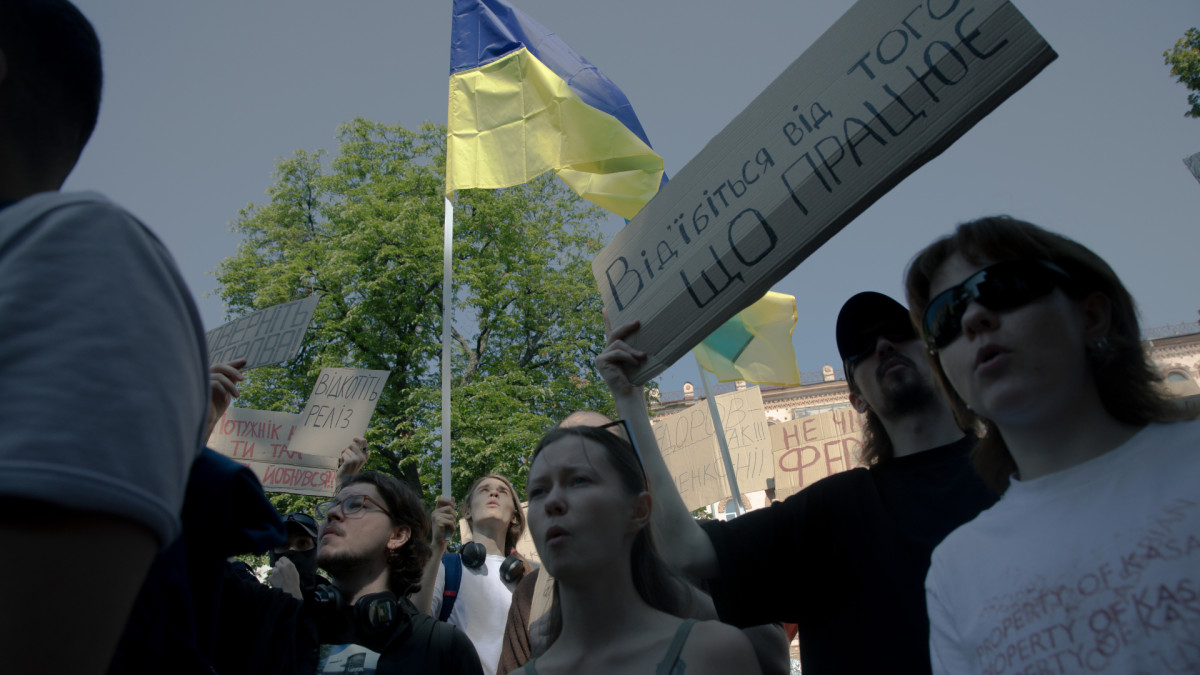
The demonstrations in Kyiv and other cities are particularly significant. They do not question the necessity of continuing the resistance to the Russian invasion, nor do they express a rejection of the war effort. What they are raising is a far more delicate issue: the fear that the concentration of power, initially legitimized by the war, is weakening the democratic mechanisms of checks and balances.
“The dismissal of the Defense Minister has triggered a wave of criticism both domestically and among some of its major Western partners”
It is not the first time Zelensky has faced such a reaction. Just a year ago he already had to backtrack on a reform that reduced the autonomy of the National Anti-Corruption Bureau and the Specialized Anti-Corruption Prosecutor’s Office after strong protests by civil society and warnings issued from Brussels. That reversal highlighted two fundamental elements. On the one hand, that Ukraine retains an extraordinarily active civil society, heir to the Maidan protests and capable of conditioning government decisions. On the other hand, that the European Union accession process remains one of the main external mechanisms of democratic scrutiny of Ukraine’s political system.
However, the current crisis runs deeper because it directly affects the heart of political and military power. The replacement of the Armed Forces’ Commander-in-Chief and the reorganization of the chain of command seek to convey an image of renewal at a moment when the war is undergoing a prolonged weariness. But personal changes cannot easily conceal a much more structural problem.
Over these years, a process of presidentialization of the political system has hardened. Martial law, centralization of decision-making, the subordination of Parliament to the Presidential Office, and the growing prominence of a small circle of advisers have shaped a governance model in which institutional checks and balances have gradually weakened. The war explains much of this evolution, but it is not enough to justify it indefinitely. The paradox is evident: the longer the conflict lasts, the more the government needs to preserve national unity. But precisely that prolongation brings to light debates that cannot be resolved simply by appealing to patriotism. Recruitment, mobilization, troop rotations, management of casualties, corruption in military contracting, or economic reconstruction are deeply political issues that directly affect the government’s legitimacy.
“The remodeling of the Government and the military leadership underway is a reflection of the start of a new stage in Ukraine’s political evolution”
To this is added a much more complex international context than in the early years of the war. Western support no longer presents the same solidity. The second Trump administration has introduced new elements of uncertainty into the transatlantic relationship, while some European governments show increasing difficulties in maintaining the same level of financial and military commitment. Zelensky needs to project stability and reliability outward while trying to respond to growing internal discontent, though he does not always do so according to democratic criteria. Not every time are both objectives compatible.
There is also an element that deserves special attention from a European perspective. In the past, Ukraine has tended to be presented as a fully consolidated democracy that only needed to resist Russian aggression to join Western institutions. That image oversimplifies, if not distorts, a reality far more complex. Even before the war, Ukraine was an electoral democracy with significant deficits of institutional quality, strong oligarchic influence, and serious corruption problems. The invasion did not erase those weaknesses; it merely hid them under the necessities of war. The current protests reveal that Ukrainian citizens are willing to demand transparency and limits on power even in extraordinary circumstances. This dynamism is one of the main political assets of the country as it moves toward its future European integration, but undoubtedly it is not enough.
Yet, it would be erroneous to idealize the situation either. The personalization of leadership carries growing risks. In the early months of the invasion, the identification between Zelensky and the national resistance was a crucial element for maintaining social cohesion. But as the war has become a prolonged conflict, that identification, far from working in his favor, could work against him—something the president surely tries to avoid through two means: first, sidelining potential political opponents; second, concentrating more power.
“The current protests show that Ukrainian citizens are willing to demand transparency and limits on power even in extraordinary circumstances”
Thus, one of the first challenges Ukraine faces today is not merely sustaining the war effort. The question being raised is no longer only how to sustain it, but what kind of State will emerge when the war ends. Rebuilding infrastructure will be a colossal task, but it will likely be even more difficult to reconstruct institutions capable of rebuilding the democratic mechanisms that have inevitably eroded during these years of exception.
The political crisis of this summer 2026 does not necessarily herald the end of Zelensky’s leadership. He remains one of the country’s most popular political figures, and the opposition remains highly fragmented. But it does mark the end of a period in which legitimacy derived solely from resisting the Russian aggression seemed enough to govern with little contest.
If Ukraine truly aspires to become a member of the European Union, success will not depend solely on its ability to defend its territory or on the military capabilities it has acquired. It should also depend, and this depends on the European side, on its ability to demonstrate that the exceptional nature of the war does not become a permanent way of exercising power. If Ukraine does not advance along the path of democratic regeneration, the outcome of the war could be irrelevant not only for Ukraine but for the very nature of what the EU says it defends.
