
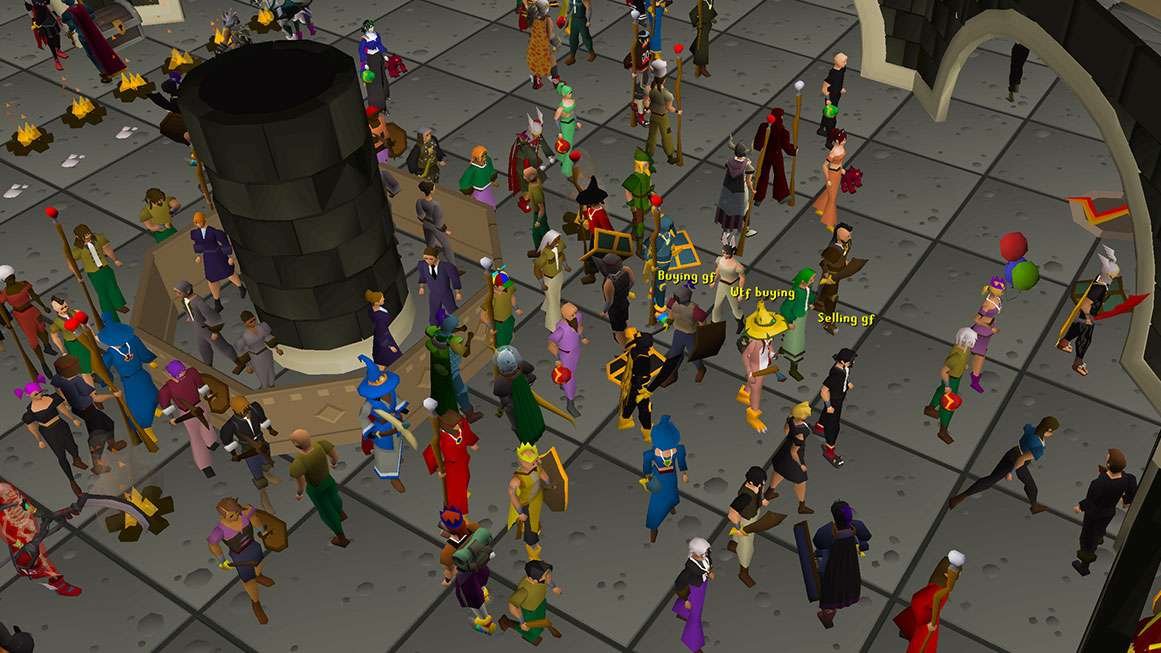
Venezuelan players extract in-game resources and convert hours spent playing into cash or digital currencies.
Against a backdrop of political uncertainty in Venezuela, the tremors of change reach beyond Caracas and into the intricate economy of a decades-old browser-based game.
In the last ten years, thousands of Venezuelans have signed into Old School RuneScape (OSRS) not merely to play but to earn. As hyperinflation eroded wages and traditional jobs vanished, Venezuelan players mined and gathered prized in-game resources and pursued the coveted level 99 in various skills, turning long hours of play into real money or cryptocurrency.
Their influence on the game’s internal economy grew so pronounced that domestic instability could destabilize the virtual marketplace. When blackouts struck or when many Venezuelans left the country, prices inside OSRS shifted almost overnight.
As Venezuela’s course shifts again, OSRS reminds us that the boundary between virtual and real economies is not as clearly drawn as it might seem—especially for people whose livelihoods rely on both spheres.
A Browser Game That Outlived Its Era
RuneScape debuted in 2001 as a Java-powered browser game created by brothers Andrew and Paul Gower. The game fused simple mechanics with relentless grinding in a fantasy world laced with dry British humor. Unlike many MMO titles of its era, RuneScape could run on nearly any computer with a dial-up connection. A free-to-play option allowed youngsters to log on without begging their parents for a monthly subscription.
Trading, barter, and exchange have long been embedded in the game, with players buying and selling the commodities—lumber, ore, and herbs—needed to reach the coveted level 99 in each skill. While not originally intended as a core mechanic, “playing” the economy quickly became a central delight of RuneScape. Players spontaneously organized bottom-up markets that rivaled real-world markets in sophistication. Infamously, some individuals even purchased in-game relationships, giving rise to the “buying gf” meme.
Underestimating the significance of this virtual economy, the game’s developer, Jagex, introduced economy-wide price controls and trade limits in 2008, hoping to curb the real-world sale of in-game gold. The update triggered protests across virtual cities in RuneScape, with players demanding the restoration of “free trade.” Jagex yielded two years later, but the damage was done: the temporary abolition of free trade—along with unpopular changes to combat mechanics and the advent of “pay to win” features—pushed many players away from the game.
The tale of RuneScape might have ended there. Yet the franchise now exists as two distinct games. The original evolved into what players now call RuneScape 3, while in 2013—at popular demand—the developers revived a 2007-era version of the game dubbed Old School RuneScape.
The older version now sees roughly ten times the daily player count of the newer one. In 2025, OSRS surpassed a million paid members and attracted more than 240,000 concurrent players, the highest peak in its history. (RuneScape 3, by comparison, averages about 30,000 concurrent players.)
Part of that resilience comes from OSRS‘ unusually democratic development model. Learning from the decline of RuneScape 3, Jagex allows OSRS players to vote on new features, granting the community an unusually large role in steering the game’s evolution. But the marketplace remains a crucial factor as well. RuneScape has never been merely about quests or boss battles—it’s a comprehensive virtual economy.

Venezuela’s Collapse Meets a Virtual Marketplace
In the late 2010s, as hyperinflation gnawed at salaries and political turmoil hollowed out Venezuela’s formal labor market, many Venezuelans turned to OSRS—not to escape reality, but to endure it. Within the game’s medieval fantasy world, players mined resources, defeated monsters, and amassed virtual gold, which could be traded outside the game for U.S. dollars or cryptocurrency. The digital gold offered more stability than the bolívar, Venezuela’s official currency.
The shift reflected the magnitude of Venezuela’s collapse. Once among South America’s wealthier nations, Venezuela has endured one of the most severe economic crises in modern history, triggering mass migration and widespread poverty. By 2019, independent surveys estimated that roughly 96 percent of Venezuelans lived in poverty, with the majority unable to afford basic necessities.
As formal employment became less viable, many Venezuelans turned to digital work: freelance gigs, cryptocurrency mining, and online games with sophisticated economies.
OSRS was a particularly appealing option. The game’s modest hardware requirements made it accessible on aging computers, and its low data usage allowed players to operate despite slow internet speeds. Most importantly, the in-game currency held real-world value, even if selling in-game gold violated the game’s terms of service.
“Over time my salary became less than four dollars a month,” one Venezuelan player told Polygon in 2019. “I decided to try a game my neighbor was telling me to play for money.” By “farming” RuneScape gold, the player earned hundreds of dollars each month, enough to help his family leave the country.
Farming has existed in online games for decades: Players accumulate virtual currency or valuable items and then sell them outside the game. But Venezuela brought both a new scale and a new motive to this old practice. With the bolívar losing value by the day, RuneScape gold became a more reliable store of value than local wages.
Other players shifted away from gold farming toward other activities, such as account leveling. Increasing a character’s agility from 1 to 99 (the highest level) can take more than a week of nonstop play, according to Jagex. For players with more cash than free time, paying someone else to undertake the famously arduous grind to level 99 can be enticing—even if it is also a violation of the game’s terms of service.
A Venezuelan OSRS player, preferring to remain anonymous, tells Reason that he was working in IT in 2016, providing maintenance, repairs, and systems support. But the country’s economic collapse was reshaping his daily life and the value of his work. “At that time, the bolívar was basically worthless,” he says. “My salary didn’t even cover a week’s worth of groceries.”
That same year, he created an account on OSRS after hearing about it from friends. The game ran smoothly even with an unstable internet connection. When the company he worked for began scaling down operations and sending employees home early, he suddenly had more time. He already played MMOs as a hobby, so he adapted quickly.
“I played for several months, and when the company closed at the end of 2016, I started dedicating much more time to the game,” he says. He wasn’t chasing profit at first. While other players farmed in-game currency to sell, he focused on maxing out his account. But “when the crisis became more severe, I had to sell my account on a website….After completing the process, [the website] emailed me offering work doing services in OSRS on one of their servers.”
“There was a minimum deposit of $250 required to join, which I didn’t have—but they were buying my account for $350,” he recalls. “So I used part of my payment, $250 to be exact, in order to get in.” Soon he was defeating in-game bosses for pay and making “an amount that was very significant compared to my regular income.”
Finding a normal job was hard. “I’m a professional systems engineer, and salaries were extremely low,” he says. “I think the most I was offered in several interviews was $40 to $50 a month, which was very little considering I was earning much more money from the comfort of my home.”
Specialized marketplaces and intermediaries emerged to facilitate transactions, converting in-game assets into cash. Some players reportedly earned more than $300 a month—modest by global standards, but significantly more than many Venezuelan jobs paid at the height of hyperinflation.
A Fragile Economy in a Fantasy World
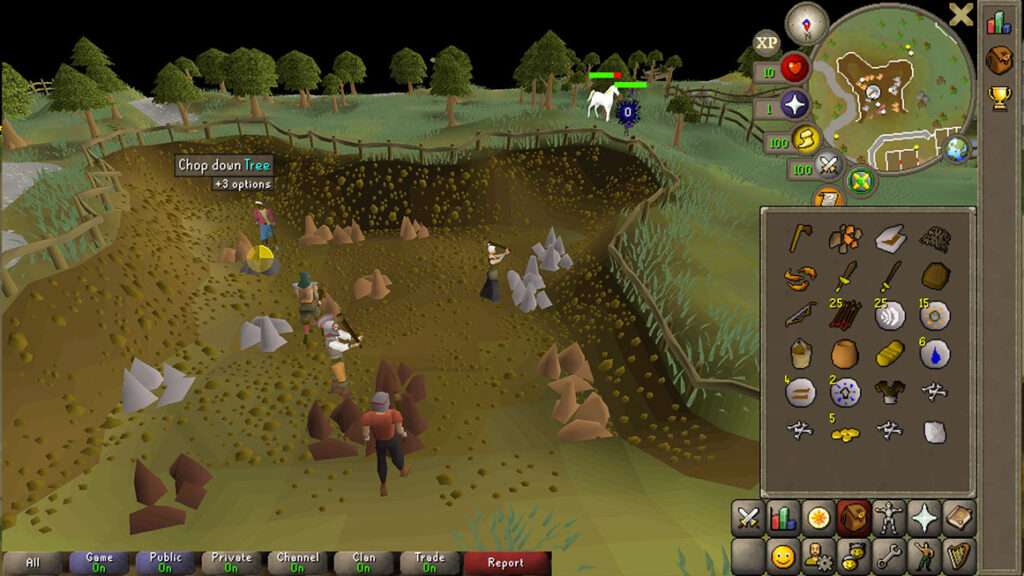
RuneScape‘s fiercely competitive market operates on the same forces as any real-world economy: supply and demand. When prices rose for goods—from dragon bones to Zulrah’s scales—Venezuelan players would jump into action and flood the market with more supply.
Yet the system was never fully legitimate. Real-world trading violates Jagex’s terms of service, and the company has long attempted to curb the practice. Former CEO Mark Gerhard once estimated that as much as half of active players had purchased gold from third parties. Despite bans and enforcement efforts, many farmers simply create new accounts or work through intermediaries.
Within the OSRS community, Venezuelan activity was consistently controversial: many players grew frustrated with “vennies” crowding popular gold-farming spots, such as green dragonhides, and flouting the game’s ban on real-world trading. At the same time, many recognized that the game served as a crucial economic lifeline for Venezuelan players. In more than one thread on r/2007scape, OSRS players debated the ethics of “player killing” Venezuelan participants, with one remarking, “I know they’re just trying to put food on the table for their families but it’s ruining the game and I can’t help but feel a bit of Schadenfreude about it?”
For Venezuelans relying on the game, however, the greatest danger wasn’t Jagex or fellow players but their own infrastructure. In March 2019, power outages swept the country, leaving millions without electricity for days. Venezuela’s internet connectivity—already among the slowest in the world—collapsed along with the grid. For players who depended on steady gameplay to earn income, the blackouts were devastating.
Inside OSRS, the effects were immediate: as thousands of Venezuelan players vanished from servers, the supply of certain farmed items dwindled. Nature rune trading volume—a pillar of the virtual economy—fell by half. Prices for commonly farmed commodities such as dragon bones and black chinchompas (a type of weapon) swung sharply, revealing how deeply the game’s economy had become entwined with real-world labor conditions. Players suddenly faced scarcity of items that had previously been abundant.
A Changing Landscape
The RuneScape franchise marks nearly a quarter-century of existence amid renewed growth, even as Venezuela’s path remains uncertain. Some Venezuelan players have migrated to other MMOs, such as Tibia or World of Warcraft. Others have fully dedicated themselves to boosting accounts.
Today, Reason‘s Venezuelan source describes boosting—the practice of playing on behalf of others for pay to raise their ranks or skill levels—as a growing industry, particularly among Venezuelan gamers navigating a fragile economy. “I know several friends who do the same,” he says.
“Some tasks pay a lot of money in a short time—it all depends on client demand,” he adds. “A job in Venezuela today might pay at most around $150 [a week] plus bonuses. With boosting, you can make over $500.”
On January 3, 2026, the U.S. military raided Caracas and captured dictator Nicolás Maduro and his wife. They were transported to New York City and placed in federal custody to face drug-trafficking charges. President Donald Trump framed this as the opening step in an effort to rebuild Venezuela’s economy and political system. “We are going to run the country until such time as we can do a safe, proper, and judicious transition,” he said at a press conference.
What form such a transition will take remains unclear. The Chavista regime retains control of the country. Maduro’s longtime vice president, Delcy Rodríguez, was sworn in as interim president and has signaled willingness to cooperate with Washington. Yet her track record is nearly as controversial as Maduro’s, having overseen much of the country’s feared intelligence service and facing a long history of human rights concerns.
If economic conditions in Venezuela shift again—driven by political change, new opportunities, or renewed instability—the consequences could ripple through the OSRS marketplace once more. A sudden decline in Venezuelan players could reduce the supply of goods and push prices higher again.
OSRS isn’t simply a place for quests, community, and nostalgia. It stands as a reminder that in a globalized world, the lines between work and play, between virtual and real, are thinner than ever.
