
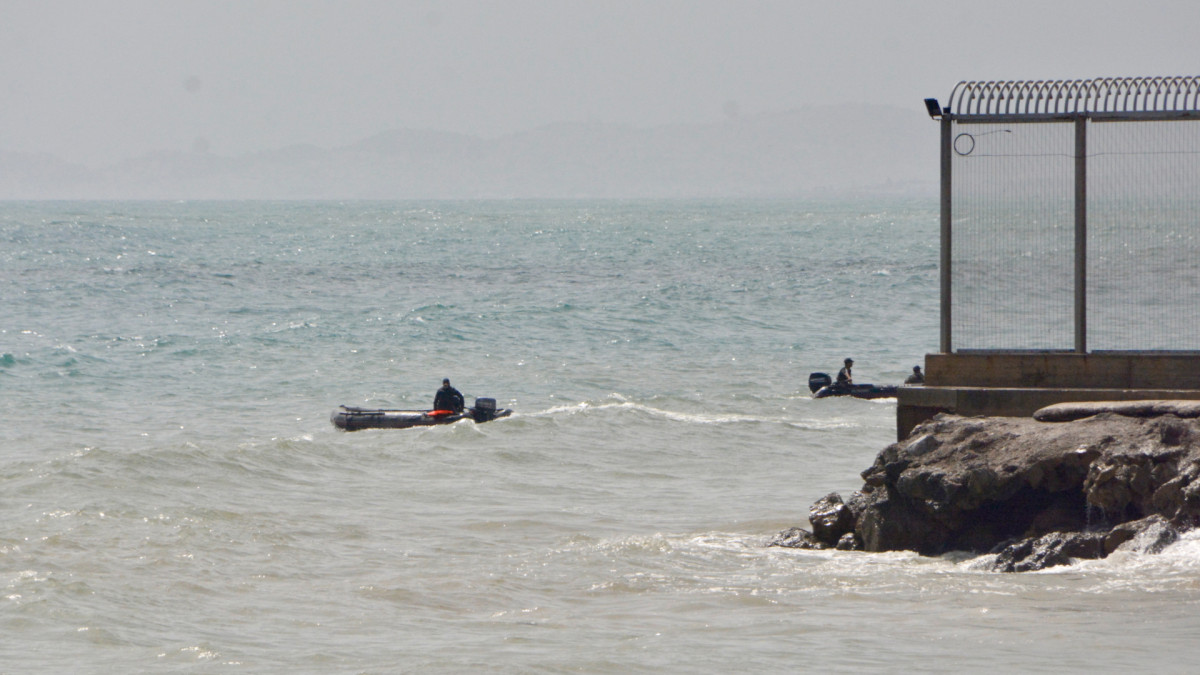
Following the mass migration episode in Ceuta, many questions remain unanswered. Agenda Pública has turned to prominent analysts to learn their views on how and why it happened, what it means for Spain’s relationship with Morocco, and why so many conspiracy theories rooted themselves online after the events. This is a story about migration, geopolitics, and disinformation. This is what the analysts shared with us.
Riccardo Fabiani
Riccardo Fabiani, project director for North Africa at International Crisis Group:
At this point, there is sufficient evidence to assert that Morocco was involved in the Ceuta crisis, though it is difficult to determine exactly what occurred. We know the mass arrival was organized online through groups and seems to have been largely spontaneous. At the same time, the Moroccan security forces almost certainly knew this was going to happen, as they monitor internet conversations. We also have migrant testimonies saying they were “encouraged” by security forces to head toward Ceuta, and we have videos of police remaining passive while migrants descend from trucks or queue to go to Ceuta. Finally, there is the 2021 precedent, when a similar crisis was almost certainly directed by Morocco.
“We can only make assumptions, but I believe the crisis was facilitated by Morocco, not manufactured by Rabat, and used to send a message to Spain”
“We can only make assumptions, but I believe the crisis was facilitated by Morocco, not manufactured by Rabat, and used to send a message to Spain. The message could have related to the unresolved status of Ceuta, as a reminder that Morocco regards it as occupied territory, and also as a way to respond to the exhortations of numerous right-wing American and Israeli officials who urged Morocco to act on Ceuta to “punish” Madrid for its support for the Palestinians and for its stance during the Iran war. But, again, this is a hypothesis and we have no way to prove it.
Although, of course, it is not justified to believe that the United States and Israel were involved in the crisis, it is reasonable to assume that Morocco may have wanted to do a “favor” for its allies, given the numerous calls to action issued by figures on the American and Israeli right. Regardless of what happened, the mere fact that we are discussing this possibility shows how unpredictable this American administration is and what the global perception is of the range of actions it might be willing to undertake.

Intissar Fakir
Intissar Fakir, senior researcher at the Middle East Institute:
We still cannot point to a single explanation. The factors seem to be a combination of difficult economic conditions, misinformation circulating on social networks, and possibly smuggling networks that facilitated the movements. What remains unresolved is whether Moroccan border authorities were truly overwhelmed by an unprecedented mass movement of people in an extremely short period or whether, on the contrary, they deliberately stepped aside and allowed the movement. These two possibilities lead to different conclusions. If this is an unprecedented operational failure, we must discuss Morocco’s resilience and whether the country is reaching the limits of its border-management system. If it was deliberate, we must discuss the incentives to use migration as a tool of political pressure in foreign policy.
This again shows how central migration is to the bilateral relationship. Attention has focused on reducing irregular migration trends and on how Morocco’s capacity to exert pressure grows as its role in border control expands. So, whether it was intentional or a failure, it obliges Spain and Europe to confront the implications of outsourcing border management.

Sabina Henneberg
Sabina Henneberg, senior researcher at The Washington Institute for Near East Policy:
The conspiracy theories are, of course, hard to explain, but in this case several factors may have converged. The Spanish Supreme Court ruling concerning migrants crossing by sea and the tensions between the United States and Spain could be a coincidence that helped feed accusations of a US and Israeli involvement in the rise in arrivals. However, the other trends highlighted by observers on social networks, such as the articles published by Rubin and the report on the Díaz-Balart budget bill, likely reflect the longer-term evolution of the Morocco–United States relationship, linked, of course, to Morocco’s relationship with Israel, more than a direct manipulation of a migratory crisis. Finally, this situation seems to have been fed by the misinformation about Ceuta migration spread on social networks, so it is not necessarily surprising that conspiracy theories about US and Israel involvement also spread through these channels.

David May
David May, director of research and senior analyst at the Foundation for Defense of Democracies:
Israeli Israelis and their supporters eagerly seized the opportunity afforded by the Ceuta crisis to highlight Spain’s hypocrisy in criticizing Israel while Madrid maintains colonial possessions. This came after years in which Pedro Sánchez and other Spanish ministers have waged a diplomatic campaign against Israel and condemned the Jewish state for alleged human rights abuses. Since Israel benefited from the instability and seemingly rejoiced in it, conspiracy theorists — and even a Spanish minister — suggested that Jerusalem had something to do with it. This fanciful thinking rests on classic antisemitic tropes about Jewish malice and covert influence, arguing that Israel can and would manipulate tens of thousands of Moroccan youths to storm a Spanish possession. The conspiracists cling to any sign to turn Israel into the scapegoat, rather than confronting Spanish policies and the geopolitical realities that actually led to the Ceuta crisis.

Federico Santi
Federico Santi, senior Europe analyst at Eurasia Group:
The lack of resources and attention from Spain probably played a role. It is hard to imagine an arrival of this magnitude without the acquiescence, if not the active participation, of the Moroccan authorities, which only intervened very late. The early anecdotal evidence seems to support this. As such, the latest episode in a series of similar events shows how exposed and subordinate Spain is to these kinds of pressure tactics, already tested, as well as Spain’s isolation within the EU itself. Spain is not alone in this: we have seen a similar dynamic in Tunisia, in relation to Italy, and in Turkey, in relation to Greece. More broadly, internal divisions within the EU and short-term electoral interests continue to prevent the Union from adopting a more strategic approach to migration and from using its economic and diplomatic weight more effectively on neighboring countries to better control irregular migration, with the human costs that this entails.
