
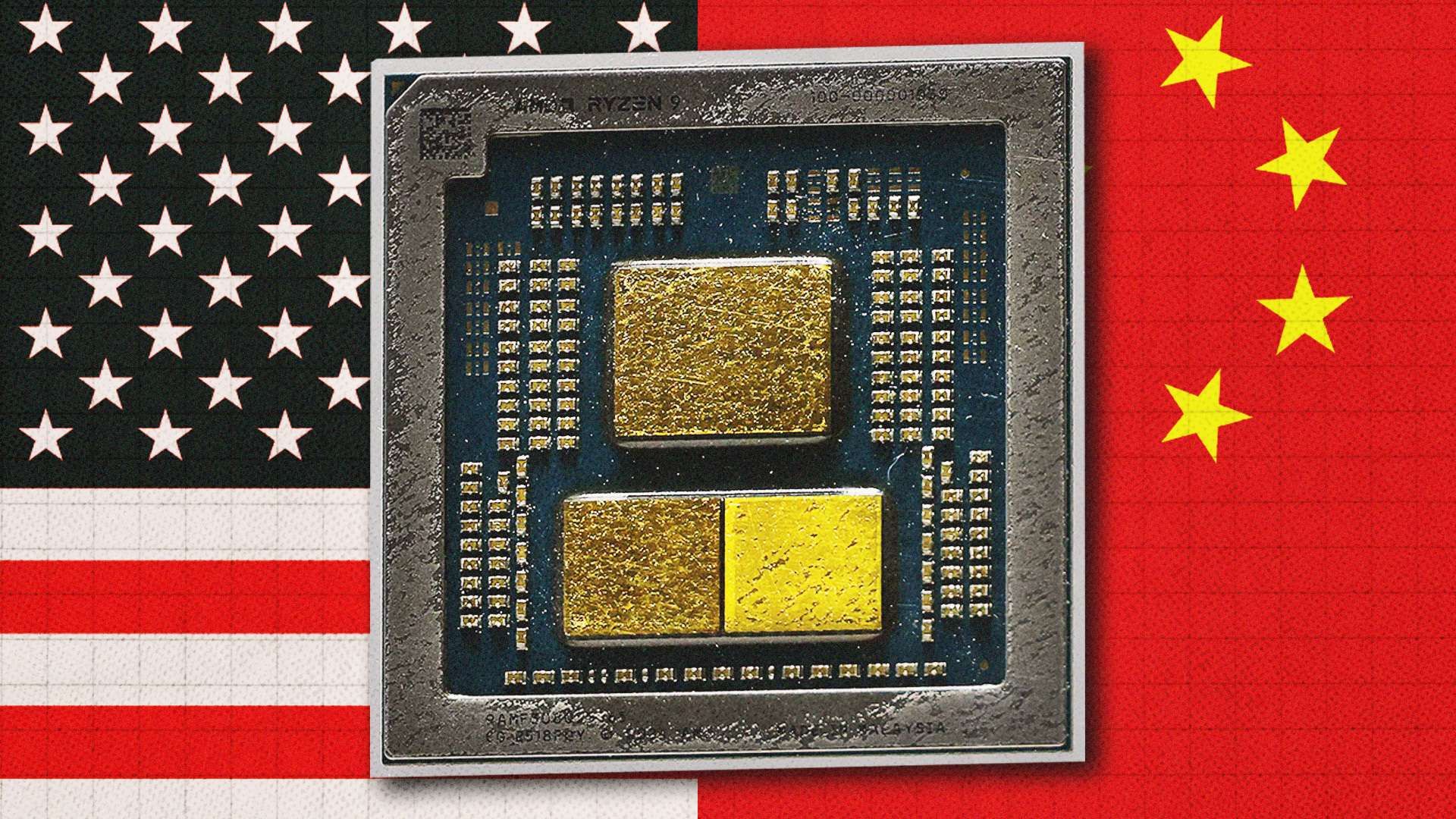
This Monday, the Bureau of Industry and Security (BIS) within the Commerce Department rolled out an interim final rule developed under the guidance of the Treasury Department and the National Security Council. The measure imposes nation-specific limits on “exports, reexports, or transfers (in-country)” of advanced semiconductor chips to overseas data centers that remotely provide substantial computing power.
The move follows recent chip-policy turmoil during the Trump era. Treasury Secretary Scott Bessent charged the Commerce Department with failing to implement adequate controls on cutting-edge computer chips. While some outlets disputed that account, Commerce Secretary Howard Lutnick remains reportedly in President Trump’s good graces, and Semafor said the Commerce chief would join Trump’s China delegation, heading to Beijing on Wednesday.
Current law already requires a license to “export, reexport, or transfer (in-country)” advanced semiconductor chips to entities headquartered in, or whose ultimate parent is headquartered in, Country Group D:5 or Macau. The rule adds that any actor knowingly supplying data centers located in a Group D:5 country—designated by the State Department as subject to U.S. arms embargoes—or a Macau-based company with “direct or indirect access to a significant volume of computing power” must obtain a license.
To monitor which country falls into which export-control category, the government classifies foreign nations into labeled groups—A, B, D, and E. When controls are active, federal agencies rely on these groupings to decide whether a license exception applies and—depending on the end use and where a company’s headquarters are located—whether an additional license is required. Group A members (such as South Korea, India, and Singapore) are typically part of a U.S.-backed multilateral regime or already eligible for a license exception. Group D countries (including Iran, North Korea, and China) generally possess governments that are tyrannical or untrustworthy, resulting in tighter restrictions and fewer license exceptions.
As with much of Trump’s second term, the BIS rule presents a foreign-policy maneuver aimed at China and its allies, designed to limit Beijing’s capacity to source advanced technology for its AI sector. BIS contends the measure will “undermine the ability of companies headquartered in countries of concern” to train their AI models using chips produced by American firms.
Yet export controls on advanced semiconductor chips have largely failed to halt transshipments (where a third country serves as an intermediary) to prohibited markets. Across sectors—from nuclear to aerospace, defense, and critical minerals—U.S. companies and the federal government frequently conduct business with American adversaries, despite the national-security implications.
The new rule broadens the federal licensing regime for advanced chips significantly. It requires overseas data centers to obtain a license within 90 days of the rule’s publication if they “directly or indirectly” supply “significant volumes of compute to companies headquartered, or with an ultimate parent headquartered, in Macau or Country Group D:5.” It also compels “data centers, foreign foundries, and chip exporters” to conduct thorough due diligence on their customers, including any direct or indirect ownership or control by individuals based in Country Group D:5 or Macau.
However, commercial recommender systems—platforms used by social media and e-commerce companies to analyze user data—will be exempt from licensing requirements because the BIS argues they do not pose the same national-security threat. That reasoning is debatable. The exemption could inadvertently sweep in Chinese firms like Alibaba, the e-commerce giant blacklisted by the Pentagon. It would also cover ByteDance, the owner of TikTok, a platform previously subject to federal restrictions.
Because some nations can carry more than one group designation, for example Israel and Taiwan appearing in both A and D, the BIS rule provides a carve-out for such dual-listed countries. The rule also waives the licensing requirement for exports, reexports, and in-country transfers to any entity “headquartered in, or whose ultimate parent company is headquartered in, the United States,” provided the exporting party completes the mandated reporting.
In its bid to stamp out illicit activity in the advanced-chip market, the administration has effectively made ownership or operation of a company with semiconductor links more burdensome. Under the rule, foundries—such as Taiwan Semiconductor Manufacturing Co.—and firms that package and test these chips would need a license to operate as de facto quality-assurance contractors for federal regulators.
When evaluating exports, reexports, or in-country transfers “to or within Country Group D:5 and Macau,” the rule directs BIS to begin with a “presumption of denial,” while countries in Groups A:5 or A:6 carry a “presumption of approval.” Rather than simply extending existing controls, the new export regime places the United Arab Emirates—an economy that, per the government, shares the same transshipment risk as Singapore—on par with South Korea in terms of presumptive approval, even as Korea’s semiconductor exports rose “259.4 percent year-over-year in October to $56.47 billion,” according to Yonhap News Agency.
Indonesia, Malaysia, Singapore, Brazil, and Thailand are singled out as posing an “unacceptable risk of diversion” because of their ties to China. In August, the White House claimed that four of these countries “combine significant illegal transshipment volumes with deeper integration into Chinese-linked supply chains, input sourcing, manufacturing platforms, logistics systems, or regional rerouting channels.” A fifth, Singapore, was noted for having “lower absolute transshipment volumes but particular weak-link advantages,” making it an attractive pathway for “China-linked rerouting.” Yet the five-country list is only a starting point. Under the rule, the Commerce Secretary—with input from the secretary of state or the assistant to the president for national security affairs—has the authority to designate further nations as unacceptable risks.
Of course, executing these restrictions in practice would require a substantial commitment of time and money from private firms, a burden likely feasible only for the sector’s most successful players.
If history is a guide, letting politicians frame the AI race as a matter of national security tends to curtail freedoms for Americans and for domestic corporations alike.
