
Tax receipts rose by roughly 3 percent durante the prior year, while outlays rose at about twice that pace. And interest on the national debt topped the $1.1 trillion mark.
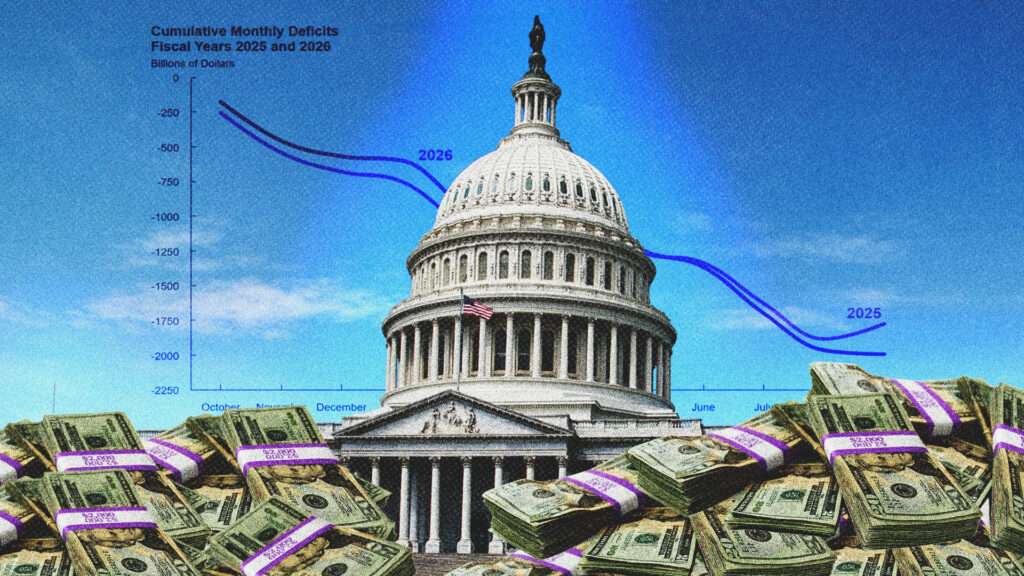
The federal budget shortfall reached nearly $2 trillion for the fiscal year that ended September 30, marking the third-largest deficit in U.S. history, surpassed only by the two COVID-era gaps.
The figures for the year, released on Thursday by the Congressional Budget Office (CBO), present another bleak snapshot of the nation’s finances. That near-record shortfall occurred even as tax collections grew by around 3 percent from the previous year. The government gathered more than $5.4 trillion in tax revenue over the last year.
Nevertheless, total spending was about $7.4 trillion, up about 6 percent from the prior year. That is what drove the widening deficit.
The rise in spending was largely driven by mandatory programs, defense, and interest payments on the national debt. The CBO notes Social Security outlays rose by about 5 percent last year due to higher average benefits and more beneficiaries. Medicare and Medicaid expenditures climbed by 8 percent, while military outlays also rose by about 5 percent.
“The economy can’t keep pace with the relentless growth of programs like Social Security and Medicare,” commented David Ditch, a policy analyst at the Cato Institute, to Reason. “Seniors are receiving far more in benefits than they contributed in payroll taxes. Our leaders should stop pretending otherwise.”
Nevertheless, the dominant driver of rising outlays and expanding deficits remains the size of the national debt itself. Interest payments climbed 11 percent in the 2026 fiscal year and surpassed the $1.1 trillion threshold.
On the revenue side, the CBO data undercuts President Donald Trump’s repeated claim that tariffs are bringing in “trillions” for the United States.
The CBO reports that customs duties totaled $182 billion for the year, which is actually an 11 percent decline from 2025 because refunds were issued for tariffs deemed unlawful by the Supreme Court earlier this year.
The CBO estimates those refunds reduced tariff receipts by about $130 billion—meaning that even if the government had been allowed to keep that money, the revenue totals would still fall far short of Trump’s lofty assertions.
The president isn’t the only one ignoring the federal budget trajectory. Neither major political party appears to have a credible plan to curb the growing deficit or to address the underlying factors creating the gap between revenue and spending. Budget deficits were rarely discussed during this year’s midterm campaign, even as bond-market indicators signaled concern—yields on both short- and long-term government debt have risen steadily, suggesting investors view U.S. debt as riskier than in recent years.
Maya MacGuineas, president of the Committee for a Responsible Federal Budget (CRFB), a nonprofit advocating deficit reduction, stated that policymakers should aim to reduce future deficits to roughly 3 percent of the economy’s total size—about half the level reached in 2026.
“Obviously, we can’t continue on our current path,” she added. “Our fiscal trajectory has been moving in reverse for far too long; it’s time to begin charting a forward course.”
Reports indicate Treasury Secretary Scott Bessent has urged the Trump administration to adopt that same target of shrinking the budget gap to 3 percent of GDP by 2028.
Yet it seems likely that Congress will convene in the post-election lame-duck session to weigh Trump’s plan for a substantial uptick in military spending. The president has also pledged to send $5,000 to every American if Republicans maintain control of Congress—a policy move that would cost well over $1 trillion.
When you find yourself in a hole, the first step is to stop digging. Nevertheless, another year of full Republican control over the federal government has produced a predictably dismal outcome: more spending and a larger deficit.
