
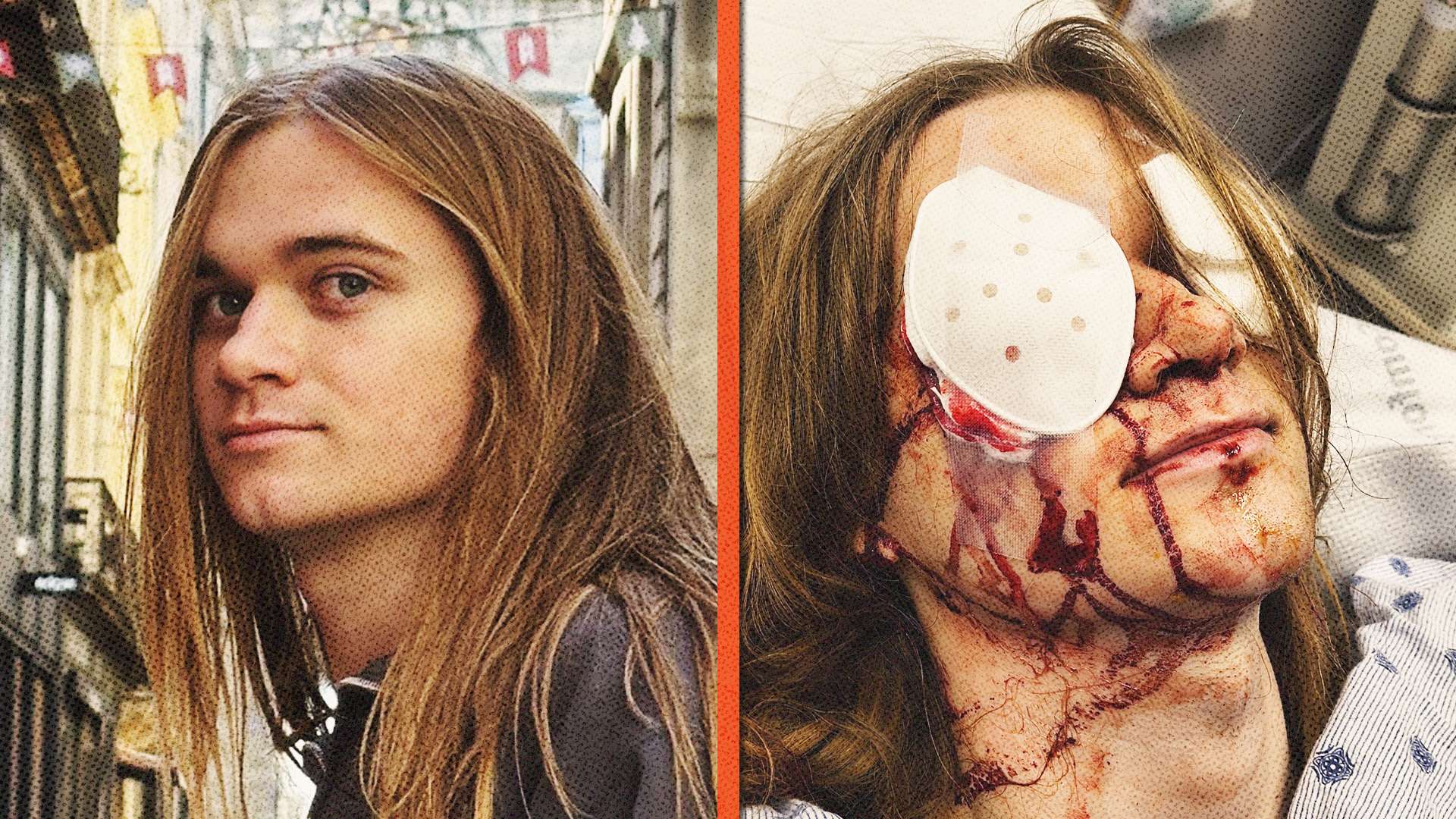
Tucker Collins was documenting a March “No Kings” demonstration in Los Angeles when a DHS officer discharged a less-lethal projectile that struck him in the eye.
A Los Angeles teenager who lost sight in one eye during a March protest against the “No Kings” movement after a Department of Homeland Security (DHS) officer fired a projectile at his face has filed a civil rights lawsuit on Monday.
Tucker Collins, an 18-year-old freshman at the University of Southern California, was documenting a March 28 “No Kings” demonstration outside the Metropolitan Detention Center in downtown Los Angeles when he was struck in the face by a less-lethal round. Several videos show that he stood well behind the line of officers, gripping a large camera as the projectile hit him and he collapsed to the ground. Surgeons later had to remove Collins’ right eye.
Collins’ lawsuit against the U.S. government and several unidentified DHS officers seeks damages for causing catastrophic physical injuries and emotional distress, arguing violations of his Fourth Amendment protection against excessive force and his First Amendment rights to free speech and assembly.
“Tucker never posed a threat to anyone,” said V. James DeSimone, a civil rights attorney representing Collins, in a press release. “No one around him was throwing anything, no one ordered the crowd to disperse, and still an officer fired a projectile into his eye. The Constitution protects the right to peaceful assembly and to document governmental actions in public, and simply recording what is happening should not cost someone their sight.”
According to the lawsuit, Collins will require ongoing prosthetic and eye care, and perhaps cosmetic and reconstructive surgeries, for the rest of his life.
The suit states that Collins intends to continue participating in demonstrations but now fears for his safety. “It feels safer to climb a mountain than to exercise my First Amendment rights,” Collins states in the filing.
DHS agents have repeatedly been documented retaliating against videographers, protesters, and legal observers. Collins’ case is only one instance of individuals being harassed, assaulted, and seriously injured by federal agents for activities that courts have deemed protected speech.
In January, a 21-year-old protester in Santa Ana, California, was permanently blinded in one eye after a DHS officer shot him in the face with a less-lethal weapon. Another 23-year-old in Los Angeles was blinded by a Los Angeles Police Department projectile in March.
Last year, the Justice Department paid $7.65 million to settle a lawsuit brought by a Portland man who was struck in the head with a crowd-control munition by a U.S. marshal, fracturing his skull.
In response to a lawsuit accusing DHS of First Amendment retaliation against protesters and journalists, a federal court in California issued a preliminary injunction in September 2025 barring DHS agents from using crowd-control weapons on reporters, legal observers, and protesters who did not pose a threat of imminent harm to a law enforcement officer or others.
Another federal judge issued a similar injunction in 2020 ordering federal agents to stop assaulting and arresting protesters and legal observers in Portland, Oregon.
A deeper problem is that “less-lethal” police projectiles frequently maim and can even kill people. Police departments are well aware of these dangers, but continue to maintain lax oversight and rules about their use.
In 2020, The Miami Herald obtained body camera footage showing police officers in Fort Lauderdale, Florida, laughing as they shot protesters with rubber bullets, fracturing one woman’s eye socket.
“Did you see me mess up those people?” one of the officers said, mistakenly thinking his body camera was turned off.
DHS did not immediately respond to a request for comment about Collins’ lawsuit.
