
In early August, I debated with several parishioners in a town in eastern Germany about the regional elections in Saxony-Anhalt and the ones to be held later this month in Mecklenburg-Vorpommern and Berlin. I asked them about the possibility that Alternative for Germany, the AfD, could come first and even govern. Also about the Brandmauer, the “firewall” that democratic parties have kept up against the radical right. The responses were varied, but deeply revealing: one argued that that cordon sanitaire had failed because it allowed the AfD to present itself as a victim of the system. Another saw it as a democratic embarrassment: “What is this about excluding parties you don’t like?” A third wasn’t sure, though added that perhaps it would be good for the AfD to govern alone to show that their project does not work, that things will continue not to work even with them in power. Those three answers, in my view, condensed a large part of Germany’s political problem, materialized on the election night in this eastern region.
Saxony-Anhalt is not the most populated or the wealthiest state in Germany, but as of this Sunday it is the country’s political epicenter. With a very high turnout, above 75%, the results confirmed the polls, with the AfD above 40%, the CDU far behind, completely crushed by below 20%, while the other parties’ shares are under 10%; the other winner is the “red-pink” BSW, which, at the time of writing these lines, has reached the 5% threshold. The possibility of forming a government opens up to several formulas under the parliamentary arithmetic: a very difficult solo government given that “cordon sanitaire,” a also extremely complex four-party coalition from the CDU to Die Linke — given Chancellor Merz’s rejection of coalitions with Die Linke — or, finally, a coalition or support from Sahra Wagenknecht’s BSW. The BSW, open to handing the government to the AfD, would become a significant player.
“The possibility of forming a government opens up to several formulas under the parliamentary arithmetic, including a highly intricate four-party coalition”
The result is a very fragmented parliament in which any government without the AfD requires difficult agreements, awkward tolerances, or institutional creativity through multi-colored coalitions that, while no longer surprising on the German political stage, increasingly leave a sense of inability to govern — and, thus, feed the anti-system breath of this radical right. On the other hand, something larger is at stake than a regional government: the normalization of a party classified as far-right extremist by the intelligence services and the overall effect this will have on German politics.
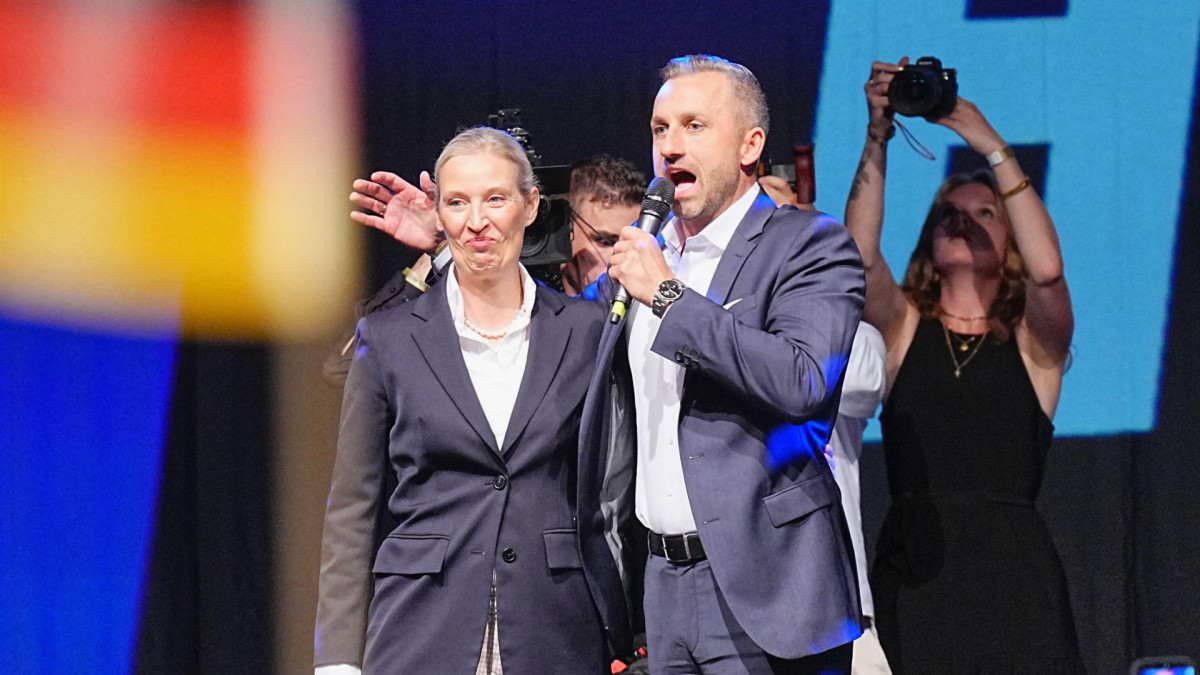
The AfD has mobilized the vast majority of the abstainers who went to the polls on Sunday, swept among workers, garnered a very high share of the female vote, and won across all age groups except those over seventy. A resounding success. The AfD candidate, Ulrich Siegmund, built a campaign with a markedly populist tone, unashamedly identitarian and highly personalized. He presented himself as the voice of a “true people” against those political, partisan elites allegedly sold out to foreign interests. He revived old slogans of the peaceful revolution that ended the German Democratic Republic (GDR), appropriating symbols and slogans that had previously been linked to freedom against communism. It is a political tactic that has paid off: he has turned discontent into identity and the critique of the system into a promise of national recovery around a never-specified past, letting everyone place their idyllic era in the historical period that suits them best.
“AfD has turned discontent into identity and a critique of the system into a promise of national recovery”
Civil society mobilized in the campaign against the AfD. A few days ago, a direct message could be seen on the façade of Magdeburg Cathedral: “We do not abandon what we love. True love of the homeland is not the AfD.” It was a phrase that challenged precisely the terrain the AfD seeks to monopolize: the homeland, belonging, local pride. Yet, that mobilization has not been enough to halt a deeper social current.
Many voters of the various extremist options and, in particular, of the AfD do not seem to seek a crafted program. They seek punishment, signaling, identity, rupture. They accept that solutions may be rough because they believe that, at least, the critique points to the right people to blame. There are few concrete measures and much appeal to wounded dignity. There are few detailed programs and much insistence on expelling those who prevent “the people” (truly German) from having a better country.
The eastern German economic explanation will recur to justify the AfD’s rise. There is some basis for it; the former East Germany lags in income, in productive structure, in demographics, and in symbolic recognition relative to the West, especially compared with the more prosperous southern Länder. Yes, there is a sense of impoverishment amid a stagnant economy and galloping inflation… but as in the rest of the country. The real factor in many eastern states is a political culture grounded in a victimhood narrative. There is a culture of grievance, an identitarian reading, and a permanent suspicion toward Berlin, the media, the traditional parties, and institutions at large. Even among the neighbors I spoke with, some of whom showed explicit or semi-explicit sympathy for the AfD, there was a shared discomfort with the permanent division between wessis and ossis, West and East Germans, when I asked them: they said they were tired of their problems being explained always by that difference, as if East Germany’s past identity condemned it to a separate political identity. They preferred to talk about insecurity, social deterioration, loss of trust, and lack of answers. If that identification with the old GDR kept reappearing in public debate, they added, it was not so much because of them as because of the insistence of some media outlets that, on this point, everyone agreed, manipulated the image of eastern Germany. I do not know how much of a categorical fact this anecdote is, but I share the sense that those economic distinctions between the two Germanys, so loved by the international press—and also by the national one—are becoming less and less able to explain things.
“There is a culture of grievance, an identitarian reading, and a permanent suspicion toward Berlin, the media, the traditional parties, and institutions at large”
The AfD’s victory is immense. And the electoral calendar will add pressure and uncertainty to the political stage. After Saxony-Anhalt will come Mecklenburg-Vorpommern and Berlin on September 20. In the first, the AfD is also very strong. In Berlin, the competition is more open and the left maintains better options, although the capital has always been its own political ecosystem, hardly extrapolatable to the rest of the country. That’s why the focus is now on Magdeburg, the capital of Saxony-Anhalt. If the AfD manages to transform its electoral triumph into institutional power, Germany will definitively enter a new phase. But even if it does not succeed, the question will remain how long a policy of governing exclusion can be sustained when the excluded party becomes the leading force in several territories.
From all this, several consequences emerge both internally and externally. The first impact on domestic German politics is, of course, the tension in the political and social climate. Walking many streets in Saxony-Anhalt or Mecklenburg-Vorpommern this summer, I noticed that most AfD posters talked less about concrete regional problems and more about major national issues: immigration — the state has one of the lowest immigration rates, around 9%, compared with the national average of 20% —, security, energy, prices, war, sanctions, identity. Regional politics turned into a diffuse referendum on the country’s direction.
The second internal consequence affects the party system. Saxony-Anhalt may have limited weight in population and economy, but it can act as a viability test for the AfD. If it solidifies as a governing party or as an inevitable force to shape majorities, it will no longer be seen only as an opposition party. That would greatly complicate Friedrich Merz’s federal strategy; the CDU’s regional electoral disaster is a hard blow. The chancellor operates in a very narrow space: if he hardens his rhetoric on migration and security, he is accused of adopting the AfD’s positions; if he does not, part of his electorate regards him as weak. All the while, his popularity and that of his governing coalition keep falling, with a very uncertain future for the chancellor.
“If it consolidates as a governing party or as an inevitable force to organize majorities, it will stop being perceived merely as an opposition party”
The last consequence, surely long-term, will be cultural. Germany has made militant democracy and vigilance against the radical right a state concern. That a party like the AfD governs a Land breaks with a political framework that has been in place for decades. It puts in question many of the consensual principles, shifting from a liberal democracy toward the explicit, open defense of an identitarian democracy, of policies governed by ethnic criteria and a suspicion of anything that, from their point of view, constitutes a plural and social “macrostate”: from vaccines and public services to schooling itself.
Indeed, the international derivatives are also relevant. The first derivative affects European security. The AfD and the BSW share, with nuances, an openly pro-Russian stance, with a critical line toward sanctions on Russia, military support for Ukraine, and increased defense spending. In BSW posters in Mecklenburg-Vorpommern, for example, messages appeared—much more frequently than in the AfD’s—against sanctions, against the war, and against what they present as militarism opposed to the German people. In the radical-right party, positions are not identical in all its sectors, but the pro-Russian and anti-Atlantic orientation has been a constant in much of the party. A wordplay on one of its posters spoke of how to fill the car’s fuel tank “without crying”; an allusion to energy prices that neatly captured the strategy: take a daily problem, link it to a national explanation, and direct it at the Government, Brussels, Ukraine, or sanctions against Russia.
This political earthquake arrives at a moment when Germany aims to become a central security provider, increasing cooperation with Poland and other countries, particularly in the Baltic states, and massively increasing defense budgets. The elections come at a critical time, given that Germany has accused Russia of being behind the attempt to attack with explosive drones at Leipzig Airport; a logistics hub particularly sensitive due to its connection with Ukrainian cargo and its role in military and civilian transport networks. If parties openly critical of support for Ukraine and close to Russian narratives gain institutional weight in eastern Länder, Berlin’s foreign and security policy could be seriously hindered. Not necessarily because a regional government could by itself change the federal German position, but because it could further condition the public debate and institutional cooperation. The open and explicit pro-Russia sympathies of politicians from both parties, as well as their cooperation with Russian agents, create a very worrying scenario also in terms of the state’s own security and where information that these politicians would receive might travel if they come to power.
“If parties openly critical of support for Ukraine and close to Russian narratives gain institutional weight in eastern Länder, Berlin’s foreign and security policy could be seriously hindered”
The second derivative concerns migration policy. The AfD has challenged Merkel’s legacy and the welcoming culture that marked Germany in 2015; that era is over. Nevertheless, if the party confirms its ascent in these elections, the pressure to close the migration debate will intensify across the political system, with direct implications for European policy in this area. Not only because of what the AfD does—with the leader Alice Weidel promising mass deportations—but also because of how the CDU, the SPD, and other parties respond, fearing to lose ground on security and integration. Other chancelleries should take note, including the Spanish government regarding its migration strategy.
In sum, these electoral results in Saxony-Anhalt raise a question that goes beyond the regional: what happens when a democracy like Germany, defined by its capacity to contain the radical right, begins to see that extreme right becoming the leading force in parts of the territory? The answer cannot be to merely repeat the cordon sanitaire. Nor is it enough to abandon it in the name of a supposed democratic normalisation. The German dilemma is far more complex: how to preserve a plural democracy when a growing portion of the electorate mobilizes against the cultural and institutional premises of that same democracy.
“The German dilemma is much more complex: how to preserve a plural democracy when a growing portion of the electorate mobilizes against the cultural and institutional premises of that same democracy”
Saxony-Anhalt may seem peripheral from outside Germany, but it is not. This Sunday foreshadows German politics for the coming years and raises questions about whether the AfD will convert its electoral strength into executive power, and about the rest of the parties’ resistance. It may influence upcoming elections in Mecklenburg-Vorpommern and Berlin, and, certainly, the strategies and campaign promises of the rest of the country. And it could send a signal to Europe about what to expect from Germany; a Germany expected to bear more economic, military, and political weight.
