
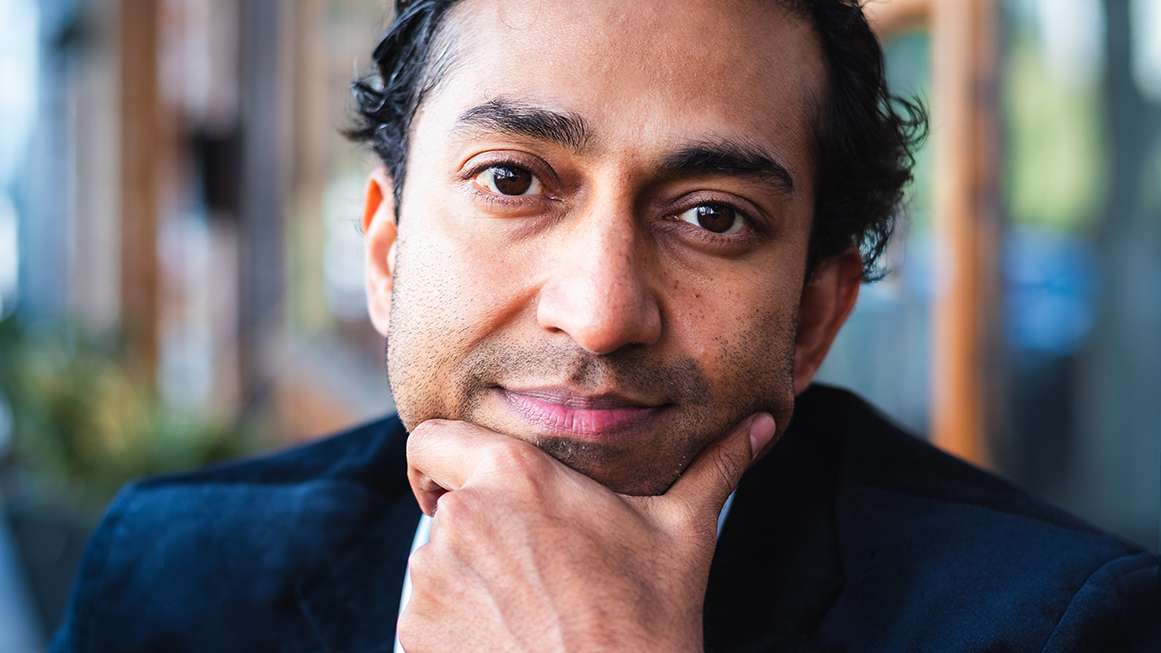
“Fauci was wrong about almost every single pandemic policy he advanced,” according to a former FDA insider speaking with Reason.
:15 :15
Download
Vinay Prasad: Public Health in This Country Is So Broken
Vinay Prasad has occupied roles on both sides of the public-health establishment. A clinician, writer, and professor at the University of California, San Francisco, he moved from a high-profile COVID-era critic to a leadership position inside the Food and Drug Administration (FDA) when he was named in May 2025 to head the agency’s Center for Biologics Evaluation and Research. His tenure included a sudden resignation in July 2025, a brief return a few weeks later, and his ultimate exit in April 2026.
Prasad joined Reason‘s Zach Weissmueller in August to discuss what he learned from his time within the FDA, what he managed to change—and what he could not—and whether the agency can ever win back public trust. Their conversation touches on Anthony Fauci and the origins of COVID-19, vaccine policy, regulatory obstacles, his growing sympathy for libertarian critiques of the FDA, and whether the agency is prepared for an era of AI-driven medicine.
Reason: The FDA experienced a turnover, replacing part of the old guard with new voices—COVID dissidents like you, former FDA Commissioner Marty Makary, and NIH Director Jay Bhattacharya. What was that transition like? Did you harbor any misgivings about leaving academia and your role as an outsider critic to join the public-health bureaucracy?
Prasad: Perhaps we shifted a mere few percent of the FDA. The FDA is an 18,000-person agency. Tens of thousands remain. Before Marty, the commissioner, and I arrived, DOGE [the Department of Government Efficiency] had just been dissolved and they laid off a couple thousand people. Yet the system, for the most part, remains the same as it always has been.
There are critics of the COVID-pandemic response and there are critics—some are more extreme than others. While Marty, Jay, and I question many aspects of the response, we don’t go as far as the most far-out critics out there.
Am I glad I took part? Absolutely. It was an adventure and a learning experience. I gained more in a single year than in the previous decade about how the world functions. I’m glad I helped improve certain facets of government—things that I think will endure—and I also tried to improve other aspects, which might not survive the test of time.
Fauci came to symbolize the old guard. He has recently drawn attention for appearing before Congress and invoking the Fifth Amendment after Sen. Rand Paul (R–Ky.) published his diary. What did those diary entries reveal to you about Fauci’s character and how he operated?
The most striking news story is how the mainstream media refuses to be candid about his legacy. Fauci was in his late seventies as the pandemic began. Had he retired at 75, he could have left behind a sterling legacy. Instead, he kept pushing, persisted through the entirety of the pandemic, and became the public face of a number of policies that his diaries reveal he privately questioned. He argued that the only explanation for the virus’s origin was a natural spillover, yet he went further than that. He helped orchestrate a Nature Medicine paper—often called the “Proximal Origin” piece—drafted by a team that reinforced that view. He edited the manuscript before publication, and in public, he acted as if those researchers were independent validators of his stance. In many respects, he pulled the strings behind that paper. The authors of that paper—Rand Paul has released their Slack-channel messages, showing they didn’t fully believe what they wrote. Their messages reveal substantial ambiguity about lab-leak versus natural-spillover scenarios.

Regarding the origins, he also helped fund EcoHealth Alliance, which had a subcontract tied to Wuhan. He played a substantial role in shaping the origin narrative, attempting to frame the discussion in terms of lab-leak—something that many platforms inhibited. Facebook even banned conversations on the topic. Then there were mask mandates for toddlers. He was a major driver of that policy. Lockdowns, school closures. He claimed he didn’t close schools himself. In his own diary, he writes, “I told [Mayor] Bill de Blasio, you need to close schools in New York City.”
At some point, someone has to own the choices they advocated for. When Florida Governor Ron DeSantis reopened schools in 2020, Fauci appeared on multiple programs arguing against it. Looking back, many of us said at the time that reopening schools was the correct move. Perhaps it could have been paused briefly, but extending closures for so long proved unnecessary. Fauci maintained prolonged school closures.
Vaccines make sense for older individuals who had not yet contracted COVID. But is it necessary to vaccinate a four-year-old, a seven-year-old, a twelve-year-old, or a 22-year-old who has already had COVID? The issue remains highly nuanced. For Fauci, the stance was: universal vaccination for everyone, with the initial series and a yearly booster, regardless of age or prior infection. Fauci was wrong about nearly every pandemic-policy he advocated.
Some defenders reply, “At least he didn’t tell people to drink bleach.” And I counter, “Is that the standard for a physician and scientist?” Drinking bleach is ill-advised, but that isn’t the benchmark for a Fauci-level figure. He should be presenting accurate information and, if uncertain, weighing evidence rather than ignoring it. He did none of that.
Fauci’s pardon stretches back to 2014, when he authorized funding that violated U.S. policy on gain-of-function research. Do you think he actually committed a crime?
Yes. Moreover, people may question whether the funds went directly to that particular project. The money supported viral-genomic research at a Chinese institute, akin to the sort of work we would worry about. That was a crime for which he has been pardoned. It’s not merely my assessment; that is the judgment of President Biden’s office, or whoever signed the pardon, that he committed a crime. That is why the pardon extends that far back. It was a crime, and now that he has been pardoned, there may be little to be done about it.
You entered the scene amid the wave of anti-Faucism. What was your main hope for what a revised vision of public health might look like, or for reforms that could be made?
I carried a relatively narrow mandate, focusing on the FDA’s biologics division. The ongoing hope is that public health can strive to be honest, employ its powers proportionally and with restraint, and act with humility. Public health, today, falls far short of these ideals. It tends to be increasingly dominated by left-aligned ideologues and reaches ever more extreme conclusions. What public health can be versus what it is remains light-years apart.
You don’t think that has shifted much?
Not considerably. Reforming a sprawling organization with tens of thousands of staff is extremely challenging. There have been some changes, and the pandemic has acted as a catalyst. Yet I doubt that genuine, institution-wide reform is possible. I suspect it may splinter into separate public-health factions.
Your position at the FDA focused on biologics like vaccines and gene therapies. Vaccines became an increasingly polarized, politicized issue during COVID. What was your objective specifically regarding vaccines when you assumed responsibility after the pandemic?
Delivering the right drug to the right person at the right moment can be life-saving; conversely, the wrong drug to the wrong person at the wrong time can cause harm. Vaccines share this characteristic. You cannot generalize about all vaccines in the same breath, just as you wouldn’t lump Tylenol, aspirin, and Plavix together. They are distinct medications with different risk-benefit profiles.
Is this the same pattern we observed during COVID, where people were categorized as either pro-vaccine or anti-vaccine, without considering age, health, or other individual factors? Everything was flattened or oversimplified.
The same phenomenon persisted: a one-size-fits-all public-health approach. It fails to fit older individuals who haven’t had COVID, particularly early in 2021, and thus should be vaccinated; whereas a healthy seven-year-old who has already had COVID in 2022 does not necessarily benefit from the same blanket policy. Public health, here in the United States, remains deeply flawed in its capacity to recognize these distinctions.
For a long time you’ve criticized poor experimental design in drug trials. Was that one of your goals when you joined the FDA? Do you feel you made progress toward that aim?
In just one year we accomplished more than our predecessors did in a decade. If you look at the sheer quantity of announcements and policy changes we issued, you’ll see we focused on one side of the equation—how some companies failed to conduct the right studies to inform the American public. We also addressed the other side, where the FDA pressured them to pursue requirements that made little sense, imposed burdens, wasted money, and stifled innovation. We tackled a lot in that domain too. The FDA makes both types of errors. It also does many things right, but there is room for improvement on both fronts.
You described two facets to FDA reform. One involved raising standards for vaccines; the other involved recognizing how costly and burdensome it can be to gain approval in the United States. What were the biggest obstacles you identified on that latter front?
So many. During my FDA tenure, I often sympathized with industry researchers who spoke about the hurdles they faced. The FDA’s remit covers both the regulation of what can be marketed and sold in the U.S. and what can be studied in the first place.
Imagine you’re a researcher hoping to test something new. You want to assemble interested volunteers, obtain informed consent, and proceed with a trial even though you don’t know for sure it will work. We regulate not only the outcome of approvals but also how you study new ideas. We impose many controls—well-intentioned, yet not always fit for purpose. For small companies or for ultra-rare diseases with limited budgets, the current early-stage regulatory framework can be excessively burdensome and misaligned with the realities of innovation.
You mentioned that your time inside the FDA made you more sympathetic to libertarian critiques of the agency.
In one respect I do sympathize: the United States spends trillions on healthcare funded by taxes. We collect tax money to provide a service that some view as a basic right, while layering in coverage and services that may or may not be effective. If you encounter a heart attack, you’ll receive care in this country irrespective of insurance status—an undeniably good thing. But embedded in that package are elements that may be dubious in value and cost billions, all funded by taxpayers and redirected to corporate profits.
That is why libertarians argue for more personal responsibility and greater involvement in how money is spent. If you’re paying out of pocket, even in small amounts, you tend to focus more on surrogate endpoints and early signals of risk, which can alter your assessment of a therapy’s value. I find that line of reasoning compelling because the system includes many opportunities for overuse or wasteful practices that don’t meaningfully improve health outcomes.
Dario Amodei, the CEO of Anthropic, recently criticized the FDA, writing: “Regulatory systems were designed for a slower pace of innovation and we are not prepared for the flood of new products and advances that AI will bring. AI could also render downstream technologies safer and more predictable in ways that challenge the assumptions of regulators like the FDA.”
If Amodei’s assessment is on target about AI’s impact on the field, do you think the FDA can adapt?
I see kernels of truth in his argument, though I wouldn’t go as far as he does. The essential point is that the FDA tends to regulate AI itself, particularly medical AI. Devices that monitor health via wearables and similar technology invite extensive regulatory oversight. That’s a difficult task because the technology evolves far more quickly than our ability to evaluate it. I share the view that regulating every aspect of digital health and health AI may not be the best path. For example, should a doctor regulate the apps they use to learn about disease or to answer questions for a patient—should the government regulate open data? I doubt that it should.
I spoke with Doctronic, a company acting as an AI prescriber in Utah where AI can refill prescriptions. This raises questions about where government should step in and where it should step back.
Governments are more likely to impede rapid innovation in this space, given how fast the field changes. It will be extremely challenging for regulators to keep up with AI advancements. In drug discovery and related AI-driven research, there are certainly opportunities to shorten trial times and reduce costs, which is appealing to pharmaceutical firms.
But when it comes to molecular discovery and fundamental science, I’m less optimistic than Amodei for a couple of reasons. Much of the data fueling models in cancer biology is contaminated by questionable research. You’ve heard about cases where high-profile studies contain non-reproducible results—indeed, some researchers have reported substantial replication failures. If AI learns from flawed data, what then? That’s a core challenge. A second issue is that AI can propose hypotheses, but you still need a few humans to validate them in the real world. The bottleneck isn’t generating ideas; it’s obtaining consent, manufacturing products, and carrying out trials.
I hope Amodei is right about a bright future, but I remain somewhat skeptical that the biology will be that simple.
Do you think there’s been enough happening for public health to begin earning the public’s trust again?
Not in the slightest. I wouldn’t trust it yet.
What would it take for public health to genuinely win back the public’s confidence?
I’m not sure it’s even feasible. The system is currently highly fragmented. People insist, with a straight face, that “Anthony Fauci didn’t make any mistakes—he did the best he could with the information available.” Then we’re asked to overlook obvious missteps, like advising a 24-month-old to wear a cloth mask in daycare all day. That was a clearly poor idea, yet their stance remains unchanged on every issue.
Public health is shortsighted. It fails to grasp that policy must account for real-world complexities and human interaction. Isn’t that a fitting analogy for COVID—avoid the outdoors, stay indoors all day, as if people don’t need face-to-face contact?
Public health has not learned its lesson. It is deeply entangled with politics now. It leans heavily to the left, with little political balance. A touch of balance, a sliver of open-mindedness, and a little humility—enough to admit a few pandemic missteps—would go a long way.
The federal public-health apparatus is still headed by RFK Jr. and Jay Bhattacharya remains connected to the NIH. Does that dynamic have a trickle-down effect or create a countercurrent within the system?
I don’t know.
Don’t get me wrong—I respect Jay a great deal and think his motivations are sincere. He’s already implemented some important changes. I agree with the core of Bobby’s ideas, though I’ll admit there are valid concerns I can identify as I think through them.
But before I entered government service, people told me there exists a fourth branch of government—the career public servants. I didn’t buy it, but now I’m convinced it’s true. There are many staffers who cluster in a handful of blue-leaning counties and hold strong, influential views. They effectively govern, with decisions that regulate all of us, and they’re largely unaccountable to Congress or the president. I suspect they’ll stay in place. The COVID pandemic exposed how we erred, and it’s likely to fuel ongoing reckonings about medicine and public health in the years ahead.
How did working at the FDA affect your personal trust in the regulatory system as a consumer?
It gives me pause. I prefer to trust but verify. I’m cautious about new therapies and especially vigilant that some safety information may be overlooked. It also nudges me toward libertarian ideas: allow people more choice and responsibility, perhaps with independent evaluators—think Consumer Reports-style assessments—that provide varying levels of quality signals and consent to pay out of pocket for options. When people bear their own costs, tiny shifts in surrogate markers or minor safety signals become far more consequential than they would under insurer coverage.
Is there something you see in the process that creates persistent gaps or flaws?
The fundamental premise of a single, one-size-fits-all standard for safety and efficacy is hard to reconcile with individual needs. What might be acceptable for one person could be unacceptable for another. The notion that a solitary government body in the D.C. suburbs can set a universal threshold for every American feels increasingly untenable to me.
This interview has been condensed and edited for style and clarity.
