
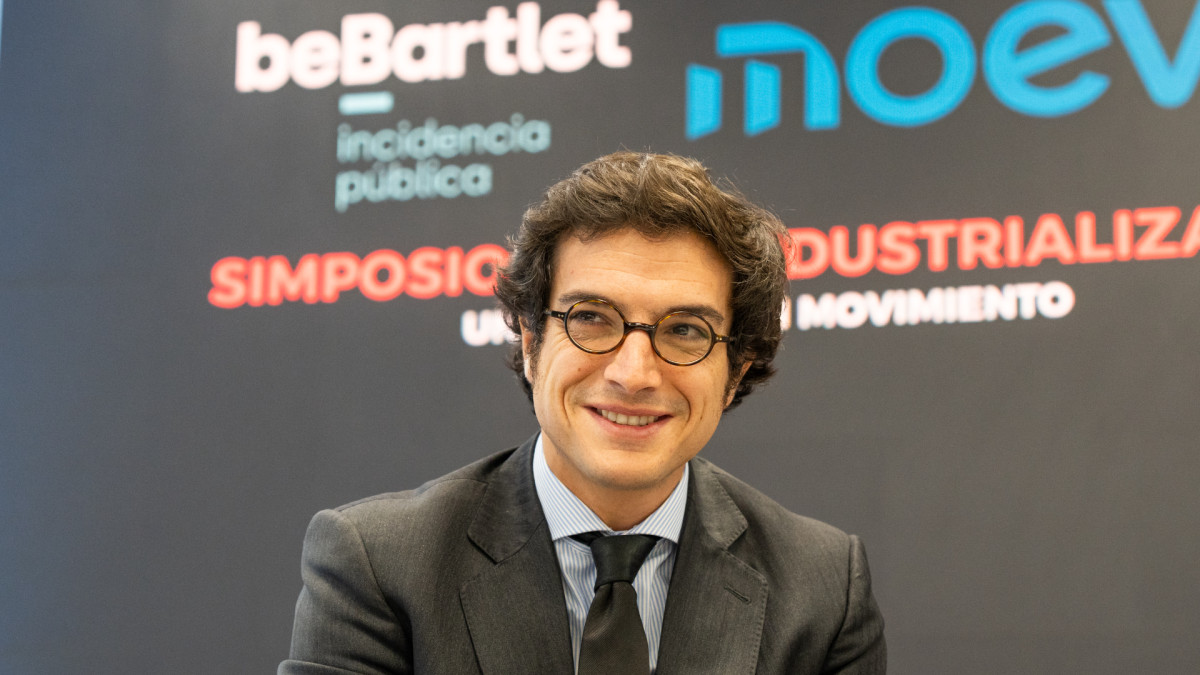
Can Europe still be Europe without industry? For José María Figaredo, secretary-general of Vox’s Parliamentary Group, no. He argued the point in a moving special session of the Reindustrialization Symposium, promoted by beBartlet with Agenda Pública as media partner. In a context marked by the European investment gap with the United States and China, as diagnosed in the Draghi report, Figaredo defended the need to recover an industrial policy that, in his view, has been relegated over the last four decades.
The Vox leader linked the gradual loss of productive capacity to political decisions that have prioritized other objectives over competitiveness and reaffirmed the role of industry as the foundation of European welfare. “If industry disappears, Europe disappears”, he warned.
Restoring industry requires regulatory reform
For Figaredo, “all industry is fundamental and necessary”, a consideration that should translate into both regulatory decisions and public discourse. By way of example, he pointed to the widespread use of plastic in hospitals to illustrate the contradictions that arise when certain industrial materials are questioned without considering their importance for the functioning of other sectors. Hence he identified two complementary areas of action, the regulatory and the narrative, in which he believes a pro-industrial stance must be recovered.
“The Vox leader linked the progressive loss of productive capacity to political decisions that have prioritized other objectives over competitiveness”
Administrative simplification occupied a large portion of his intervention. Figaredo proposed moving toward greater regulatory uniformity among autonomous communities, taking as reference the provisions that have produced the best results in each territory and extending harmonization experiences already applied in sectors such as photovoltaics.
Furthermore, he distinguished between simplification and deregulation, two concepts that, although related, are not equivalent and which form part of Vox’s priorities. His approach involves reviewing the administrative burdens that condition business activity and promoting horizontal regulations, avoiding the proliferation of provisions specific to each technology or sector.
The Vox Parliamentary Group’s secretary-general in Congress during the Symposium.
Electrical grids, a priority of energy policy
Energy is, in Figaredo’s view, one of the main determinants of Spanish reindustrialization. He placed the development of electrical grids among Vox’s energy priorities, considering that access and connection limitations are preventing the full use of both available generation capacity and new opportunities for industrial investment.
During exchanges with business representatives, he questioned the lack of coordination between consumption needs and infrastructure development, which causes delays in project implementation and hampers the utilization of generated electricity. In particular, he advocated facilitating closed distribution networks and supply schemes linked to industrial parks, so that generation installations can connect more directly to consumers.
“Energy, in Figaredo’s view, is one of the main determinants of Spanish reindustrialization”
The administrative slowness was another of his main criticisms. Figaredo deemed it anachronistic that certain authorizations may take up to five years and called for a revision of the planning and permitting system, with procedures more adapted to the needs of each project. “Five-year plans no longer work”, he stated, questioning the responsiveness of the current model.
This view extends to the composition of the energy system. Although he recognized opportunities for technologies such as hydrogen, biomethane or biofuels, he argued that their development must respond to industrial viability criteria and help strengthen national value chains. In the case of hydrogen, he argued that its momentum would make sense if Spain manages to develop a substantial portion of the value chain, avoiding new external dependencies.
The decarbonization, he explained, is not for Vox an end in itself, but must be subordinated to its industrial and economic benefits. Under this premise, he defended taking advantage of existing energy capacities, maintaining nuclear energy, and revisiting the hydrological planning debate, as well as exploring the possibilities of exploiting national energy resources currently restricted by climate legislation.
“Decarbonization, he explained, is not an end in itself for Vox, but must be subordinated to its industrial and economic benefits”
In terms of storage, he backed leveraging hydraulic potential, without excluding other technologies, and showed a preference for price-arbitrage mechanisms over systems that guarantee payments for capacity. He also warned of the need to preserve the development of a European value chain in this area in light of Chinese technology advances.
European competitiveness and commercial reciprocity
International competition, especially in the automotive sector, allowed for a deeper look at the industrial consequences of European regulation. Figaredo questioned the course followed on car electrification, which, in his assessment, has placed European manufacturers in a position of growing vulnerability against Chinese rivals.
Although he acknowledged the difficulties of reversing decisions that have already mobilized millions in investments, he argued for revising the regulatory framework that has driven this transformation and maintaining production capacities linked to internal combustion engines while there is demand. He also called for stronger reciprocity conditions with China, arguing that European companies face access barriers to that market that do not have an equivalent in Europe.
The response, from his perspective, should be oriented toward reducing regulatory and fiscal costs, strengthening existing industrial capacities, and giving companies more freedom to determine their technological choices.
“Figaredo showed a preference for price-arbitrage mechanisms over systems that guarantee payments for capacity”
In this same vein, he was critical of the European CO₂ emissions trading regime and border adjustment mechanisms, which he views as additional sources of market distortion. Although he assured that any modification would be addressed in accordance with legal procedures, he supported gradually reorienting legislation that, in his view, is not meeting the real needs of industry.
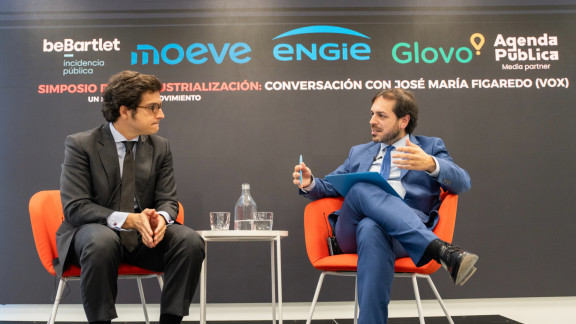
José María Figaredo spoke at the session alongside Ramón Mateo.
Tax incentives and technological sovereignty
The push for innovation and new industrial activities completed the proposals laid out during the session. Figaredo defended an ambitious reform of tax incentives to attract investment and foster technological development in Spain, backing general mechanisms that offer stability to businesses.
Among the measures proposed, he highlighted the creation of a corporate vehicle with broad tax exemptions, designed to channel R&D&I initiatives, family-owned businesses, and nonprofit projects. According to him, this model would allow applying tax advantages to returns derived from patents and certain productive activities, as well as facilitating the transfer of tax credits and reducing administrative burdens.
The leader identified the tech industry as one of the areas with the greatest growth potential and pointed specifically to opportunities linked to data centers, especially when their deployment is tied to research activities. To foster their development, he stressed the importance of having stable regulation that facilitates investment and enables the growth of new industrial capabilities. Finally, he linked these proposals to the Vox principle of national priority, proposing to use instruments such as public procurement to promote the maintenance and development of productive capacity in Spain.
In partnership with:

