
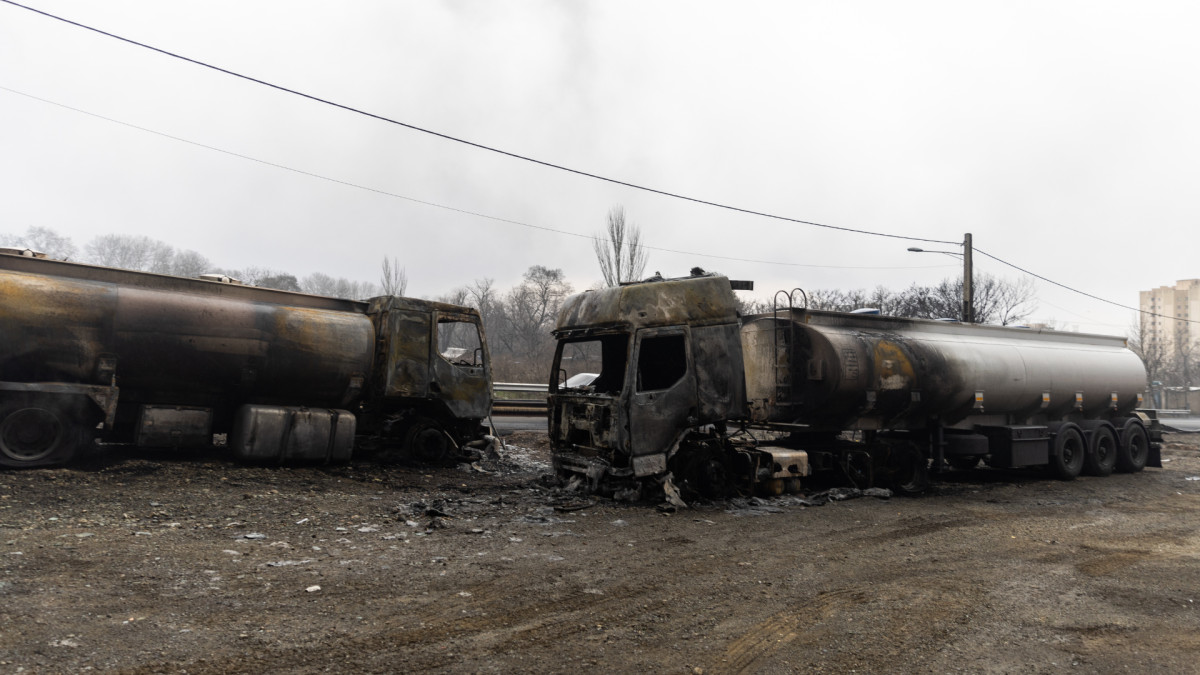
Six months after the start of the war with Iran, the confrontation in the Strait of Hormuz continues to rock the global economy. Stock traders and governments are watching for any sign of escalation, while households and businesses pay more for fuel and fear energy shortages. But the war is also having a deeper environmental impact, though less visible, by boosting carbon dioxide emissions and undermining international climate cooperation. And, unlike high oil prices, these costs will not disappear when the war ends.
Iran, of course, is only one of the focal points of geopolitical tension. In 2025 there were sixty-five state-involved armed conflicts worldwide, the highest figure since records began in 1946. While the Middle East and Ukraine grab the headlines, civil wars in Sudan and Myanmar continue to rage. Global military spending rose for the eleventh consecutive year in 2025, reaching nearly $2.9 trillion. By contrast, official development assistance fell by more than 23% in real terms —the largest annual decline on record—.
Meanwhile, the climate crisis continues to worsen. The last three years have been the warmest on record, and every year between 2015 and 2025 ranks among the eleven warmest ever recorded. A 2025 report by the Planetary Boundaries Science Lab revealed that seven of the nine Earth’s planetary boundaries have been exceeded — ocean acidification was the latest to move out of the safe zone. An intensification of El Niño could worsen the situation, warming a planet that is already exceptionally hot and increasing the likelihood of droughts, floods and other devastating extreme weather events.
Emissions related to conflicts remain inadequately accounted for in climate records, which difficulties in estimating the total environmental impact of the Iran war. Military emissions are often underreported, if reported at all, and rarely scrutinized. A 2026 review analyzing 263 independent studies found that more than 90% of emissions tied to military operations and conflicts go uncounted. Methods are improving, but estimates still vary depending on what is considered military activity and how damage to infrastructure is assessed.
“More than 90% of emissions linked to military operations and conflicts are not accounted for”
Around the start of this year, an analysis by the Climate and Community Institute estimated that the first fourteen days of fighting between the United States, Israel and Iran generated more than five million metric tons of carbon dioxide equivalent (CO₂e), more than Iceland emits in a year. Emissions have continued to rise since then, though there is no comparable estimate for the war as a whole.
The war’s carbon footprint will keep growing once the fighting ends. Rebuilding roads, homes and damaged industrial sites requires producing large quantities of cement and steel, materials with high carbon intensity. A 2024 study found that , in some cases comparable to the emissions of a country before the war.
Then there is the war’s toxic legacy. Attacks on refineries and petrochemical facilities can release sulfur compounds, heavy metals, and other pollutants into air and water, contaminating soils, aquifers and coastal ecosystems in a region already suffering extreme heat and water shortages. Plumes of smoke can disappear from satellite imagery in days, but contamination can persist for generations.
“The war’s carbon footprint will keep growing once the fighting ends”
The indirect effects of the war can be even more harmful. Wars destroy physical assets, but they also alter the calculations behind energy policy. When established routes cease to be reliable, governments and firms turn to supplies they deem secure and politically manageable, even if that means using dirtier fuels.
In this sense, the closure of the Strait of Hormuz marks a turning point. Maritime traffic through this waterway has been severely constrained since the war began on February 28 and was halted again in early July, prompting what the International Energy Agency described as the “largest supply disruption in the history of the global oil market”. Oil prices surpassed $110 per barrel. The brief ceasefire between the United States and Iran briefly reopened the strait and pushed prices down, but since it broke and the negotiating deadline expired, shipping has been disrupted again and global energy markets today face renewed pressure.
The Irresistible Allure of King Coal
Although a single naval incident today can trigger a global energy crisis almost overnight, governments and markets continue to rely on a reliable supply of fossil fuels. In July, for example, the U.S. Energy Information Administration projected Brent prices would fall to $74 per barrel in the third quarter; days later, new U.S. attacks made that forecast obsolete.
“The indirect effects of the war can be even more damaging. Wars destroy physical assets, but they also alter the calculations behind energy policy”
Faced with fears of energy shortages, many governments are responding to the crisis by leaning more heavily on fossil fuels. It is possible that coal-fired plants scheduled for closure will stay online, idle capacity will be brought online, and emergency gas supply contracts end up becoming permanent.
Evidence of this fossil-fuel resurgence is already visible. Several countries have increased coal generation or delayed closures in recent months, repeating the fossil-fuel scramble that followed Russia’s 2022 invasion of Ukraine. In May, 109 countries had announced energy-related measures in response to the war. Nearly twenty governments introduced structural measures to improve efficiency or accelerate electrification, but most of these interventions aimed to conserve fuel and protect consumers. While some measures may help cushion the impact, they also threaten to perpetuate the same dependencies that caused the crisis in the first place.
It is worth noting that this is the first major oil crisis in which clean alternatives are available to the mass market. The crisis may make coal and natural gas more attractive in the short term, but over time it could also erode confidence in imported fossil fuels and strengthen political and economic arguments in favor of electrification.
“This is the first major oil crisis in which clean alternatives are available to the mass market”
This is not to suggest that the transition to clean energy will be smooth sailing. Batteries, solar panels, and wind turbines depend on critical minerals produced and processed through highly concentrated global supply chains. According to a recent estimate, the full implementation of China’s controls on rare earth exports could threaten a $6.5 trillion annual output in later stages of the value chain outside China.
These vulnerabilities are often overlooked in energy policy debates, as they involve lesser-known inputs such as sulfur and sulfuric acid, which are essential for phosphate fertilizer production and for processing copper, cobalt, and nickel. The Middle East accounts for about a quarter of global sulfur production, and nearly half of the world’s sulfur trade passes through the Strait of Hormuz. Recent disruptions have already prompted China to restrict exports of sulfuric acid, pushing up costs in mineral and fertilizer supply chains.
Since electrification and food production also rely on concentrated supply chains and chokepoints for shipping, speed has become crucial. While building an LNG terminal or a power plant can take years, roof-top solar panels, batteries and efficiency improvements can be deployed much more quickly.
Clean energy, however, remains constrained by high financing costs, permitting delays, inadequate grids and concentrated supply chains. Still, solar panels and batteries can be installed piece by piece without waiting for a single large project to come online.
Strengthening domestic manufacturing could help address some of these issues, but producing all minerals and components domestically would be prohibitively expensive and unrealistic. Rather than pursuing self-sufficiency, countries should build diversified supply chains that can survive the loss of a supplier without system collapse.
Alternatives to oil also carry their own environmental costs. Take biofuels. When oil and gas prices rise, corn, palm oil, soy and sugar become more attractive, as they can be easily integrated into existing fuel systems. However, clearing carbon-rich forests to make way for crops destined for fuel production can create an emissions debt that could take decades to repay.
“Countries should build diversified supply chains that can weather the loss of a supplier without the system collapsing”
Similarly, increasing biofuel demand does not necessarily translate into higher prices for crops. What farmers can actually earn depends on government policies, refining capacity, and commodity markets. And when crop prices rise, so does the value of farmland, making deforestation even more lucrative.
The Iran war is already forcing that dilemma. Governments facing fuel-price crises tend to cut budgets, and environmental agencies rarely have the political heft to safeguard their own interests. This opens the door to land grabs and illegal logging, which criminal organizations are quick to exploit.
“Governments facing a fuel-price crisis tend to cut budgets”
Another vulnerability is food production. While the effects of farmer displacement and crop disruptions can take months, even years, to manifest, the Iran war has accelerated the process by plunging commodity markets into chaos. Disruptions in shipments of sulfuric acid and natural gas from the Gulf are already raising costs for farmers who rely on imports.
The World Bank projects that its Fertilizer Price Index will rise by more than 30% in 2026, reflecting higher input costs, biofuel demand and the Strait of Hormuz crisis. Poorest countries, where farmers have less access to credit and governments have fewer resources to cushion price swings, will be hardest hit.
The invasion of Ukraine by Russia underscored how quickly a war in one part of the world can threaten food security elsewhere. The war in Iran today is affecting the same supply chains, which were already under pressure. A fertilizer shortage that delays planting may not receive as much media attention as a missile strike, but its consequences can be even more devastating and long-lasting.
Climate Diplomacy in the Spotlight
Rather than strengthening emission-cutting plans or protecting forests, governments focus on containing energy prices and ensuring fuel supply. It isn’t hard to understand why: climate policies are already hard to sell when households and businesses balk at higher fuel costs. Climate diplomacy is one of the easiest things to postpone.
“A fertilizer shortage that delays planting may not receive as much media attention as a missile attack, but its consequences can be even more devastating and long-lasting”
As increasingly severe droughts dry rivers and fuel wildfires across Europe and North America, the timing could not be worse. The United Nations Climate Conference (COP30) held last year in Belém concluded without adopting roadmaps to phase out fossil fuels or to halt and reverse deforestation. Subsequently, the Brazilian presidency launched both initiatives on the margins of the formal COP30 agreement, but these efforts currently have to compete with a war that is drawing diplomatic attention and public money away.
Now, the consequences of delaying decarbonization are no longer hypothetical. Each year that fossil fuel use rises and forests continue to disappear puts more pressure on the climate system, which increases the risk of greater ice sheet loss, weaker ocean circulation, more erratic rainfall and severe damage to vital ecosystems.
“The consequences of delaying decarbonization are no longer hypothetical”
Like all wars, the Iran war will eventually end. Maritime transport will resume, reconstruction contracts will be signed, and the world’s attention will shift to other matters. But high-carbon-emitting infrastructure built in response to an energy crisis can stand for decades, while damaged ecosystems may never fully recover.
Although the war has complicated climate negotiations, geopolitical turbulence does not have to derail the energy transition. Betting on biofuels and returning to coal are political choices, and governments can opt not to sacrifice the Amazon to keep fuel prices low.
To avert that outcome, clear protective measures are needed. Any decision to keep coal plants online should have an expiry date, and emergency gas purchases should not obligate countries to accept supply for decades that they might not want. Environmental regulation should be safeguarded from emergency budget cuts. And when reconstruction begins, priority should be given to materials with lower carbon emissions.
These measures should be accompanied by public investment, as . Governments will need to cushion the blow, but aid should go to low-income households rather than broadly subsidizing electricity. They should also invest in .
Renewables are already starting to reduce dependence on disputed borders and dangerous sea routes. Global renewable capacity reached a record 5,149 gigawatts last year — 692 gigawatts were added in 2025 alone. Renewables accounted for 85.6% of all new power capacity and now comprise nearly half of global installed generation capacity, though the world is far from tripling renewables by 2030.
These figures measure capacity rather than generation, but they illustrate how quickly power systems are changing. Renewable energy does not make countries immune to crises. Grids can suffer attacks or failures, and much of the equipment they rely on is distributed across global supply chains. What they do reduce is dependence on imported fuels.
“Renewables are already starting to reduce dependence on disputed borders and dangerous sea routes”
The Iran war has made it hard to ignore the security benefits of clean energy. After all, domestically produced solar and wind power cannot be blocked in a strait far away. Yet efforts to cut dependence on oil can create new vulnerabilities. The renewed pressure on tropical forests due to rising biofuel demand shows what happens when ecosystems are treated as disposable.
Energy security and climate security are not the same, but they reinforce each other now. Reactivating coal plants or seeking safer oil suppliers would do little to shield the world from future energy or environmental crises. The only sustainable path is to accelerate the transition away from fossil fuels while building cleaner, more diverse, decentralized and resilient energy systems.
Lourenço Bustani has contributed to this opinion piece.
© Project Syndicate, 2026.
