
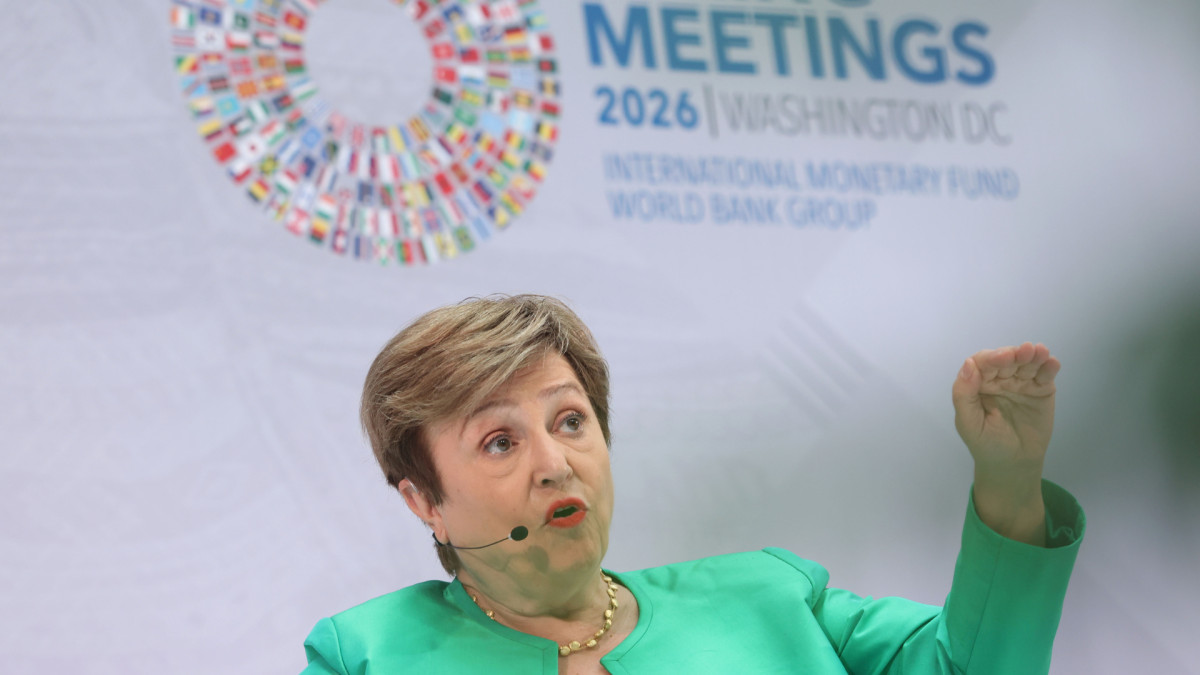
Another spring, the city of Washington has once again brought together bureaucrats, leaders and governors, bankers, economists, and non-governmental actors for the gathering between the World Bank and the IMF, where economic forecasts are updated and the global financial situation is debated. This second meeting under the second Trump administration has deepened the cognitive dissonance of the discourse: the economic outlook is bleak, yet the elephant in the room remains unnamed, lest it annoy the host. The U.S. president is the Voldemort of the corridors of power.
In April 2025, thousands of attendees were in genuine shock over the newly announced tariffs, and the side events filled with whispers about the reach of such reckless measures. A year later, the tariffs are partially buried, legally by American courts and publicly by the war in Iran and the rise in energy prices. The news of the reopening of the Strait of Hormuz arrived on the final day, too late to ease the sense of urgency and uncertainty with which the IMF managing director, Kristalina Georgieva, had opened the meeting days earlier.
“Although the Fund and the Bank are presumed politically agnostic, the MAGA movement has shaped the agenda, just as in other major international gatherings”
Rounding the loop of euphemisms, the omnipresent global crisis caused by fossil fuels has been discussed without openly mentioning renewable energy sources or climate change. A topic that until last year was central to the meetings of the two institutions and that now, along with gender, has fallen out of the main debate and is barely mentioned in the side events to the official program. Although the Fund and the Bank are presumed politically agnostic, the MAGA movement has shaped the agenda, as in other major international gatherings such as Davos.
British historian Adam Tooze describes in his newsletter the contradictions of the gathering marked by silences. “As a way of making sense of this chaos, naturalism can also offer hope,” Tooze says, citing a business source who, at one of the closed side events, assured the audience: “We know we are burning the house down. An entire system is turning to ashes. It is a historic transformation. But, you know, after a fire, growth blooms.” The Fund partly backs this idea by acknowledging that its doomsday forecasts in the spring of 2025 did not come true.
The general mood among surveyed attendees—even though there are no figures yet—the sense is that attendance was record-breaking—was that pessimism has grown, with little visibility on core economic debate elements such as growth, debt or work in the AI era. A Spanish government source present at the meeting speaks of an shock fatigue. Each edition drags a new global trauma that hundreds of countries that did not cause it must address. Sotto voce, leaders express their exasperation with the swings of the Trump Administration, but aloud no one mentions the origin of the problems. “It is hard to strike a balance between expressing criticism and not breaking ties with the U.S. that will be difficult to repair later”, says the Spanish government source. In bilateral talks, the Spanish government has found a lot of support and many compliments for its anti-war stance, the same sources assure. Spain has been recognized by the Fund as one of the developed countries that will manage to maintain a respectable growth of 2.1%, somewhat lower than expected due to the bite inflation will inflict on the economy.
Before the meeting began, Georgieva had warned that attempting to fix a problem of supply shortages by boosting demand would be harmful to economies. (In line with what Spain has done, subsidizing fuels in its aid package). The idea endlessly repeated by economists that measures have to be phased, concrete, and limited has begun to take hold, and shortly after Georgieva’s words, the European Commission suggested in Brussels to start with energy efficiency measures. These measures are necessary but unpopular among the public, at a time when populist politics is the roadmap for capitals.
“The possibility that inflation will force central banks to raise rates is another threat to growth”
The warnings also highlighted the narrow fiscal margins with which most countries face these aid packages in a context of rising interest rates and runaway debt. The possibility that inflation will force central banks to raise rates is another growth threat that Georgieva outlined in the forecast scenarios, moving from bad to worse. “We cannot exit this shock of supply without some pain,” Georgieva concluded. All told, although global growth forecasts were revised downward, expectations for the United States remain relatively positive, basing on the idea that the enormous investment made in AI will bear fruit.
Beyond energy, the Fund acknowledged that in monitoring the world economy imbalances continue to widen, with a special focus on China, which continues to widen its export surplus. Federico Steinberg, the Prince of Asturias Professor at Georgetown and a participant in the meetings, points to this imbalance as one of the hardest to resolve, since it would require China’s cooperation to somehow address its current industrial policy.
The impact of that Chinese export supremacy on lower-income countries has been one of the most shared concerns these days, Steinberg notes, saying that the overall mood is “maximum uncertainty” with some issues unresolved since last year, such as the effect of AI deployment on the job market.
Another Spanish participant who prefers not to be named says that in the last twelve months the World Bank has focused its entire energy on linking employment and AI. Many low-income countries come to the institution asking how they should face this new technology and whether they should deploy local regulations to rein it in. The Bank still cannot give them a clear answer about how to tackle this technology.
One of the virtues of this forum is that creditor countries meet debtors, and for a few days there are conversations where people speak face to face under somewhat more level conditions than those outside the institutions. And the low-income countries have arrived at the meeting pressed by rising energy prices, fertilizers, the high debt of those able to issue debt, the withdrawal of support from major donors, and their heavy exposure to Chinese dominance. A situation even more complicated than last year had predicted.
“The combination is a perfect bomb for food security,” says Gabriel Ferrero, former chair of the UN’s World Committee on Food Security and a participant this week in the meeting. Ferrero argues that, even if the Hormuz opening stabilizes, commodity prices are unlikely to return to pre-war levels. “It could be a deferred food security crisis, unlike what happened in Ukraine, due to the anticipated lack of fertilizers in the coming crops.” The senior Spanish official sums up the situation: “There is no longer any pillar of certainty, so it is almost impossible to make rational predictions.”
